Forsythia suspensa
forsythia [Blooms: Mar-Apr]

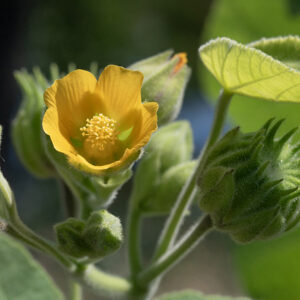
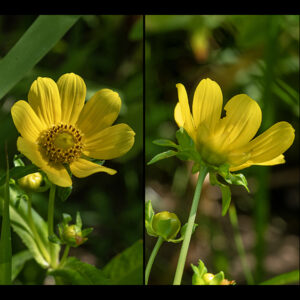
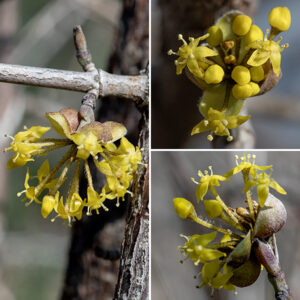
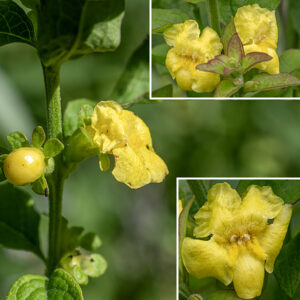
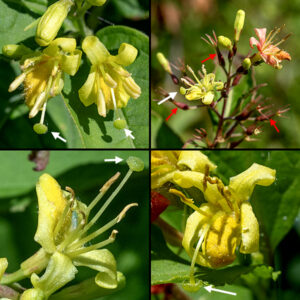
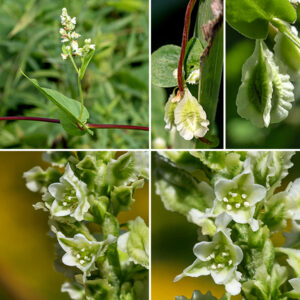
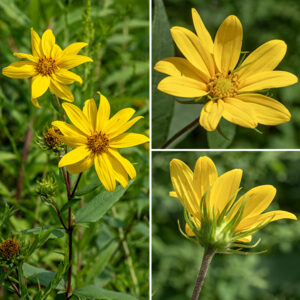
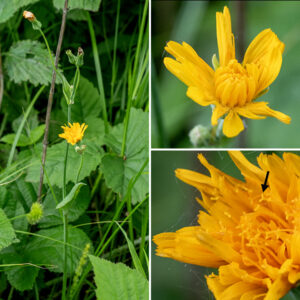
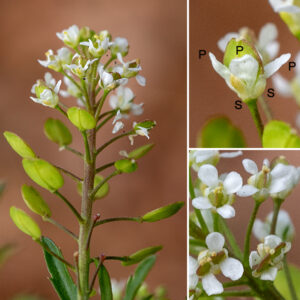
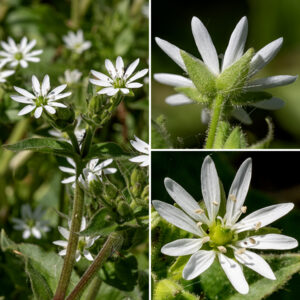
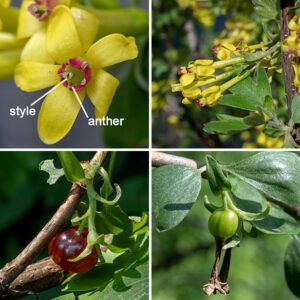
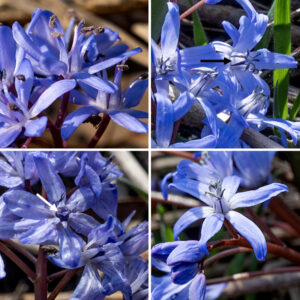
Forsythia (Forsythia suspensa) flowers. Top: two forsythia flowers on a branch. Bottom right: a lateral view of a forsythia flower. The green and brown basal pedicel (P), the four green sepals (S), and the four brilliant yellow petals are apparent. Bottom left: close-up of the center of a forsythia flower. The single style and pair of hemispherical stigmas can be seen. The monstrous structures in the background are portions of my thumb and forefinger.
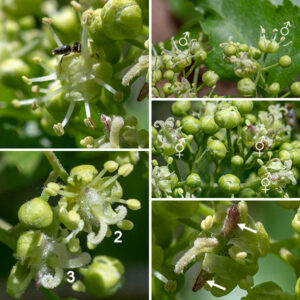
Forsythia flowers occur singly or in clusters of 2-3 arising from the axils of leaf buds; the flowers have short (1/8-1/4″) pedicels. The flowers consist of four green, 1/4″ long, sepals fused at their bases; a bell to saucer-shaped corolla that also has four deep, strap-shaped, brilliant yellow lobes; two stamens that are fused to the base of the corolla tube; and a single style with a pair of ascending, hemispherical terminal lobes (the stigmas). Forsythia is distylous, producing either short (3-5 mm) stamens in combination with long (5-7 mm) pistils or long (6-7 mm) stamens in combination with short (3 mm) pistils. Each of these flower morphs is restricted to a given plant; forsythia is an obligate outcrossing species. Fruits are rarely produced in North American forsythia, possibly because the complementary flower morph is rarely in close proximity to a given plant. However, forsythia can propagate asexually via cuttings.

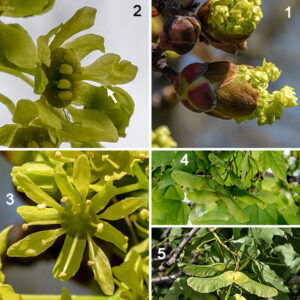
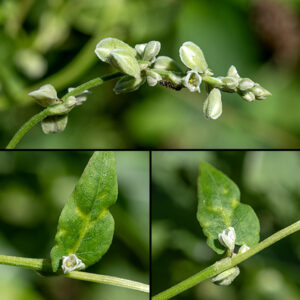
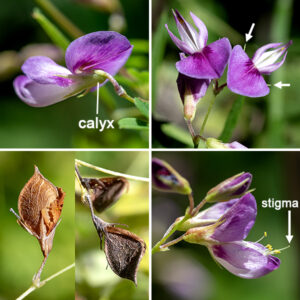
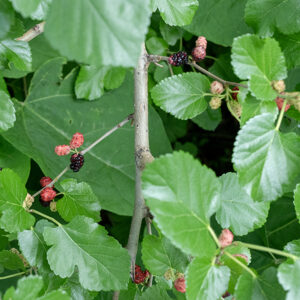
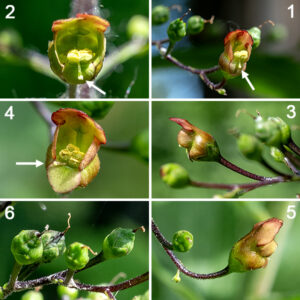
Forsythia (Forsythia suspensa) stems and leaves. (1) A mature forsythia leaf one month after the flowers bloomed. The upper (1a) and the under (1b) side of the same leaf are shown. (2) A new shoot with the pedicels of a pair of flowers visible at the top of the image. Note that the bark is thin and the shoot in cross section has two flattened sides. The white bumps are lenticels. (3) A mature stem with derivative twigs bearing flowers. Note that this stem is approximately circular in section; the bark is thickened and somewhat roughened; the lenticels have white borders.

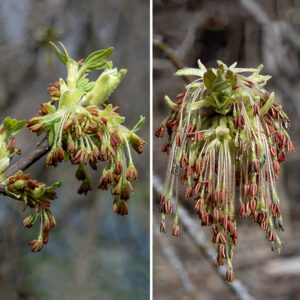
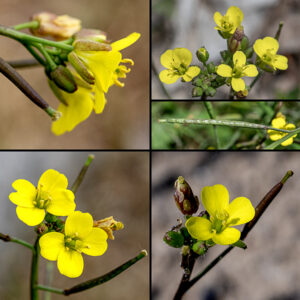
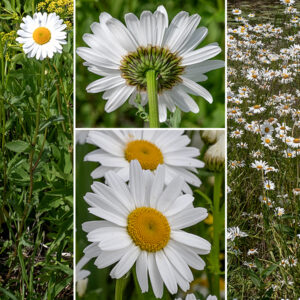
Main image: several forsythia (Forsythia suspensa) plants on the west side of Wooded Island, just east of West Trail in early April. Note that the forsythia lacks leaves at this stage; also note how unvegetated the rest of the landscape is. Left panel: an enlarged view of a few forsythia branches showing the placement and aspect of the flowers.
Forsythia (either the hybrid Forsythia × intermedia or Forsythia suspensa, depending on the source of the plants) is an exotic perennial shrub native to China and East Asia that grows to about three feet tall. Forsythia first appeared in Jackson Park on the west side of Wooded Island in 2024, where it has slowly been expanding its foothold. Forsythia produces numerous erect or arching stems from its base that are covered with a thin, tan bark that tends to peel in strips. The twigs are stout, often rectangular in section when young, and initially covered in green to reddish brown bark; the bark later becomes yellowish brown and is covered with warty-looking, pale, oval lenticels. The leaves are opposite, 1-4″ long and 5/8-2″ wide when mature, oval or oblong with 5/8″ long, hairless petioles. Leaf tips are sharply pointed while the bases are rounded or angled; the leaf margins are sharply, but irregularly, toothed. Flowers occur singly or in clusters of 2-3 arising from the axils of leaf buds; the flowers have short (1/8-1/4″) pedicels. The flowers consist of four green, 1/4″ long, sepals fused at their bases; a bell to saucer-shaped corolla that also has four deep, strap-shaped, brilliant yellow lobes; two stamens that are fused to the base of the corolla tube; and a single style with a pair of ascending, hemispherical terminal lobes (the stigmas). Forsythia is distylous, producing either short (3-5 mm) stamens in combination with long (5-7 mm) pistils or long (6-7 mm) stamens in combination with short (3 mm) pistils. Each of these flower morphs is restricted to a given plant; forsythia is an obligate outcrossing species. Fruits are rarely produced in North American forsythia, possibly because the complementary flower morph is rarely in close proximity to a given plant. However, forsythia can propagate asexually via cuttings.
I think it most likely that the forsythia in Jackson Park is an escapee from one of the numerous Hyde Park gardens and hedges where it has been planted. Forsythia is one of the earliest blooming shrubs in Jackson Park; like the native spicebush (Lindera benzoin) it blooms in April before its own leaves have emerged. Spicebush and forsythia flowers are the few spots of yellow on the landscape to be seen that early in the spring. Right now, in Jackson Park forsythia is limited to a narrow strip immediately adjacent to West Trail; it will be interesting to see how forsythia fares in more direct competition with native plant species.
Browse more plants
Want to keep exploring more plants? You can view other plants like this one by selecting a characteristic from the list below, or 'browse more plants' to go back to the Plant Finder.