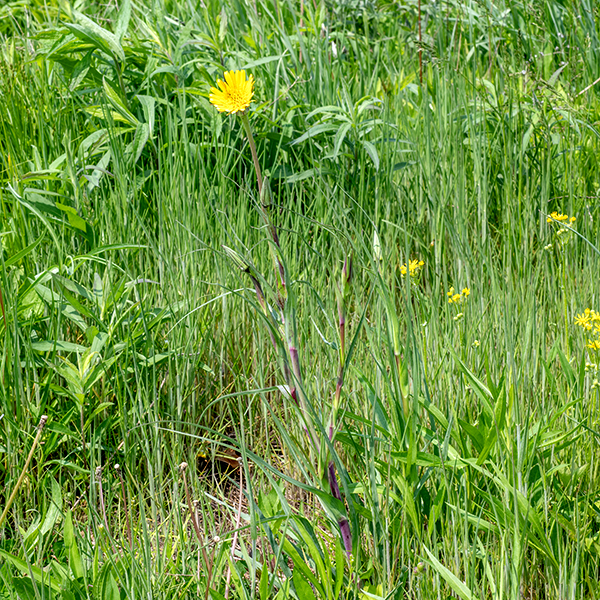
To date, I’ve compiled records and photos of 553 species of flowering plants in Jackson Park, a respectable diversity given the modest size of the park (about 500 acres) and the fact that about half of Jackson Park’s area is devoted to an nine-hole golf course and a driving range. The Illinois Wildflowers mobile phone app lists 2,732 species of flowering plants in the state of Illinois; 20% of them occur in Jackson Park.
Native species
403 (73.01%)
Exotic species
150 (27.1%)
Much to my surprise and delight, of the 553 species of flowering plants in Jackson Park, 403 (72.9%) are native to the Midwest. Despite the proximity of all the gardens in Hyde Park, the many visitors (human and animal) carrying seeds in the mud on their shoes/feet or stuck to their clothes/fur/feathers, and the heavy road traffic passing by on all sides, only 150 plant species (27.1%) in Jackson Park are “exotics.” Some of these exotics have been growing and reproducing in North America for hundreds of years and are thoroughly naturalized. Jackson Park is by no means a pristine ecosystem but it still reflects the ecological context present when Jean Baptiste Point DuSable settled here.
Conservation status
G5 (secure)
308 (77.8%)
G4 (likely secure)
22 (5.5%)
S5 (secure in IL)
20 (5.1%)
S3 (vulnerable in IL)
33 (8.3%)
S2 (imperiled in IL)
3 (0.8%)
S1 (critically imperiled in IL)
12 (3.0%)
Information on the conservation status of the plant species in Jackson Park was taken from the International Union for Conservation of Nature (IUCN) website and NatureServe (which also lists species’ status for individual states where that data is available). Not all species had been evaluated for conservation status; data on 156 species in Jackson Park was unavailable or listed as “Exotic (no status rank).” Of the 553 flowering plants identified (so far) in Jackson Park, 396 had a conservation status listed; the percentages given are the number of species with a given status divided by the total number of species with a status listed.
Imperiled and critically imperiled plants — a deeper dive
Three species were listed as “imperiled in Illinois” (savanna blazing-star, Liatris scariosa; Pennsylvania buttercup, Ranunculus pensylvanicus; and Northern water-plantain, Alisma triviale). Of these, Northern water-plantain is doing well — it is widely distributed (in the lagoons and Columbia Basin) and seems to be thriving.
Twelve other species were listed as “critically imperiled in Illinois”:
bearberry, Arctostaphylos uva-ursi
pale beardtongue, Penstemon pallidus
royal catchfly, Silene regia
marram grass, Ammophila breviligulata
large-flowered penstemon, Penstemon grandiflorus
queen-of-the-prairie, Filipendula rubra
purple-flowered raspberry, Rubus odoratus
seaside sandmat, Euphorbia polygonifolia
cyperus sedge, Carex pseudocyperus
troublesome sedge, Carex molesta
Weigand’s shadbush, Amelanchier interior
Kalm’s St. John’s wort, Hypericum kalmianum
Of these, pale beardtongue and royal catchfly seem to be limited to single locations and may be declining. Bearberry, marram grass, and queen-of-the-prairie have small but stable populations, each in a single location. Weigand’s shadbush and Kalm’s St. John’s wort have widespread distributions in Jackson Park, but that success seems to be due to active planting by Park District employees or contractors. Large-flowered penstemon and seaside sandmat have significant populations and both appear to be expanding their spatial coverage. Purple-flowered raspberry is particularly notable — it is the most common shrub (in numbers and spatial extent) on Wooded Island and has been thriving since at least 2013. I find these details on the success in Jackson Park of species that are “critically imperiled in Illinois” to be a very encouraging measure of the health of Jackson Park.
Life Cycles
Annual
60 (10.9%)
Biennial
22 (4.0%)
Perennial (non-woody)
313 (56.6%)
Perennial (tree)
38 (6.9%)
Perennial (shrub)
64 (11.5%)
Mixed
66 (11.9%)
Life cycles — definitions
life cycle — from seed to reproduction to senescence
annual — a plant that completes its life cycle in a single year or growing season
biennial — a plant that completes its life cycle in two years or two growing seasons
perennial — a plant that persists for multiple years, reproducing annually or on a longer yearly cycle
Life cycles — discussion
Non-woody plants may be annuals, biennials, or perennials, but woody plants are always perennials — a plant’s huge investment in wood (basically giant cellulose molecules that are a polymer of glucose sugars) has to be amortized over a number of growing seasons.
Of all the flowering plants in Jackson Park, 75% (414 out of 552) are perennials that bloom at the same locations year after year; only 11% are annuals and 5.5% are biennials. (In this context, human agriculture seems most peculiar — virtually all the plants we grow for food are annuals.) Even if we exclude the woody plants (which are, by definition, perennials), 69% of the plant species in Jackson Park are perennials. If you return to Jackson Park repeatedly over multiple years (as I do), some individual plants become old friends, to be greeted as such when they reliably appear in the same spots at the same time of year, year after year. Many have very deep (1-5 meters long!) taproots that also function as storage organs. Other plants in Jackson Park show a mixed life cycle; e.g., [annual or biennial] depending on circumstances or [annual or perennial] or [biennial or perennial] but these plants constitute only 12% (66 out of 512) of the flowering plant species I’ve identified so far in Jackson Park.
In general, prairies and woodlands tend to be dominated by perennials; Jackson Park nicely fits into that pattern.
Forb/herb
413 (74.7%)
Tree
38 (6.9%)
Shrub
64 (11.5%)
Vine
7 (1.3%)
Gramanoid (grass-like)
31 (5.6%)
Growth forms — definitions
forb/herb — a forb is a herbaceous (non-woody) plant less than two meters tall (excluding grass-like plants). Forbs usually have stems covered with leaves. An herb is a plant without a persistent, above-ground, woody stem.
tree — a perennial woody plant with a clear main trunk that shows secondary thickening. Trees are at least 2-3 m tall when mature.
shrub — a shrub is a self-supporting* woody plant that branches at or near the ground or with multiple stems that arise directly from the base of the plant. The term “shrub” is somewhat vague; it is usually applied to woody plants with multiple stems that are less than 2-3 m tall when mature. (*The “self-supporting” stipulation rules out vines and lianas.)
vine — a climbing woody or herbaceous plant that is not self-supporting, typically with a small stem diameter. Vines are typically “climbers” that depend on other plants or objects in the environment for support.
gramanoid — an herbaceous flowering plant with a grass-like morphology; i.e., one with long, blade-like leaves and a single stem (“culm”) that is largely leafless. Graminoids include grasses, sedges, and rushes.
Growth forms — a clear-eyed view of the data
The distribution of growth forms in the 552 flowering plants that I have identified implies that Jackson Park’s flowering plants are dominated by forbs/herbs. That probably is true, but these numbers should not be accepted on face value — they include a subtle bias that suggests they are not a random sample. The source of the bias is ….. me. As I admitted previously (on the Home page), I am not a botanist; my training is in invertebrate zoology and biomechanics. When I started this project in Jackson Park, plants were one the hazier parts of my education as a biologist and the only sources available to help in identifying the plants I photographed were a variety of printed field guides. (I now have an enviable collection of printed field guides.) The available field guides were heavily biased towards forbs; for me, identifying shrubs was difficult and trees nearly impossible. (The hurdles: trees have a brief season for flowering, many of them are wind-pollinated so the flowers are inconspicuous, and the flowers are often inaccessible without a ladder. I spent almost a month in 2025 trying and finally succeeding in getting photos of the flowers of Kentucky coffeetree, Gymnocladus dioicus.) With the advent of plant identification mobile phone apps like Seek and PlantNet and the Illinois Wildflowers app, I’ve expanded my horizons; with a tentative ID or a genus name from one of these apps and online resources like the Illinois Wildflowers website, Minnesota Wildflowers, and Missouri Wildflowers, I’ve been able to home in on a firm identification for a range of growth forms not available in my printed field guides. I now actively pursue ID’s on shrubs and trees and seek out graminoids like sedges, but I’m sure I’m still undersampling the trees and shrubs and have to admit that I continue to virtually ignore the diversity of grasses.
So, you’ve been warned — the data on the distribution of growth forms of the flowering plants of Jackson Park is very much a work in progress. If you find a flowering plant in Jackson Park that I haven’t included in this site, contact me via the Contact function at the bottom of the “About” page; I’ll try to confirm your observation and include it in future updates of this site. And you’ll earn my undying gratitude.
Biodiversity in Jackson Park
Other pages on this website are devoted to descriptions and photos of individual plant species I have encountered in Jackson Park. On this page, I switch to an overview of Jackson Park’s plants as a vital, interacting system with characteristics dictated by the mix of characteristics of the plants who live, grow, and reproduce there. Here we explicitly explore some of those characteristics.
What’s On This Page
- Total number of plant species in Jackson Park
- The conservation status of those plants
- The variety of plant life cycles represented
- An overview of the variety of growth forms
If you’re visiting this site on a laptop rather than a smart phone, you can easily navigate quickly to the sections of this page using the yellow buttons on the right.