There’s More to Jackson Park Than Flowering Plants

Flowering plants are captivating, but there are other plants and plant-like forms in Jackson Park worth your attention; ferns, horsetails, and mosses are the most common. Not to mention the animals — flower pollinators, other insects, and vertebrates (fish, reptiles, birds, and mammals). Fungi are commonly thought of as being closer to plants (they don’t move and are not bilaterally symmetrical), but they are actually more closely related to animals than plants. The following are pictures captured while I was looking for wildflowers so they are a haphazard collection of what (other than flowering plants) lives in Jackson Park, but you may still be surprised by the diversity of forms represented.

Terrestrial plants all belong to a single group called the Embryophytes. Embryophytes are divided into two groups — the Bryophytes (hornwort, liverworts, and mosses) and the Tracheophytes (club mosses, horsetails, ferns, gymnosperms, and angiosperms). Tracheophytes all have a cell type called “tracheids” that functions as a pipe to bring water from the basal portions of the plant to the rest of the plant; bryophytes lack this cell type and are restricted to small sizes. All Embryophytes have a two-stage life cycle in which a haploid (“gametophyte”) stage alternates with a diploid (“sporophyte”) stage; the former has “N” chromosomes, the latter has “2N” chromosomes. (All the cells in a human are 2N except the gametes (eggs and sperm), which are N.) In Bryophytes, the gametophyte (N) stage dominates the life cycle and the sporophyte (2N) stage is smaller or parasitic; in Tracheophytes (including all flowering plants), the sporophyte (2N) stage dominates and the gametophyte (N) is smaller or parasitic.

This website has been devoted to angiosperms (flowering plants) but here I’d like to at least give a nod to the rest of Embryophyte diversity. I have not surveyed the non-flowering plants with the energy I have devoted to flowering plants, but have noted them when I have run across them and would like to share at least some of their diversity as a part of the Jackson Park ecosystem.

For all the images below, hold your cursor over the image to zoom in (or tap the image on a smart phone). If you’re viewing this site on a laptop (as opposed to a smart phone), use the yellow buttons on the right to jump to a different section.

Bryophytes: Mosses

Mosses are probably direct descendants of early land plants. Their two-stage life cycle alternates a haploid gametophyte (the leafy, green part of the moss) with a diploid sporophyte (tall stalks with a bladder of some sort at their tip). The resultant spores produced are again haploid. The spores germinate in wet environments, first producing a mass of filaments which later coalesce to produce the one-cell-thick leafy structures of the gametophyte and a number of long single cells like root hairs, the rhizoids. Mosses have no vessels (tracheids) like those that carry water long distances within a higher plant.

The moss that caught my eye in multiple locations in Jackson Park is redshank (Ceratodon purpureus), a handsome species with verdant green gametophytes and bright red and green sporophytes. I’ll be looking for more species this year.

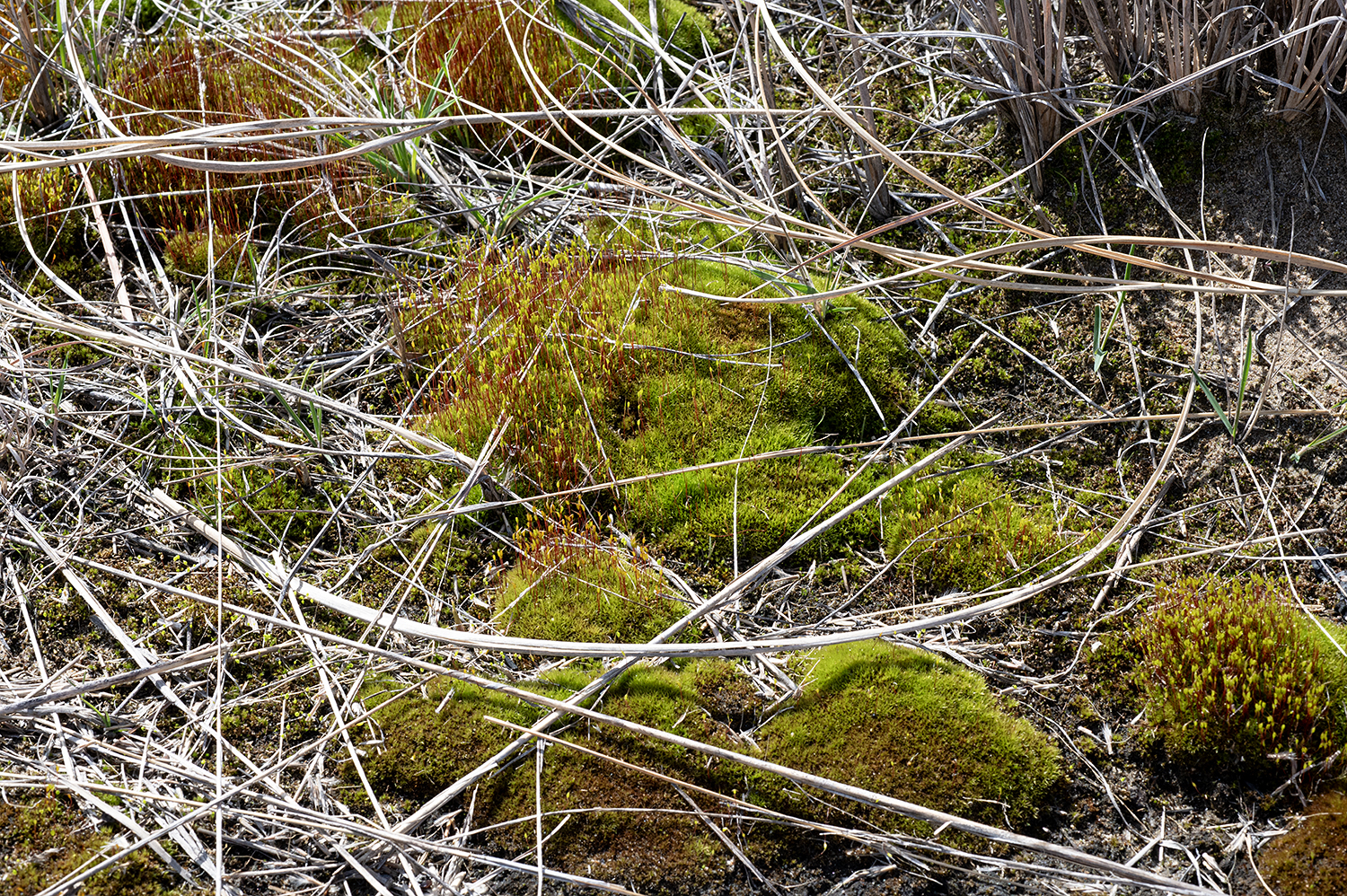
redshank (Ceratodon purpureus), 63rd St. Beach

Several clumps of redshank moss with both the gametophyte (green) and sporophyte (red stems with green tips) stages visible.

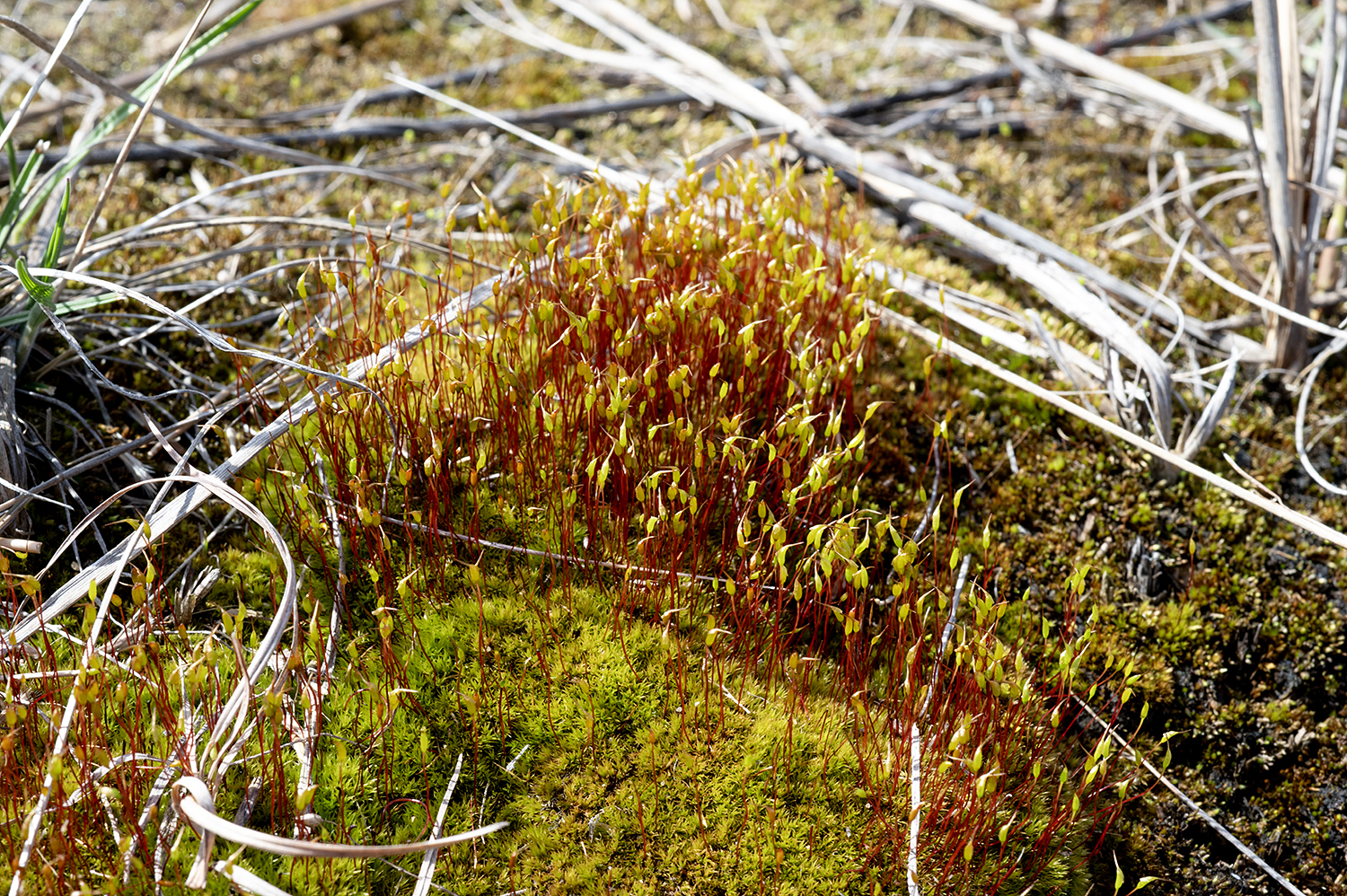
redshank (Ceratodon purpureus)

A closer view of the red shafts of the sporophyte and the greenish, teardrop-shaped terminal sacs (calyptra).

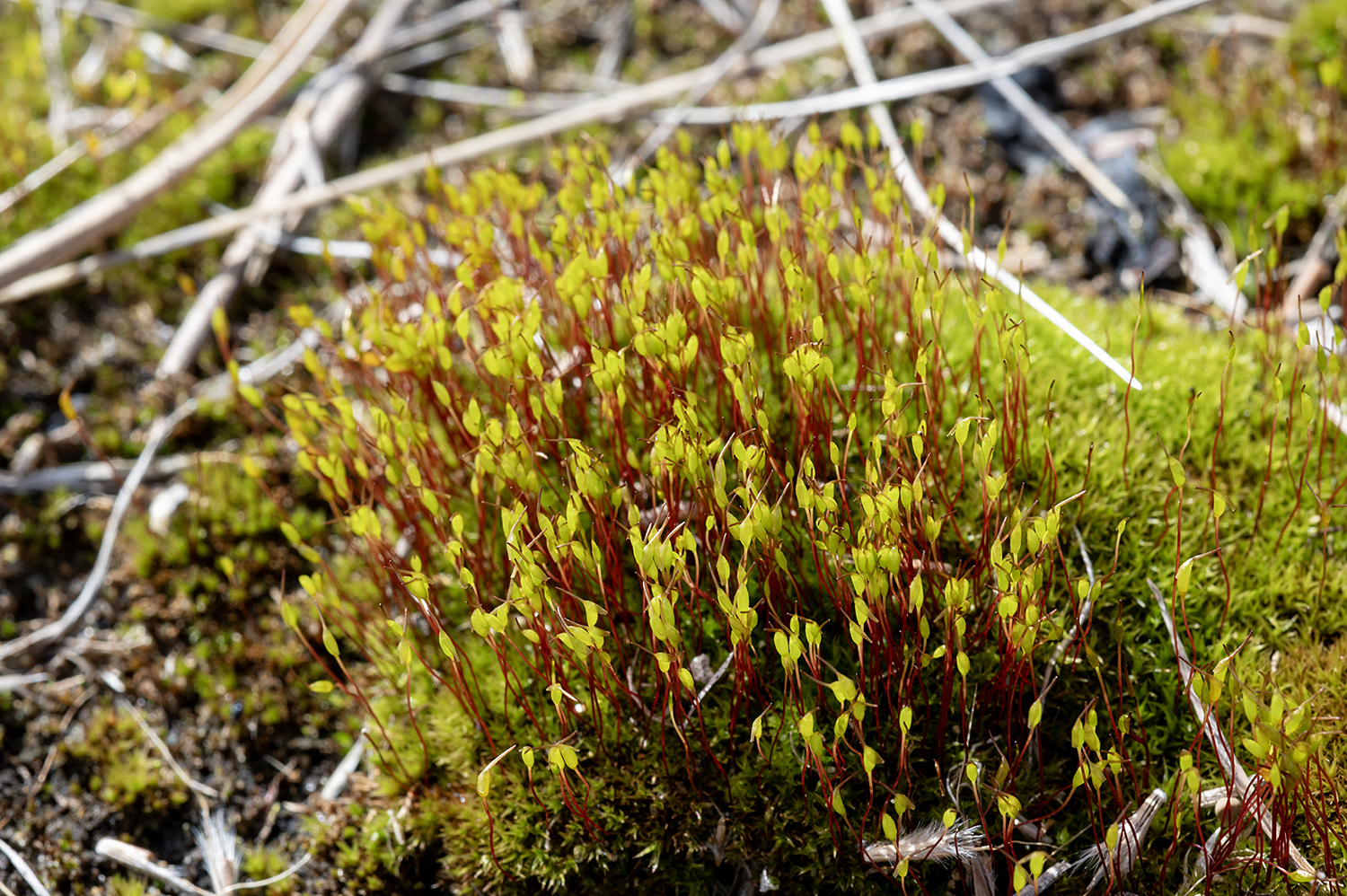
redshank (Ceratodon purpureus)

 A close up of numerous sporophytes. The green, tear-drop shaped calyptra produce haploid (N chromosomes) spores that are carried off by the wind.

Tracheophytes: Horsetails

The horsetails, Equisetum spp., are descendents of an ancient lineage dating back 345 million years. Horsetails were both diverse and abundant during the Paleozoic, but only a single genus survives today. Horsetails have a fully developed vascular system with tracheids and true roots and stems. The leaves are reduced; when mature the leaves are only dry scales, fused into a ring around the stem that alternates with the branches (a pattern unique among plants). Horsetails have complex stomata for gas exchange, and a requirement for silicon. The tough silica phytoliths made them useful for scouring pots — thus the common name of “scouring rush”.

The genus Equisetum has only 18 species but they are common in many environments, and a couple of tropical species reach heights of 12 to 24 feet. An extensive underground rhizome system allows them to tap water and nutrients and recover quickly from surface disturbance, as well as to reproduce vegetatively. The haploid spores live only a short time (about four days) and require bare mud to germinate into the (also haploid) gametophyte.

I have found two species of horsetails in Jackson Park — the scouring rush (Equisetum hyemale) and the field horsetail (Equisetum arvense). The former is widespread on the edges of the lagoons and especially along the south shore of 59th St. Harbor; the latter is found only at a single location on the eastern shore of East Lagoon.

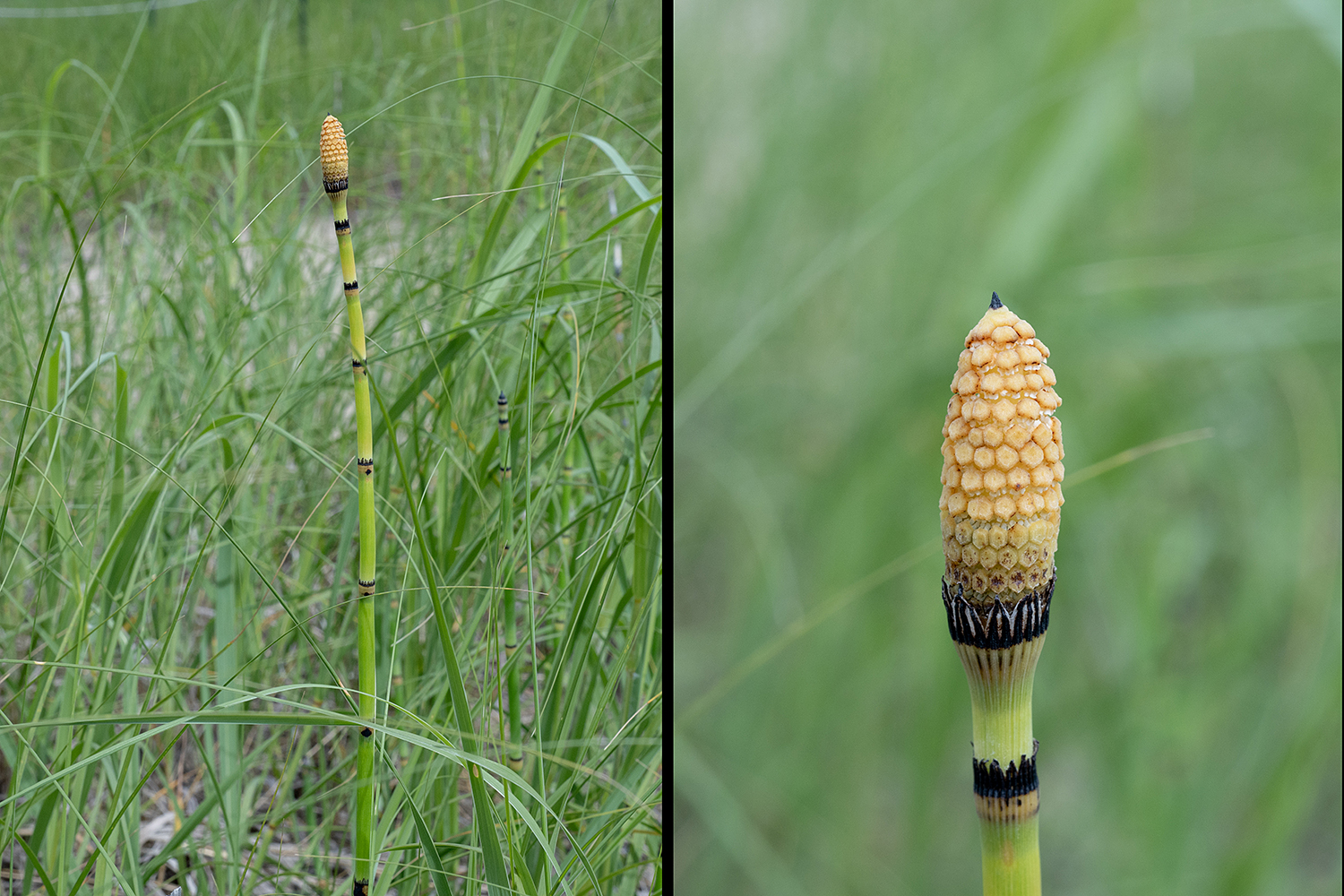
scouring rush (Equisetum hyemale)

Left: an isolated scouring rush sporophyte with a terminal strobilus (which produces the spores). Right: a close-up of the strobilus. The haploid spores are formed on the underside of the plate-like sporangiophores that cover the strobilus.

scouring rush (Equisetum hyemale)

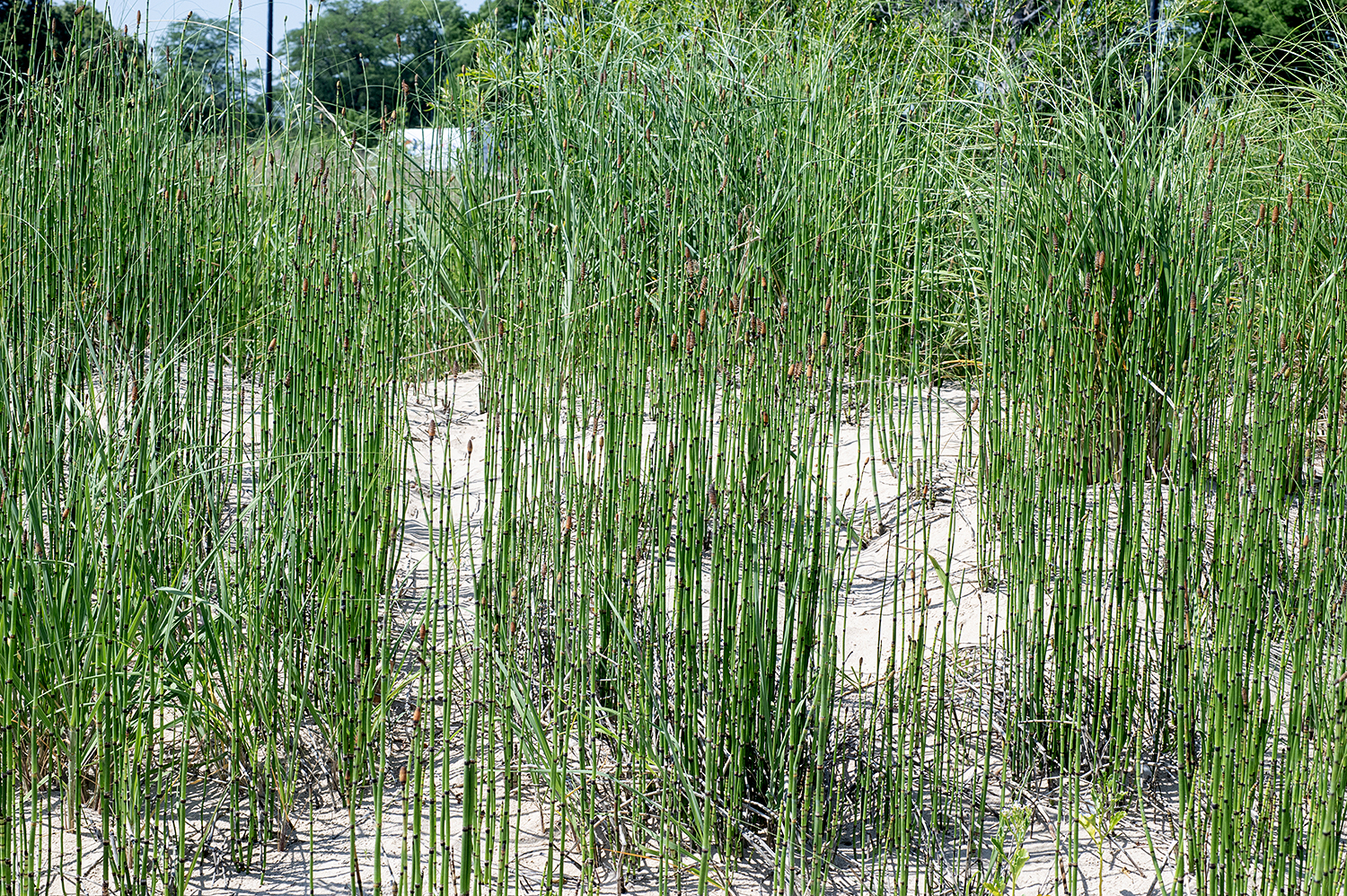
A dense stand of scouring rush sporophytes at 63rd St. Beach. Note the lack of branches in this species.

field horsetail (Equisetum arvense)

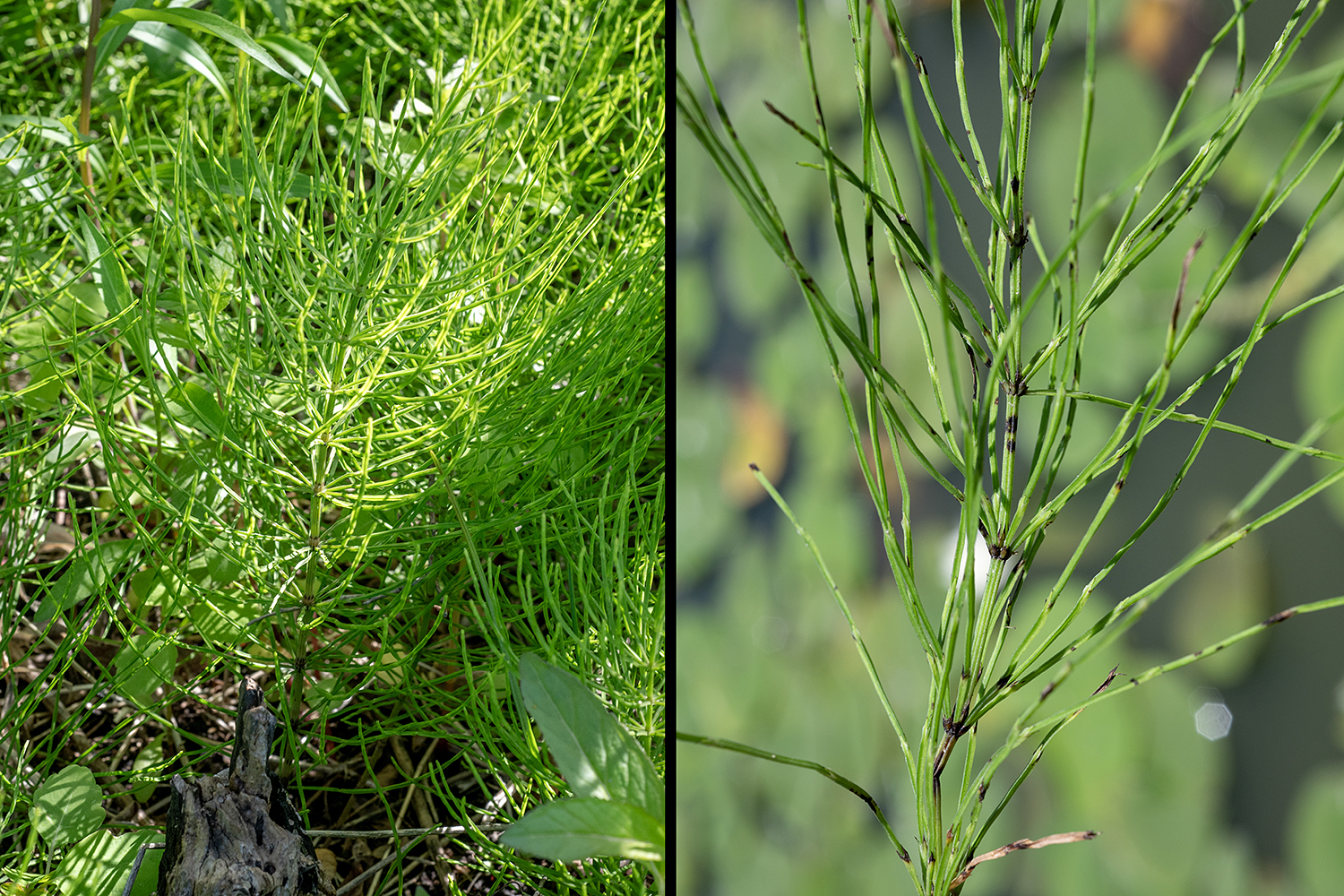
Left: a field horsetail sporophyte about a foot high on the shore of East Lagoon. Right: a closer view of the field horsetail showing the prominent branches.

Tracheophytes: Ferns

Ferns are the second most diverse group of terrestrial plants (after the flowering plants) — the group contains about 9,000 species. The leaves, called fronds, are typically large and pinnately compound. In the tropics, their stems can be quite tall (tree sized). In the temperate zone, the stems are underground rhizomes. Every spring, fronds sprout from the rhizomes. Spores are produced in sporangia on the underside of the fronds or on separate stalks. The sporangia are typically arranged in clusters (called sori) that are distinctively shaped and positioned. The haploid spores grow into a tiny (a few millimeters across) gametophyte (called a prothallus) bearing archegonia (♀︎) and antheridia (♂︎), often on the underside of the gametophyte. The sperm must swim from the antheridium to an archegonium; the fertile archegonia are usually on another gametophyte because the two structures mature at different times. The zygote (diploid)  grows into a new sporophyte (diploid), what you would recognize as a fern plant.

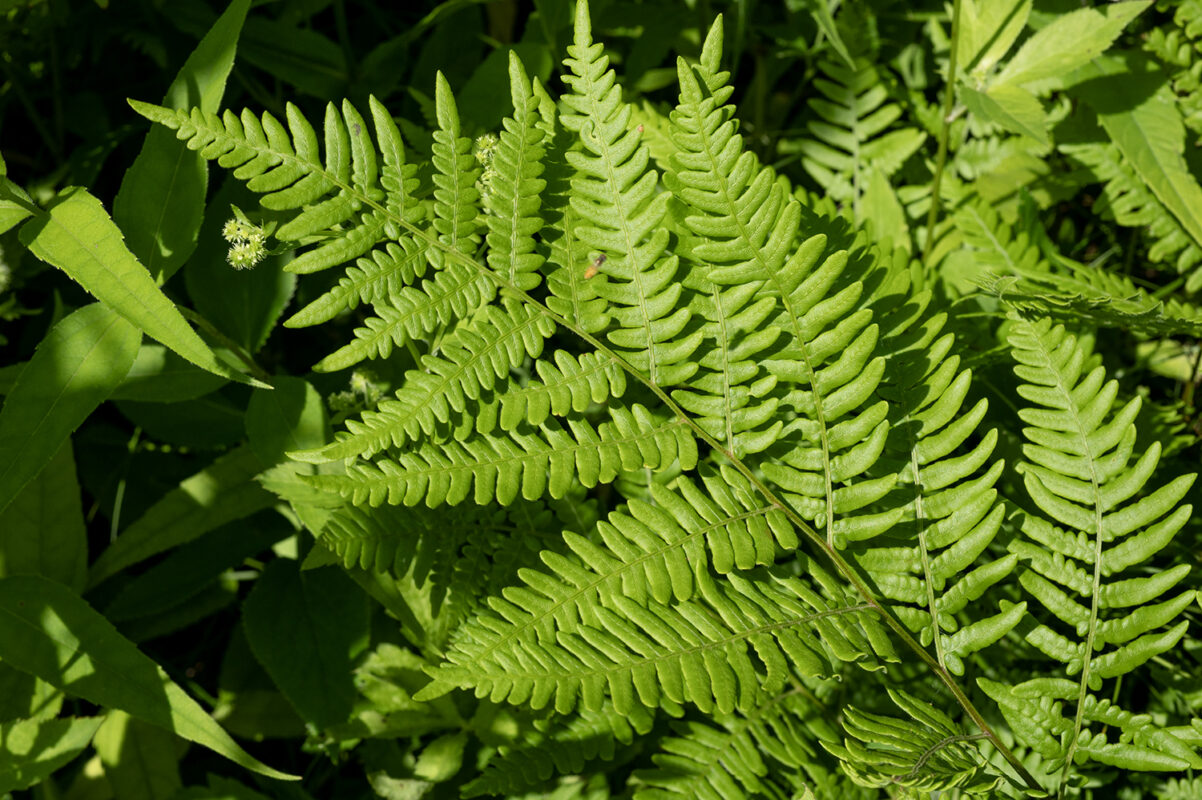
The four most common ferns in Jackson Park are bracken fern (Pteridium aquilinum), ostrich fern (Matteuccia struthiopteris), interrupted fern (Claytosmunda claytoniana), and sensitive fern (Onoclea sensibilis).

bracken fern (Pteridium aquilinum)

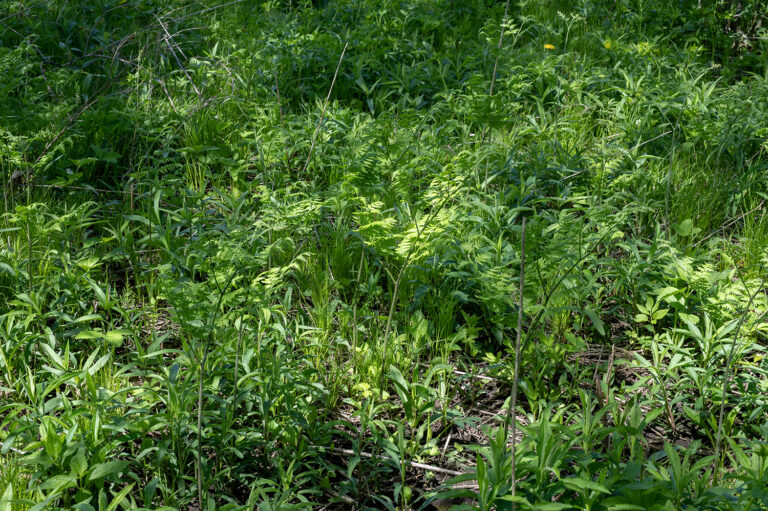
Several mature bracken fern sporophytes in a clump of woods southwest of the Driving Range.

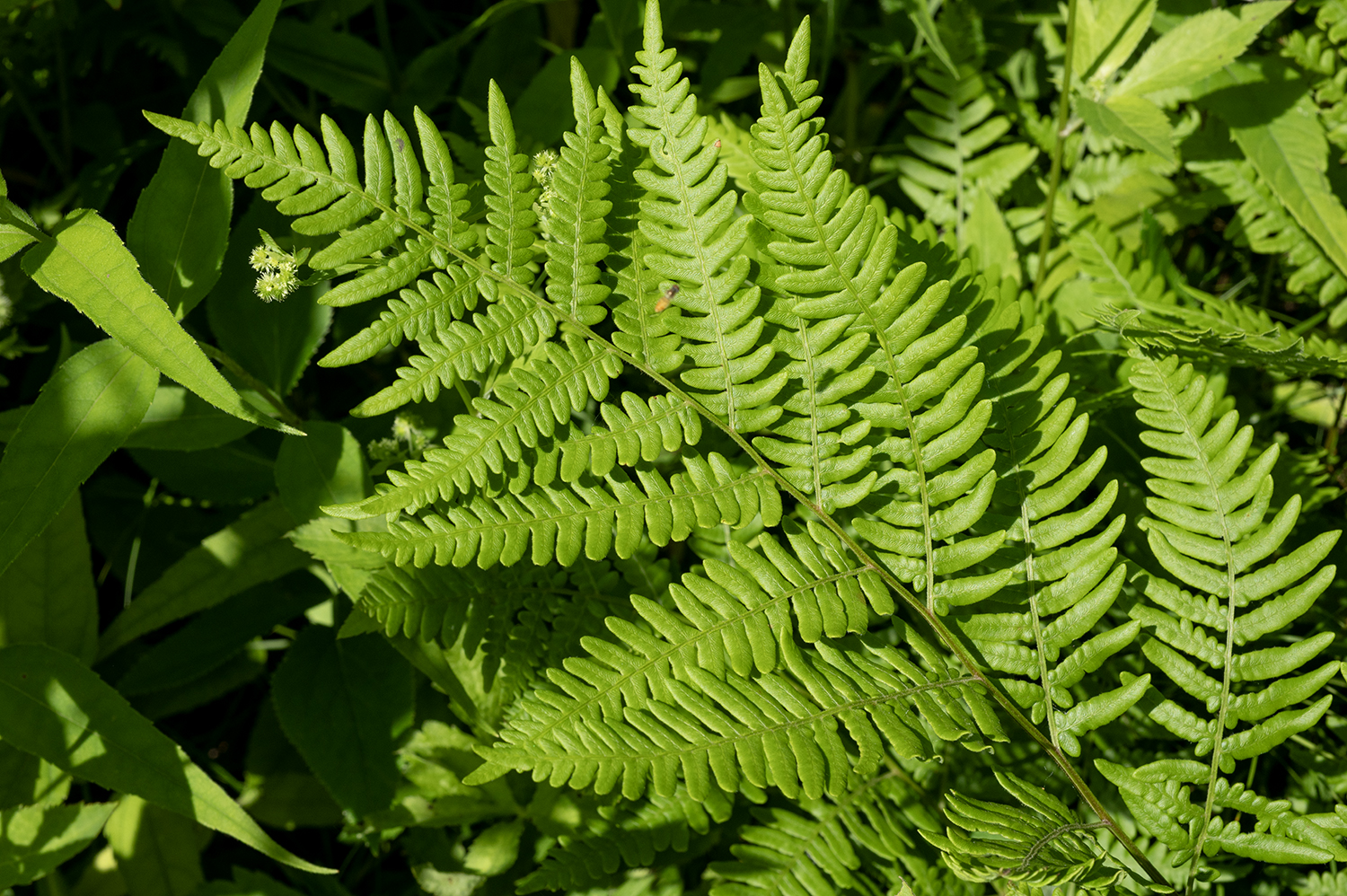
A bracken fern (P. aquilinum) frond

Note the rolled edges of the leaflets.

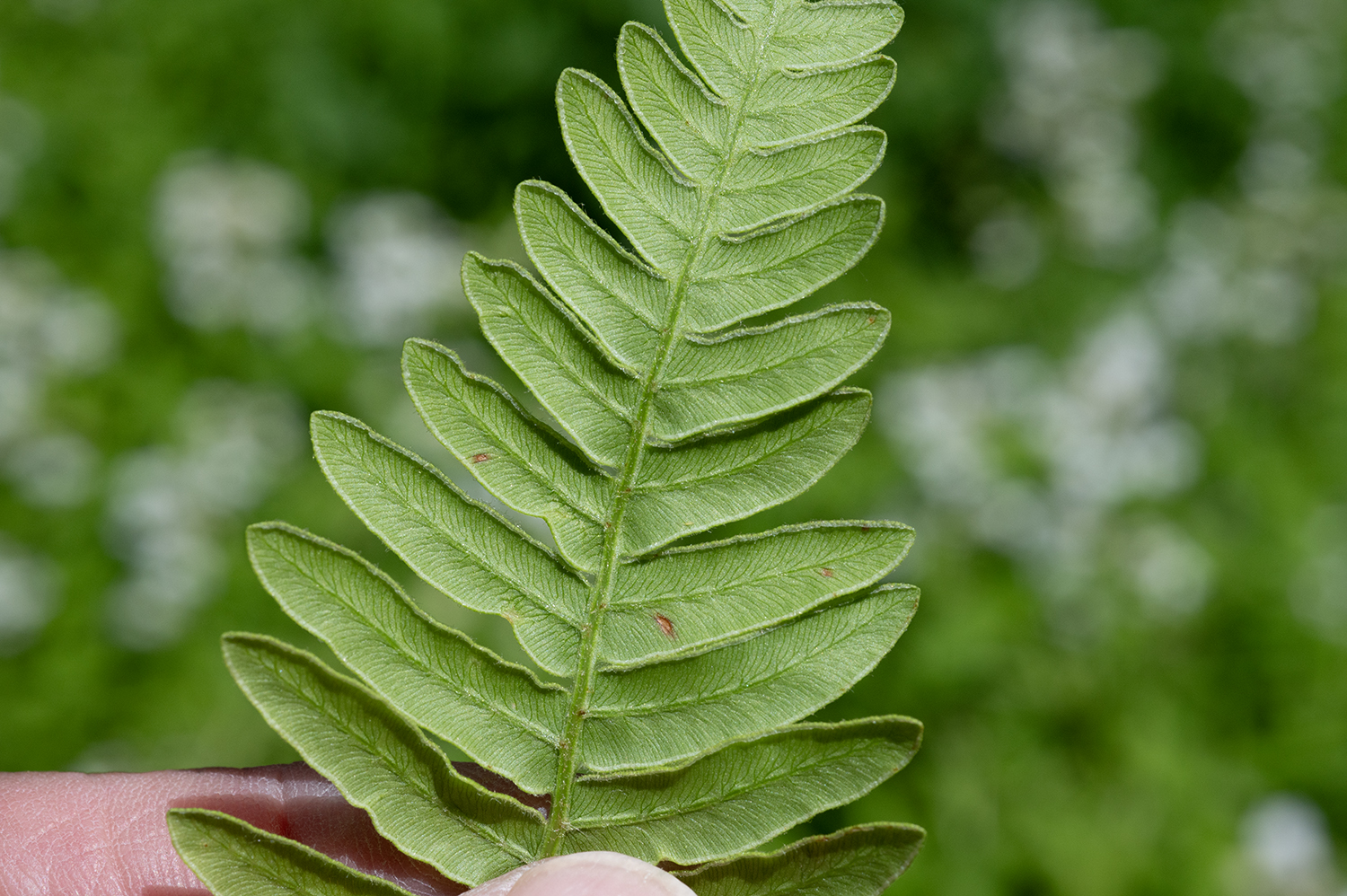
Underside of a bracken fern (P. aquilinum) frond

Note the rolled edges of the leaflets; when zoomed in, note the the Y-shaped veins in the leaflets.

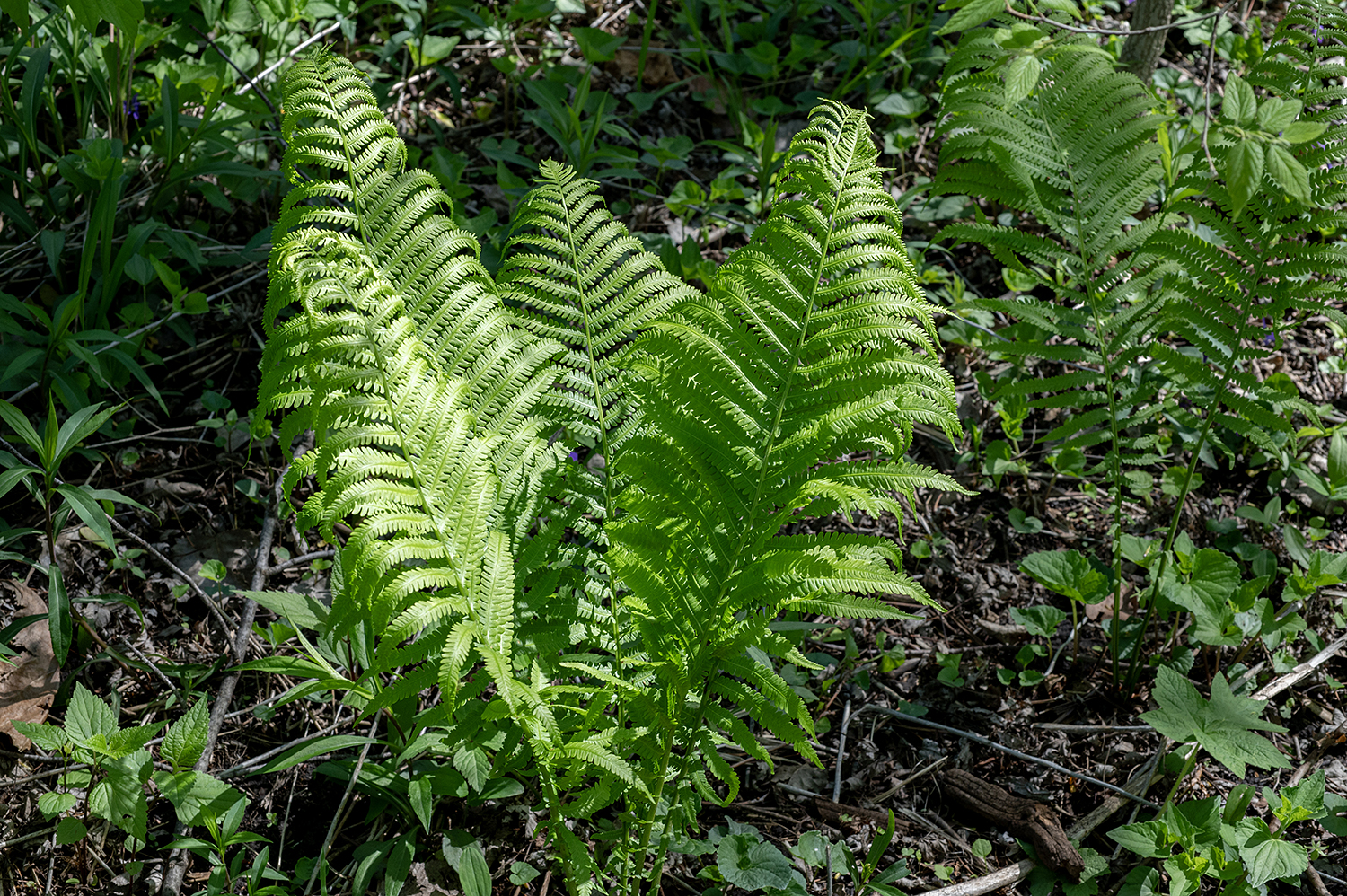
ostrich fern (Matteuccia struthiopteris)

woods north of Bobolink Meadow

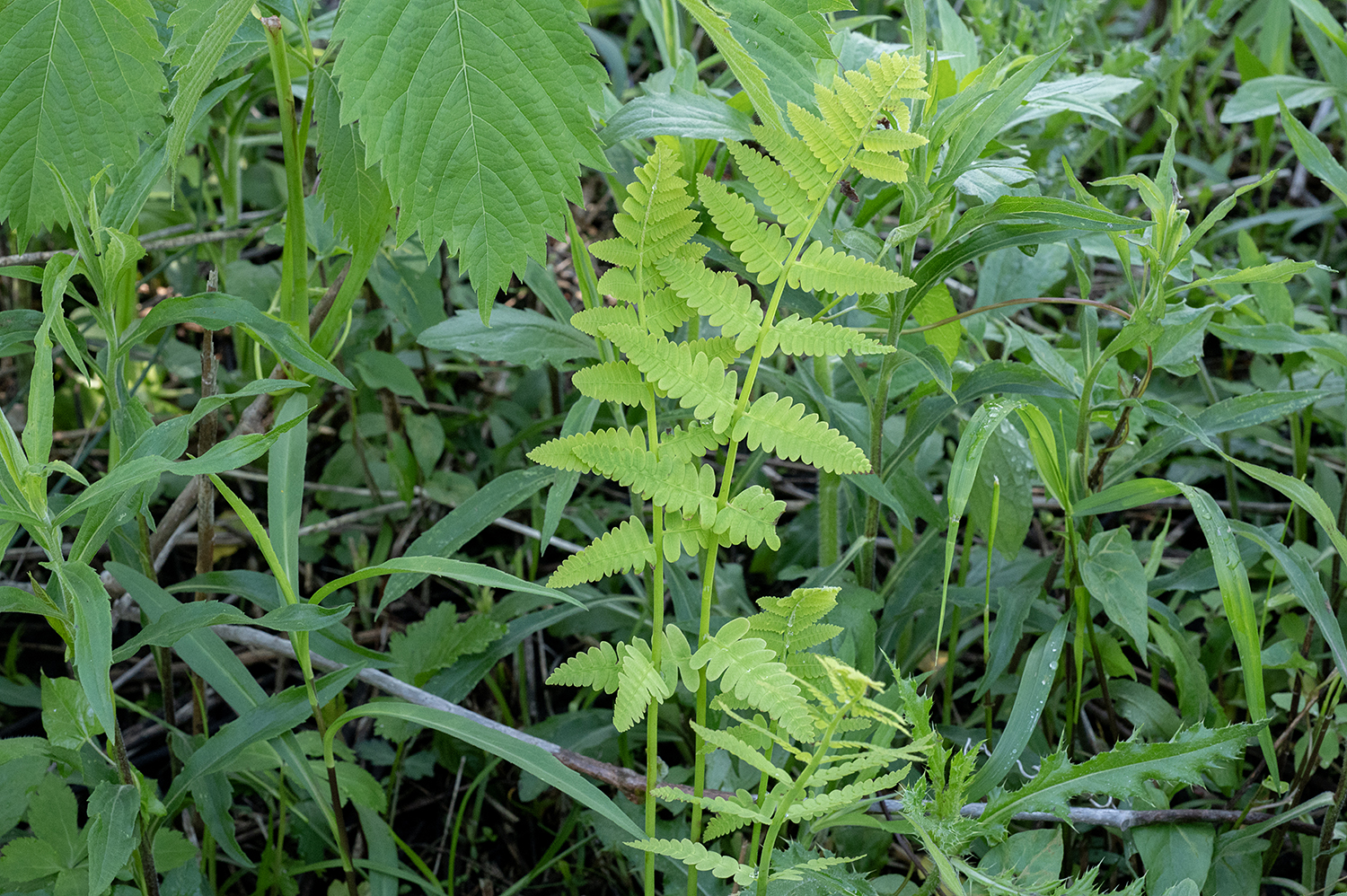
interrupted fern (Claytosmunda claytoniana)

east shore of East Lagoon, opposite the middle island

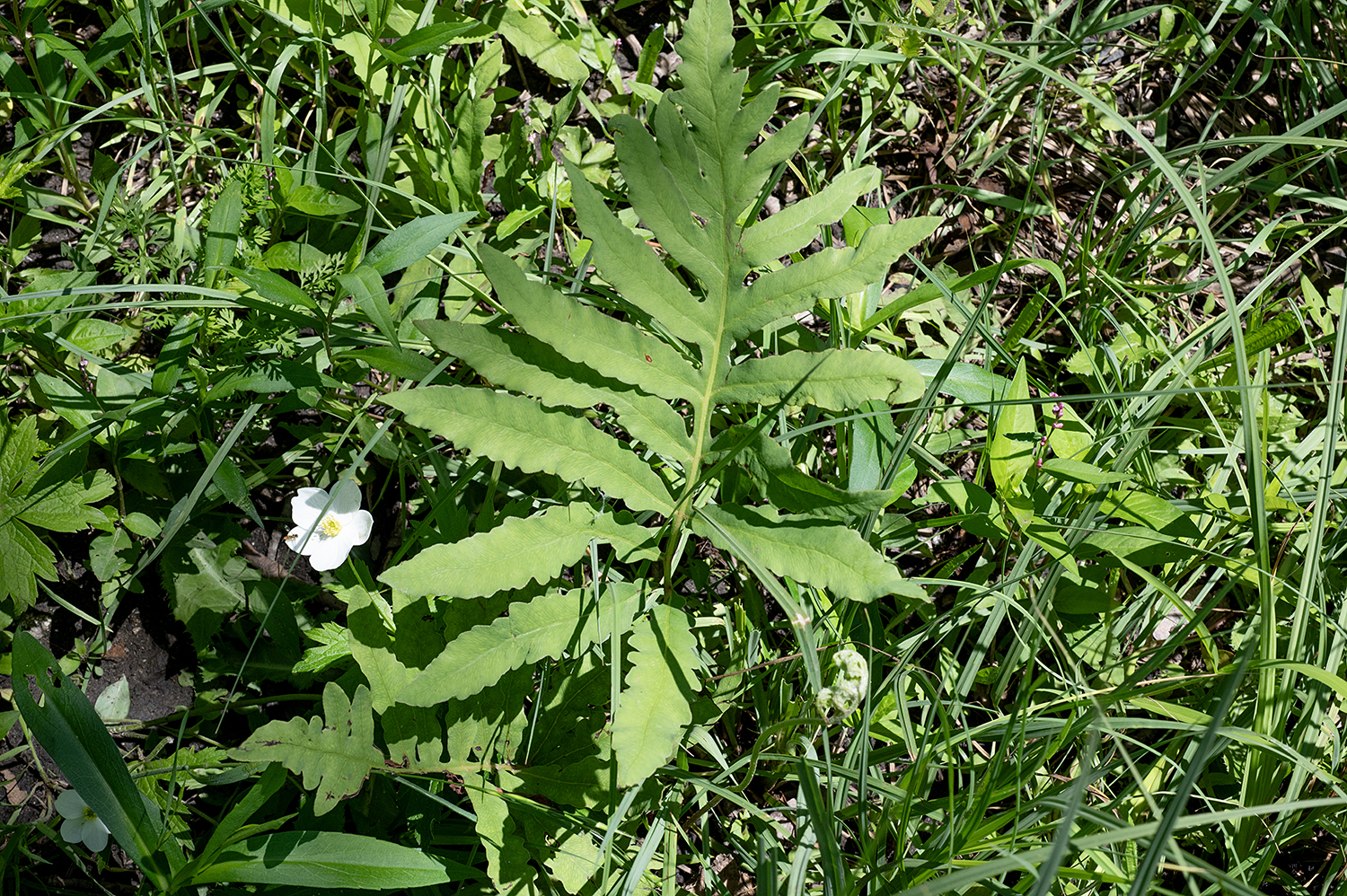
sensitive fern (Onoclea sensibilis)

A sensitive fern with infertile fronds growing on the north shore of West Lagoon.

sensitive fern (Onoclea sensibilis)

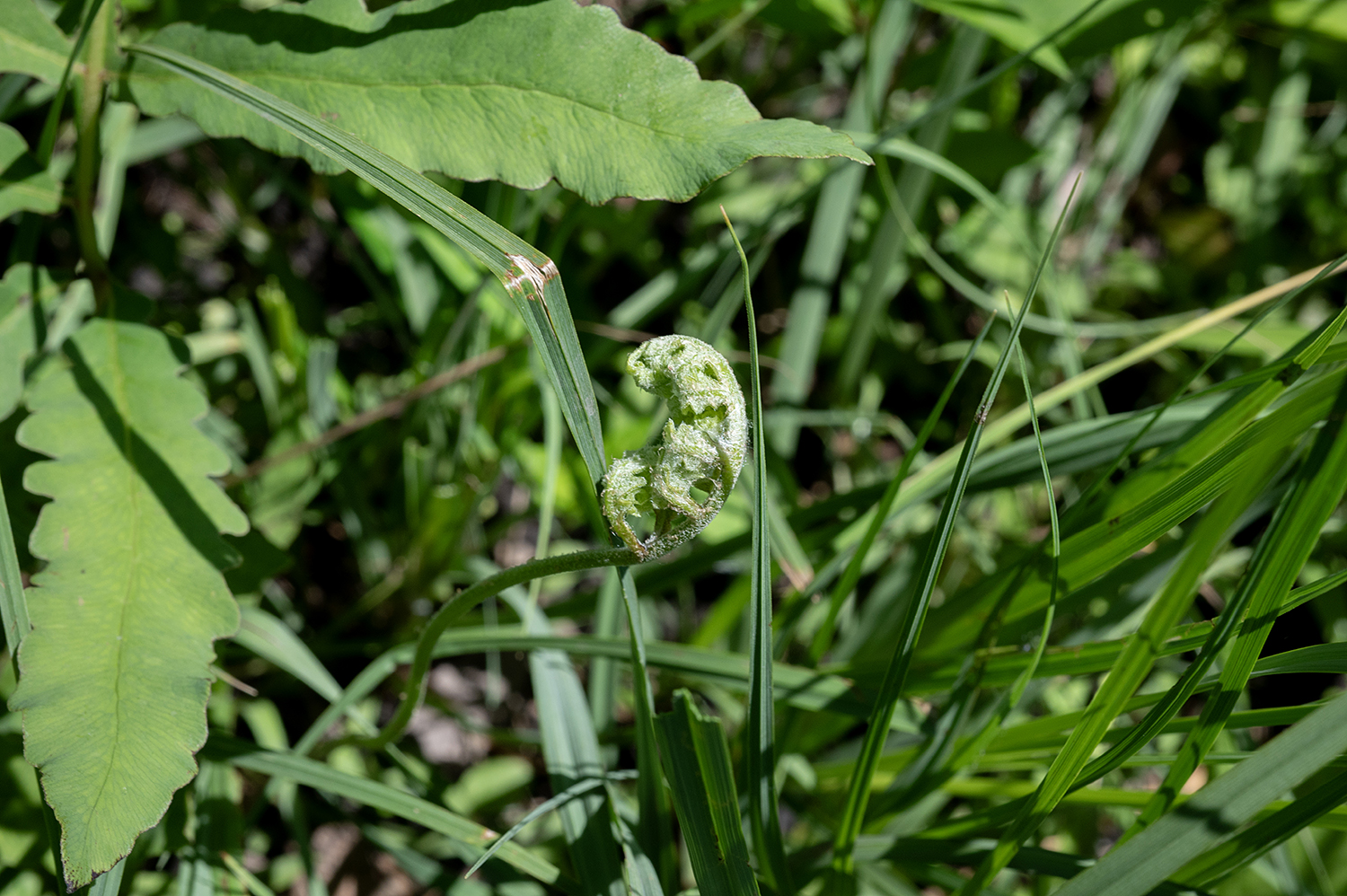
a sensitive fern fiddlehead with unfolding fronds

Fungi

Although Fungi are often implicitly grouped with plants — both have only limited mobility and are fixed in place — fungi are much more closely related to animals than they are to plants, despite their dearth of animal-like characteristics. Like animals, fungi lack the ability to produce food by photosynthesis; both depend on external sources of food to maintain their metabolism. Fungi produce macroscopic structures out of a mass of thread-like hyphae, single cells that have a cell wall made of chitin (like the structural element in the exoskeletons of insects and crustaceans). Fungal cells may be haploid (N chromosomes), diploid (2N chromsomes), or dikaryotic (possess two haploid nuclei in a single cell). The fungi I’ve identified in Jackson Park belong to two Divisions, Ascomycota and Basidiomycota. Ascomycota (or sac fungi) are the most diverse group of fungi, with about 64,000 described species; spore production occurs in a characteristic sac called the ascus. They are decomposers and parasites, especially of plants. Ascomycete species are responsible for chestnut blight and Dutch elm disease; in Jackson Park there are two species that are clearly pathogens. Basidiomycota produce their spores in characteristic club-shaped basidia; if you look at the gills of a mushroom, the basidia are the brown or black cells that cover the gills. There are about 32,000 species of basidiomycetes, seven of which I’ve seen in Jackson Park. Because they often form conspicuous fruiting bodies (mushrooms, puffballs, shelf fungi, etc.) these fungi are probably more familiar to you. Again, these images only begin to scratch the diversity of fungi present.

Ascomycota

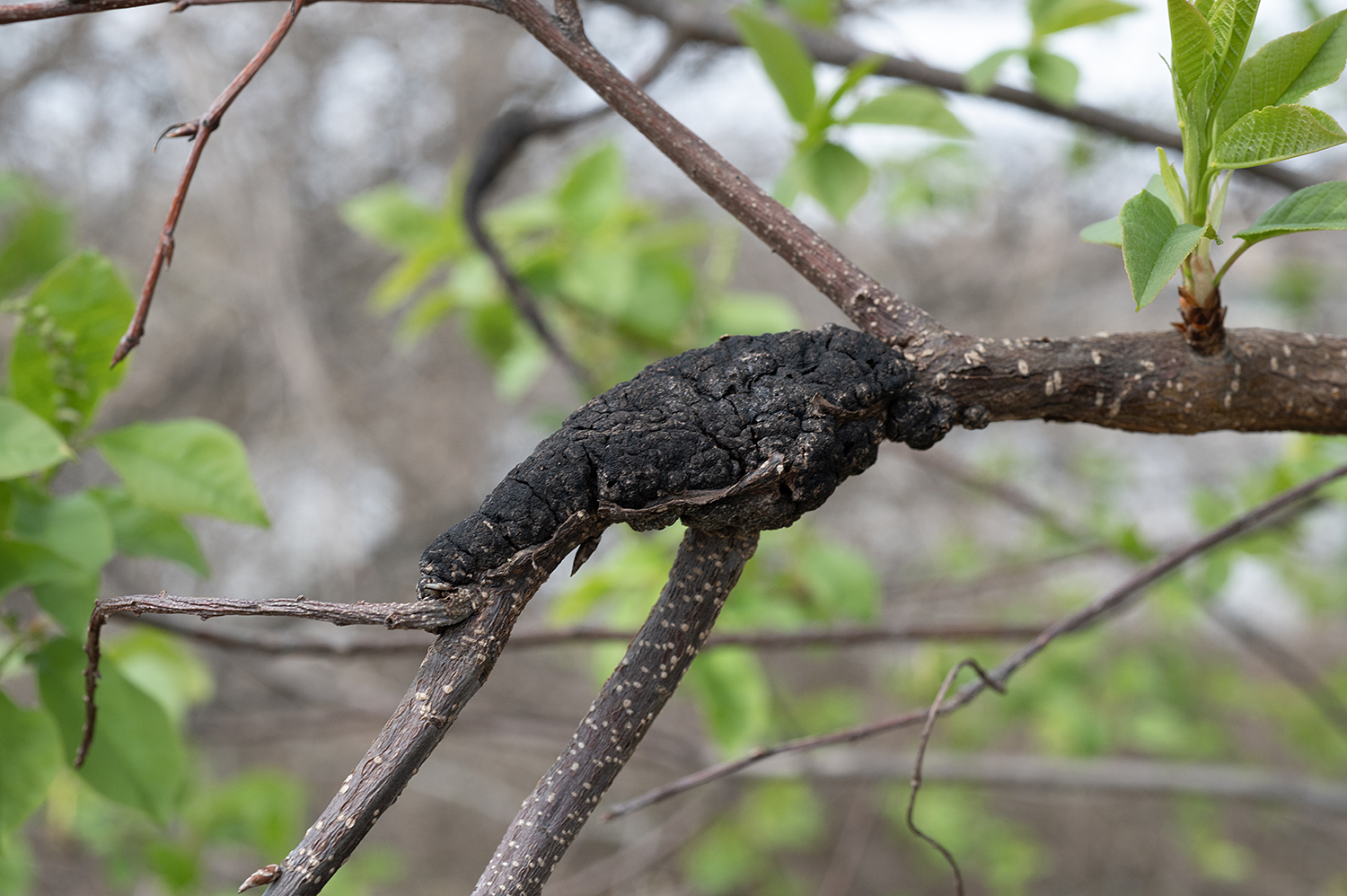
black knot fungus (Dibotryon morbosum) on a chokecherry tree

West side of Wooded Island opposite the south end of Japanese Garden. Trees in the genus Prunus seem to be particularly susceptible to infection by black knot fungus. Choke cherry trees on Wooded Island invariably have multiple sites of infection.

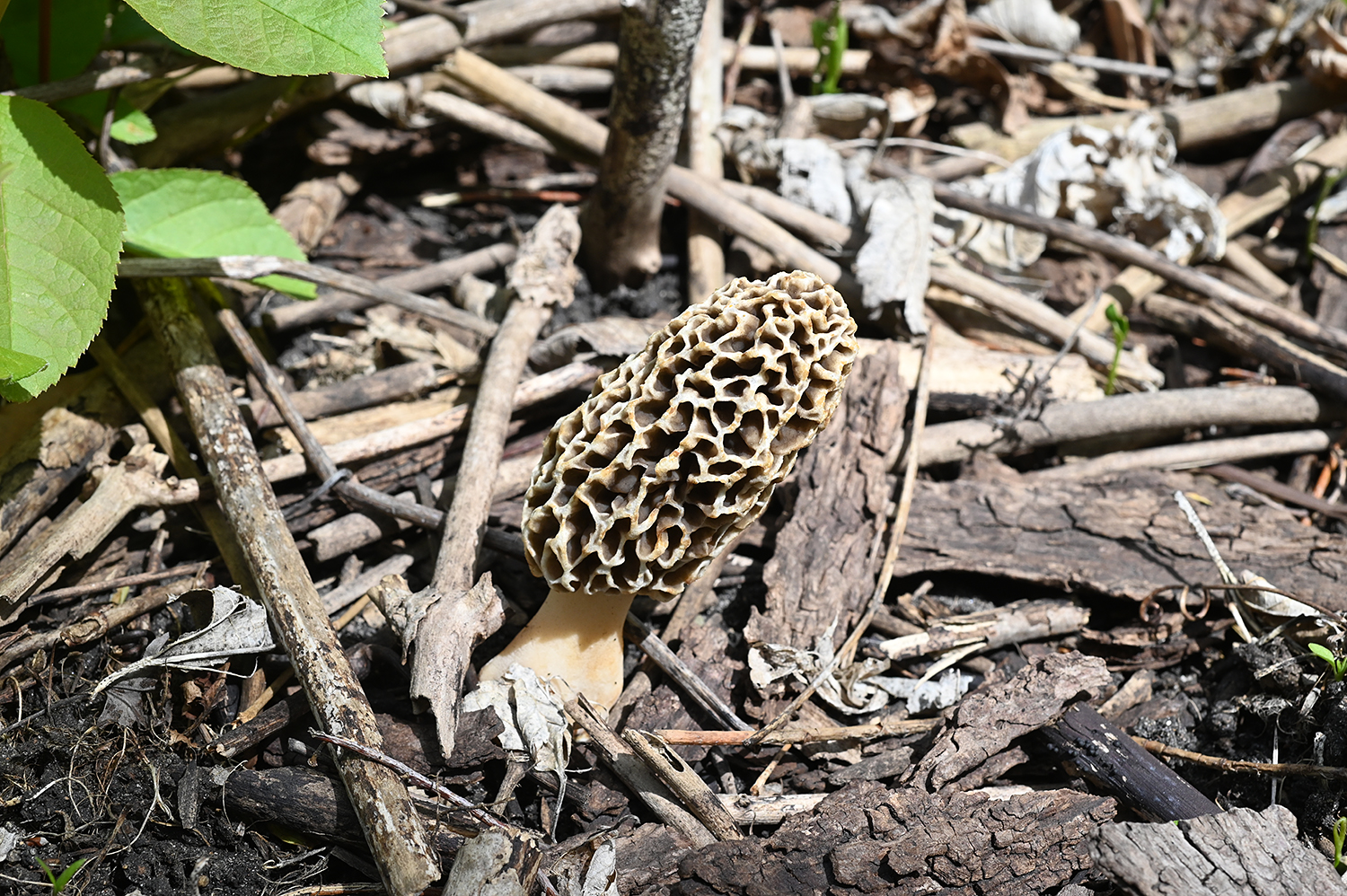
yellow morel (Morchella esculenta)

Central area of Wooded Island. If my identification is correct, this is an edible yellow morel, but I don’t trust my mycological chops enough to give it a nibble. You shouldn’t either.

Basidiomycota

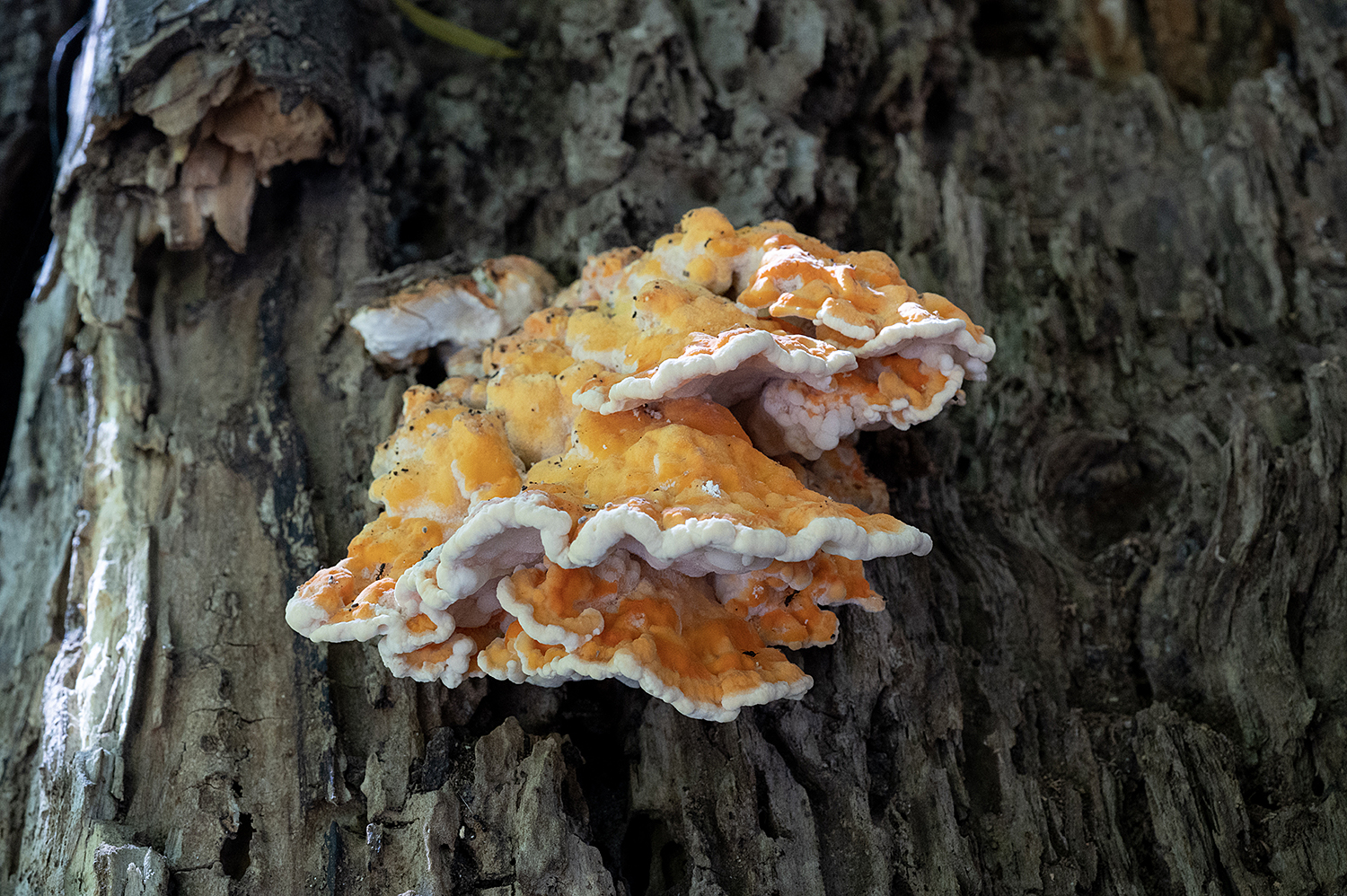
chicken-of-the-woods (Laetiporus sulphureus)

Chicken-of-the-woods is said to be delicious but, once again, I chickened out. Since I took this photograph (September, 2022) this specimen disappeared and the tree it was growing on has fallen down. Fingers crossed that there’s another specimen somewhere in Jackson Park.

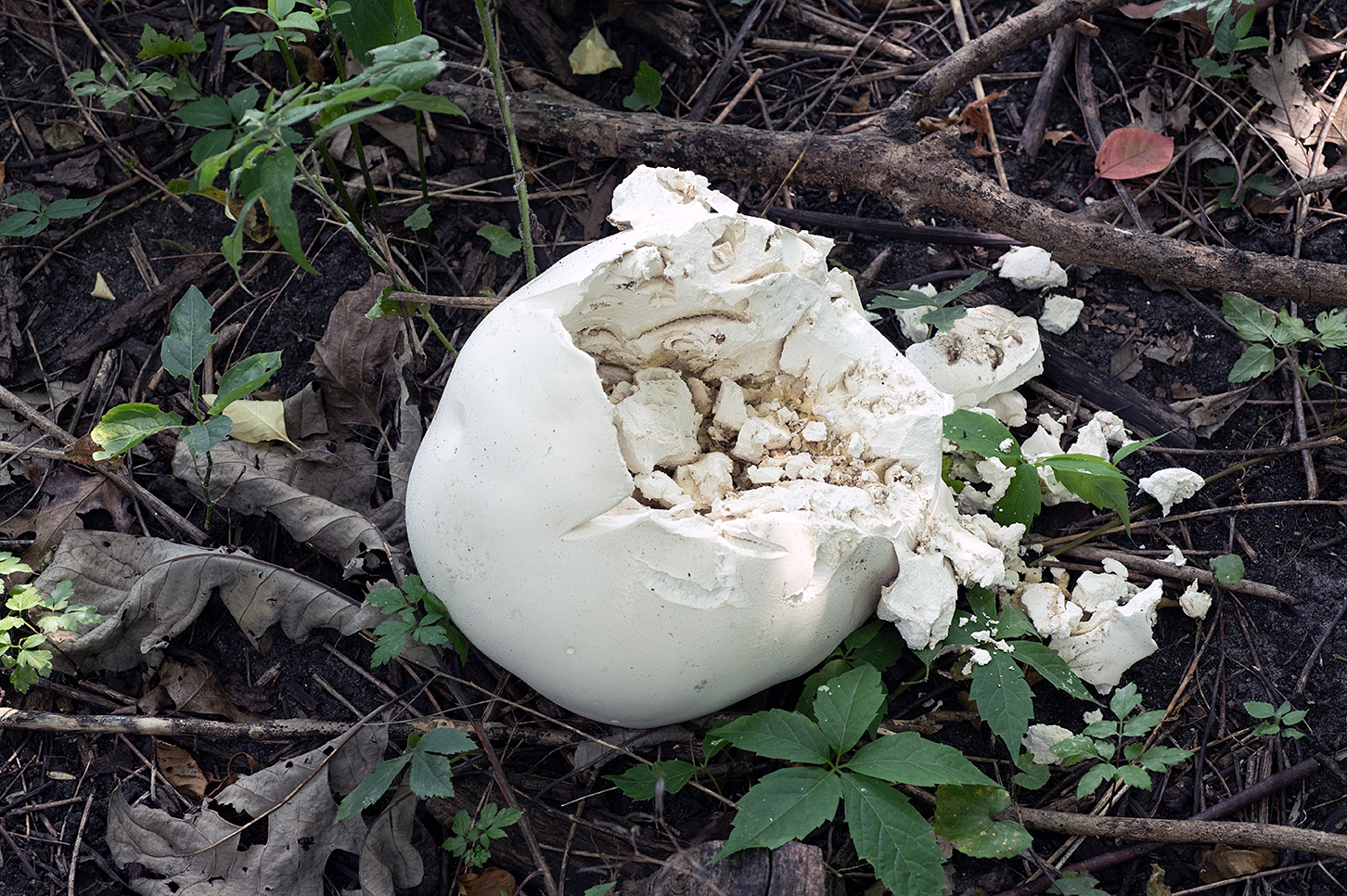
giant puffball (Calvatia gigantea)

This softball-sized giant puffball (another edible species) was growing in the middle of Wooded Island. When I found it, someone else (I suspect a gray squirrel) had already sampled it.

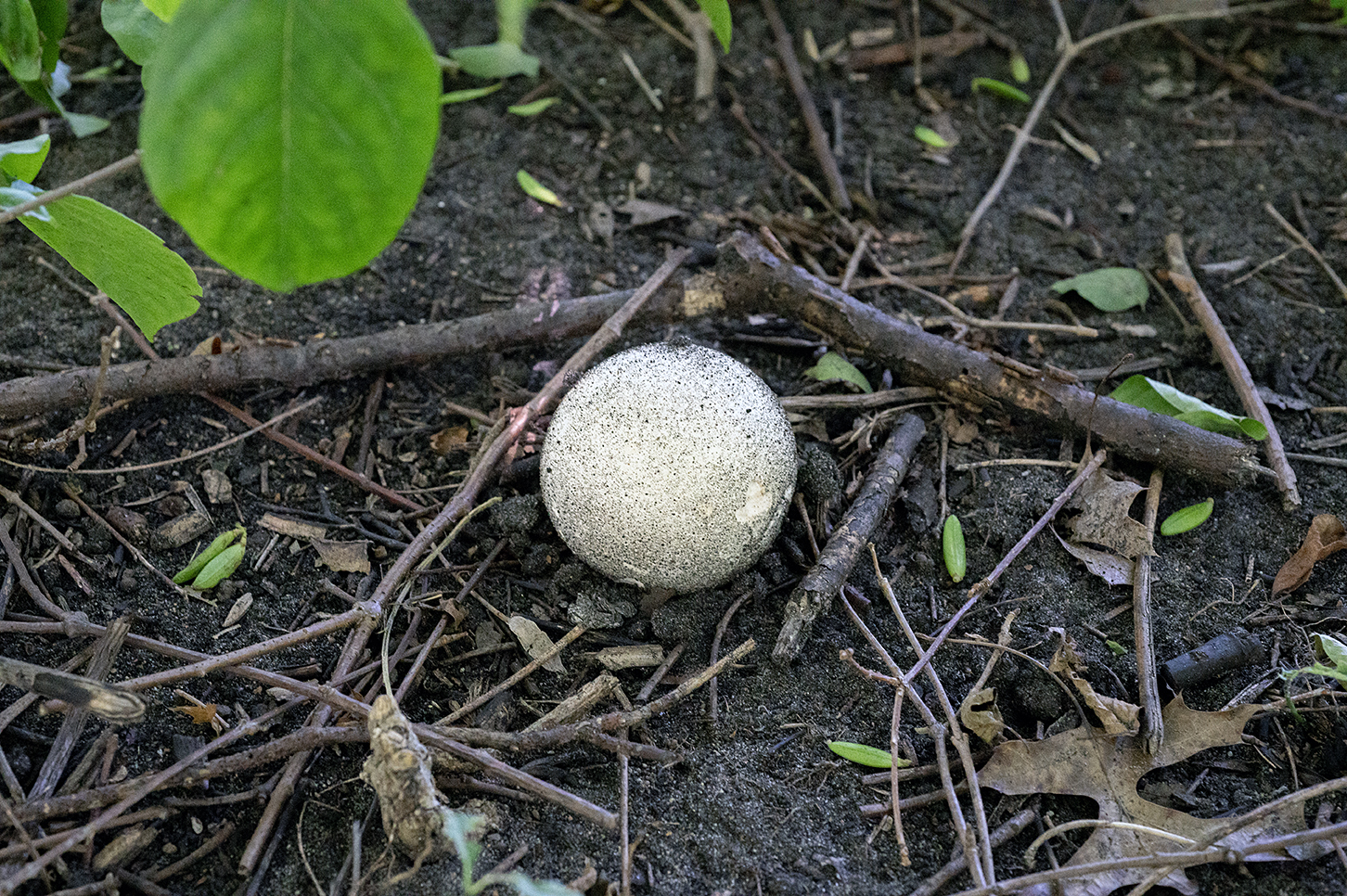
pear-shaped puffballs (Apioperdon pyriforme)

I would have guessed this was just an immature giant puffball, but Seek assured me it was a different species, a pear-shaped puffball. There were several specimens clustered within a few feet of each other on Wooded Island. It, too, is supposed to be edible, but only when it is immature and the flesh inside is white.

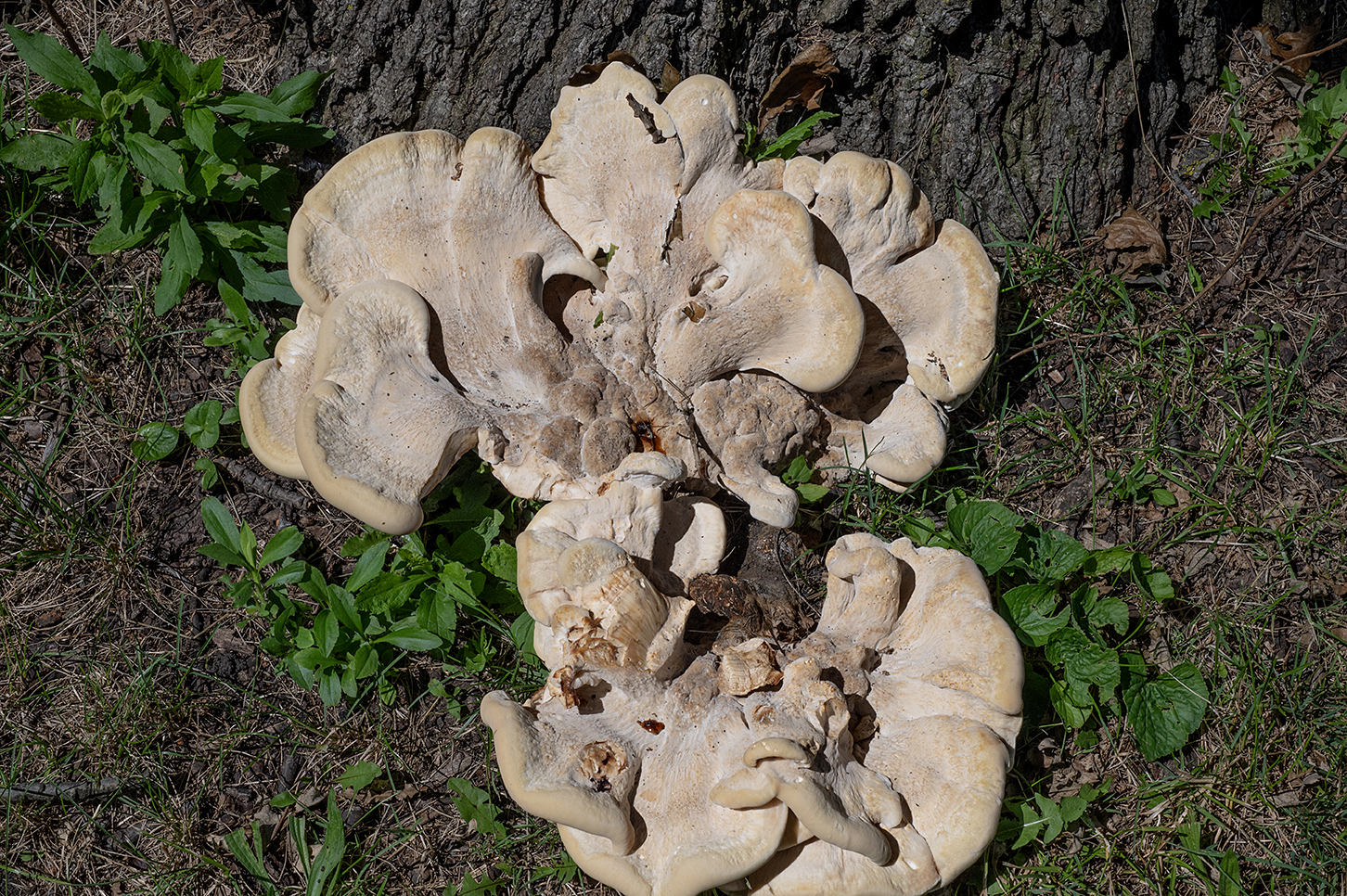
Berkeley’s polypore (Bondarzewia berkeleyi)

Berkeley’s polypore is edible only when young. It has been described as “found at the bases of (doomed) hardwoods in eastern North America, where it grows as a parasitic butt rot.” This specimen was growing on the base of a tree east of Columbia Basin.

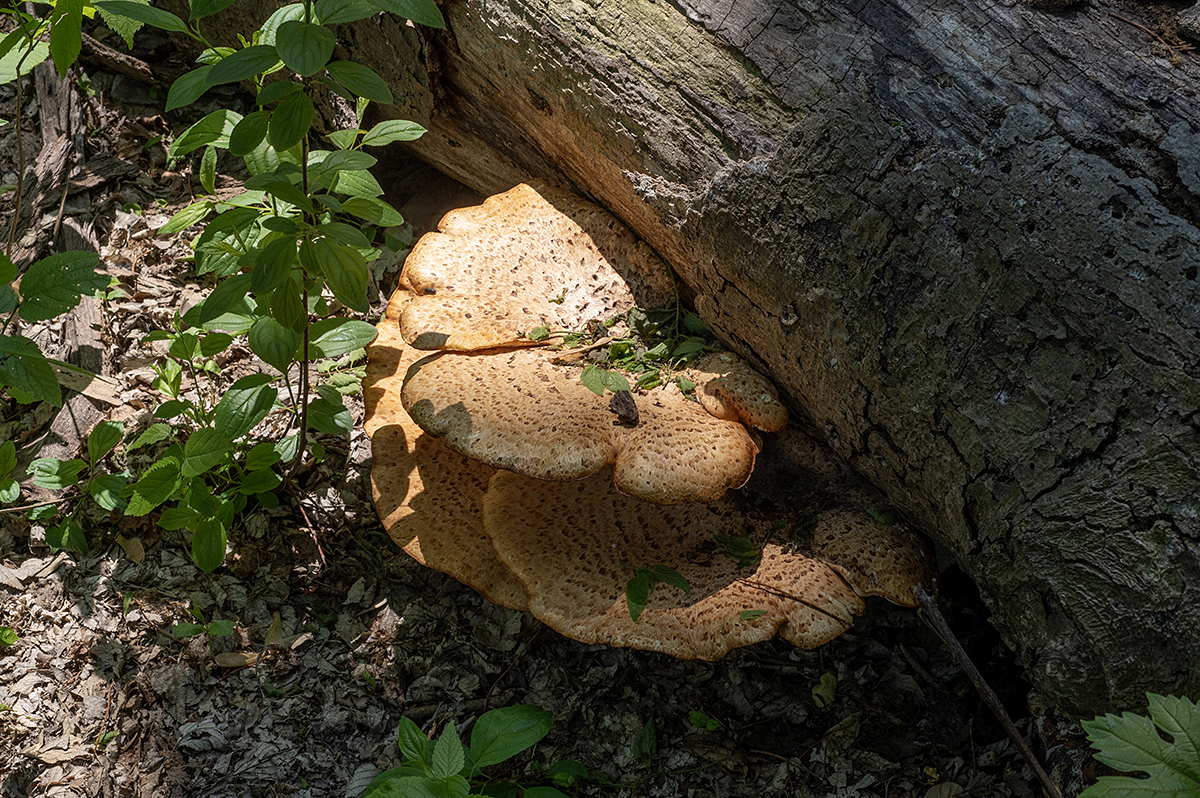
dryad’s saddle (Cerioporus squamosus; aka, Polyporus squamosus)

Dryad’s saddle is an annual that attacks living and dead hardwood trees. Here it is growing out of the trunk of a downed tree. It is said to be edible when young but rubbery (and full of maggots) later. I’ll pass.

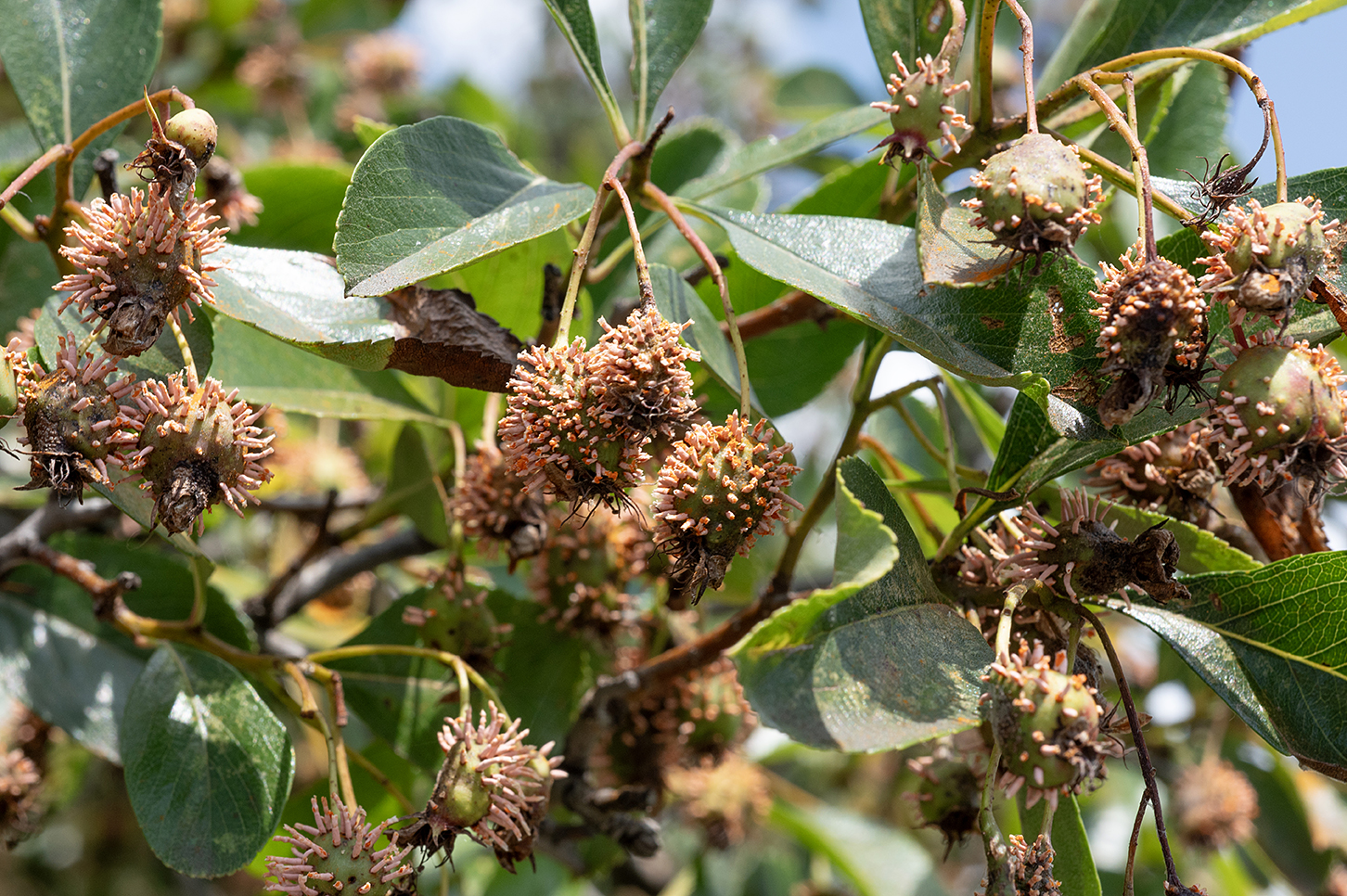
quince rust (Gymnosporangium clavipes)

Seek supplied the identification for this basidiomycote that was growing on the fruit of some ornamental trees south of the western part of Columbia Basin in 2024. Infections were much reduced in 2025.

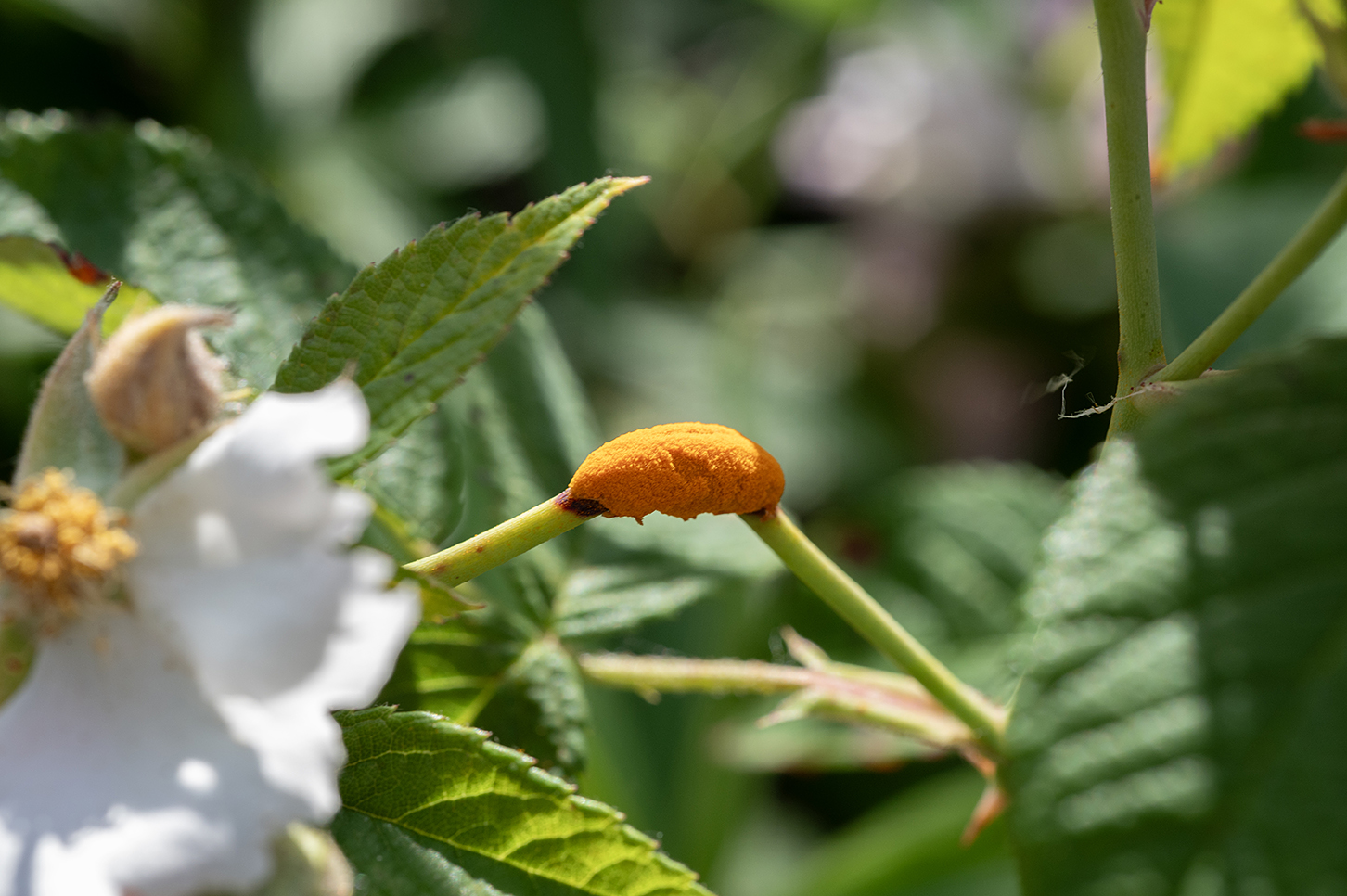
multiflora rose rust (Phragmidium rosae-multiflorae)

Another ID supplied by Seek; I would have guessed that it was an ascomycote, not a basidiomycote. This genus is widespread on members of the Rosaceae. This species infects the invasive multiflora rose (an out-of-focus flower is visible on the left).