
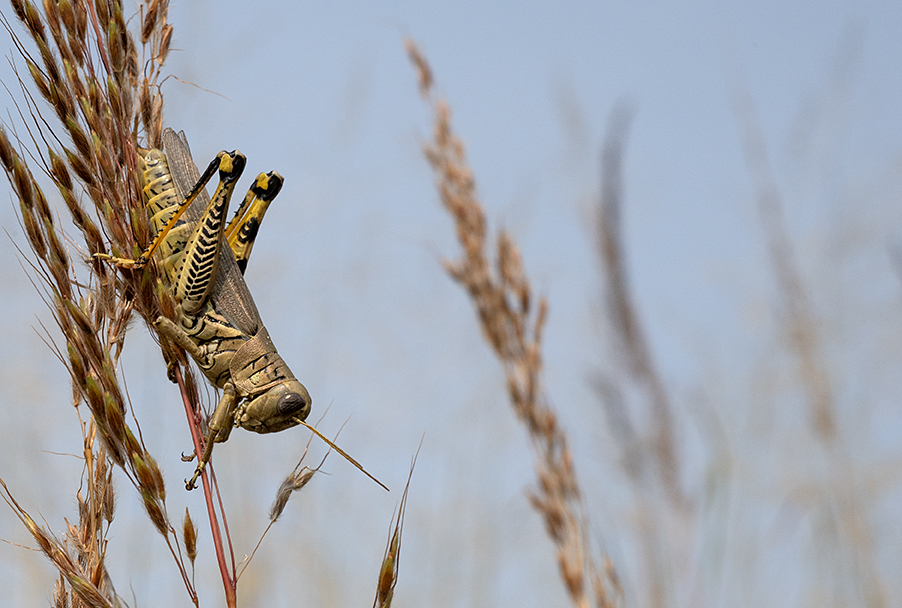
Pollinators
All pollinators are animals but not all animals are pollinators. Most of the pollinators in Jackson Park are insects — bees, wasps, flies, ants, butterflies, moths, and beetles — but a few birds also function as plant pollinators.
I’ve included number of pictures of pollinators with the montages in the Plant Finder, so I’ll try not to duplicate those here.
For all the images below, hold your cursor over the image to zoom in (or tap the image on a smart phone). If you’re viewing this site on a laptop (as opposed to a smart phone), use the yellow buttons on the right to jump to a different section.
If you have technical issues or an interesting observation, you can send me an email using the “Contact” form at the bottom of the “About” page. (See the links the top of this page.)
Pollinators: Bees
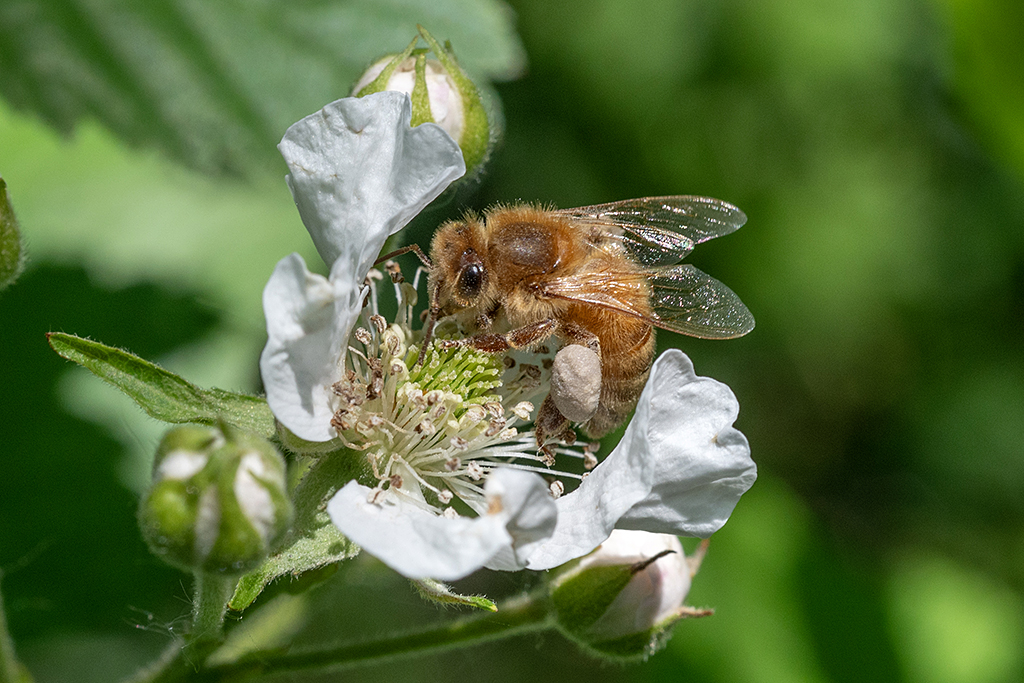
honeybee (Apis mellifera)
A honeybee on a Pennsylvania blackberry flower on Wooded Island. The bee’s “honey baskets” on its third pair of legs are packed with the grey pollen of the blackberry.
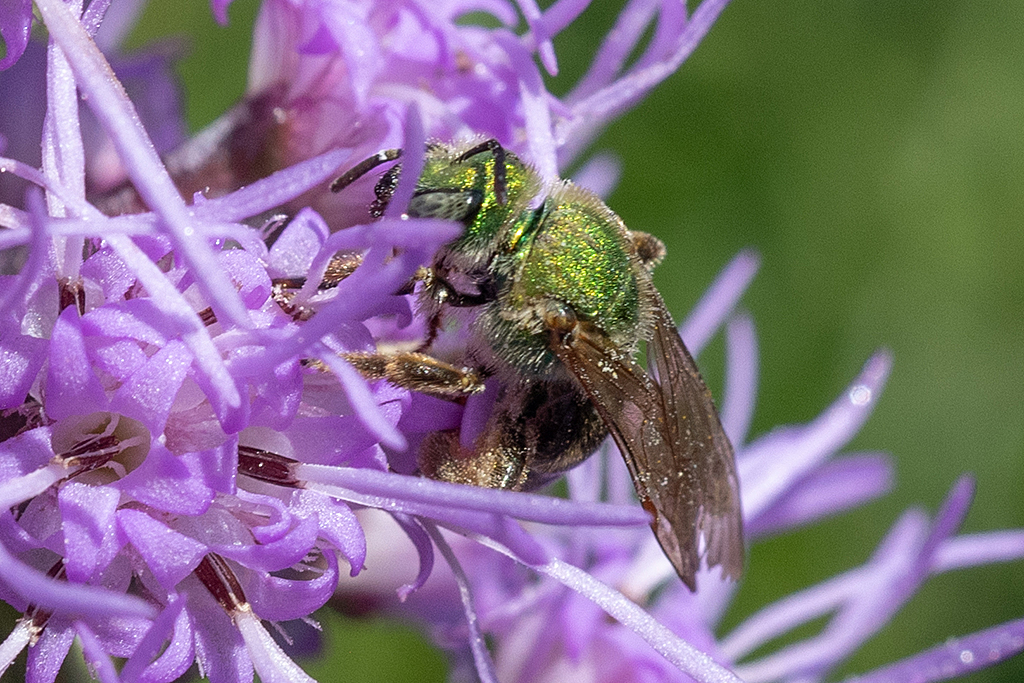
bicolored striped sweatbee (Agapostemon virescens)
A marsh blazing-star on the western shore of Columbia Basin with a bicolored striped sweatbee extracting nectar.
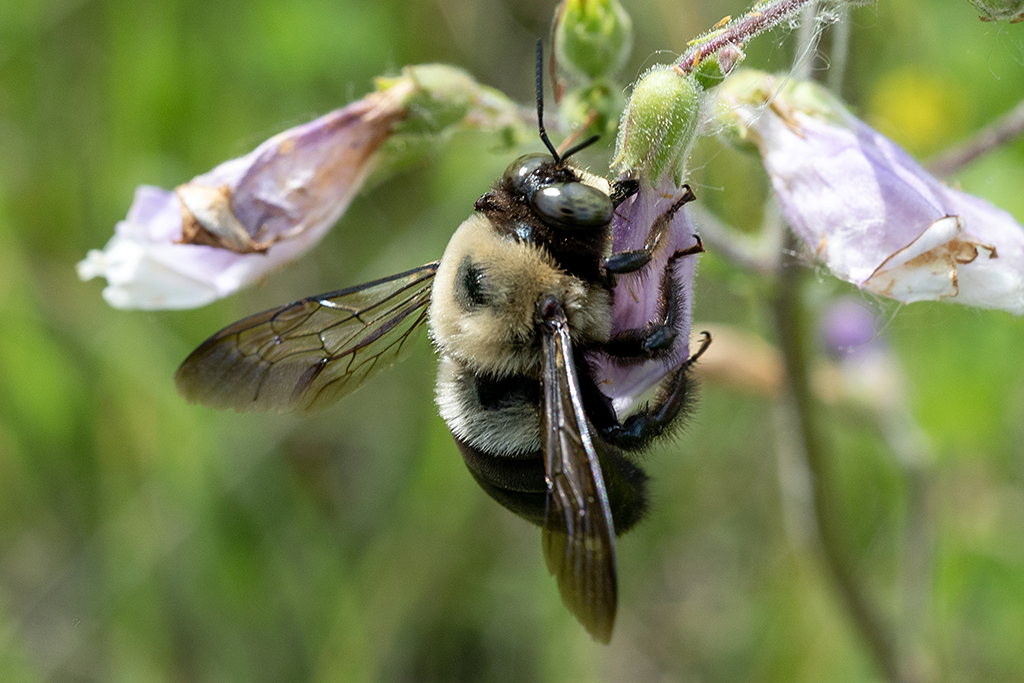
eastern carpenter bee (Xylocopa virginica)
An eastern carpenter bee stealing the nectar from a hairy beardtongue (Penstemon hirsutus) flower in Bobolink Meadow. (Note that the bee’s proboscis pierces the side of the flower.)
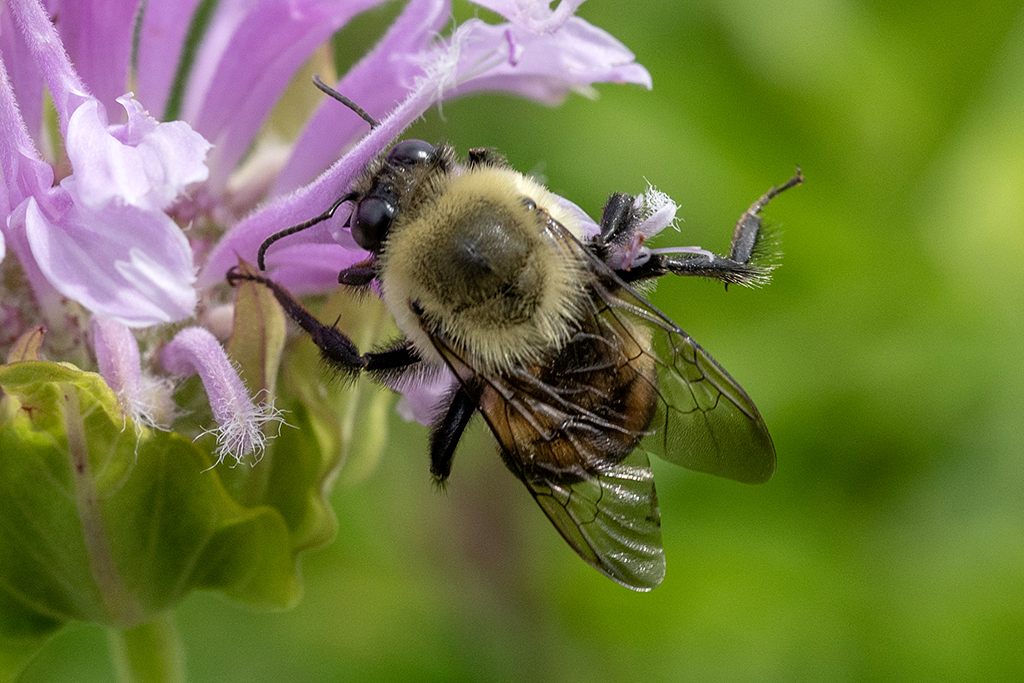
brown-belted bumblebee (Bombus griseocollis)
A brown-belted bumblebee visiting a wild bergamot flower (Monarda fistulosa) on the southwest shore of Columbia Basin.
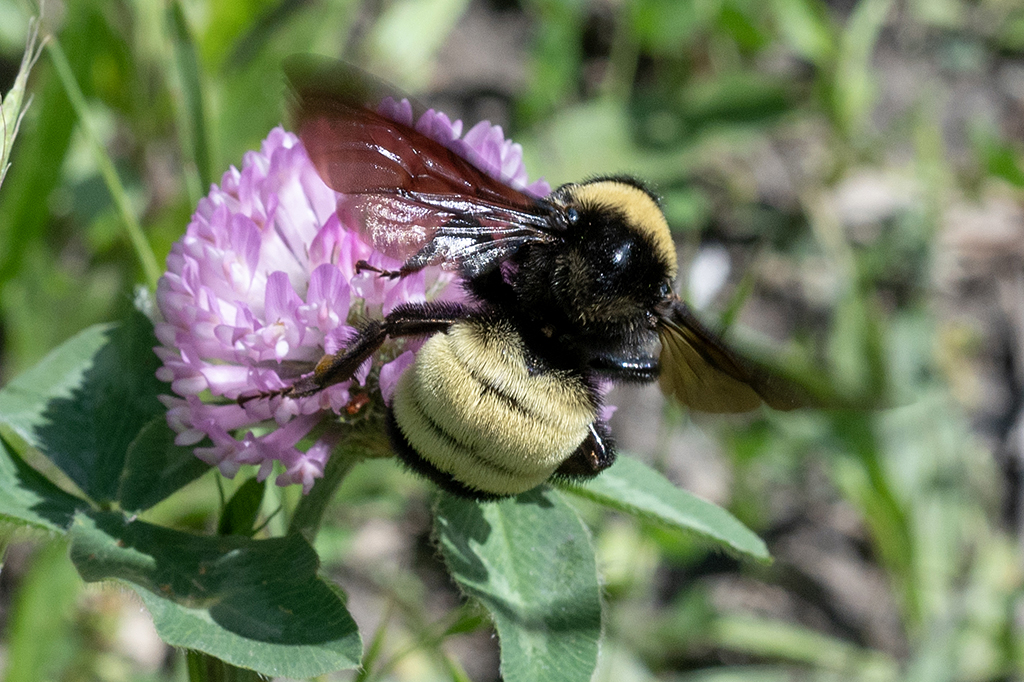
American bumblebee (Bombus pennsylvanicus)
A female American bumblebee visiting a red clover on the north shore of West Lagoon.
Pollinators: Wasps
You tend to think of bees as pollinators, but not wasps. In truth, wasps can be prolific pollinators — if you don’t believe me, check out a goldenrod in bloom and see which insects are present. Wasps don’t have a proboscis so have a hard time accessing nectar, but they consume large quantities of pollen, a rich source of protein.
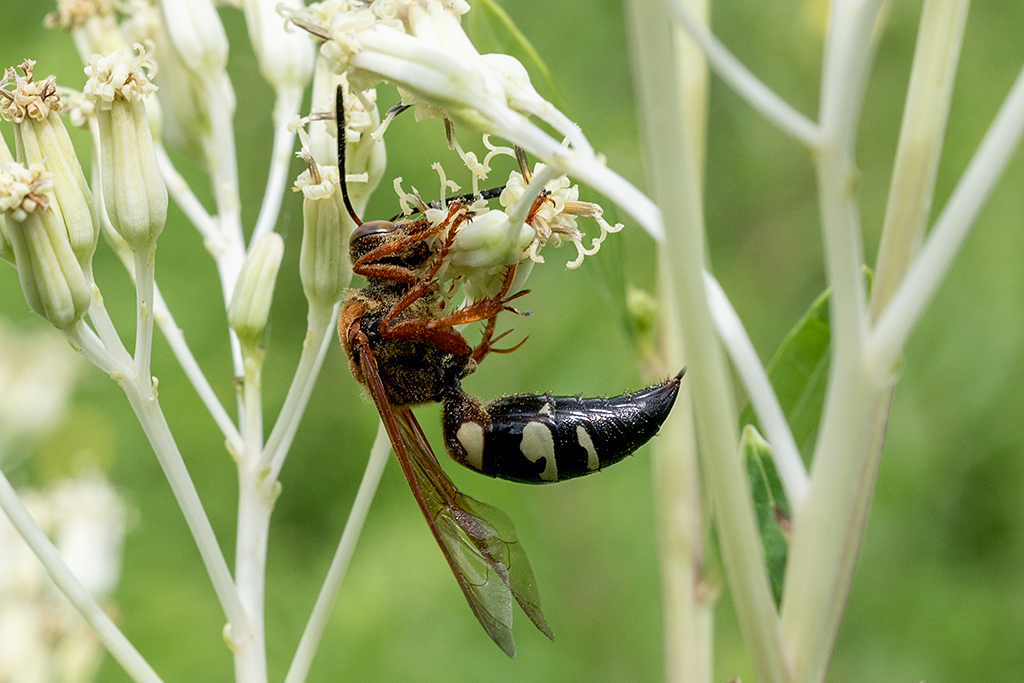
eastern cicada-killer (Sphecius speciosus)
An eastern cicada-killer on pale Indian plaintain growing on the east side of Wooded Island. Cicada-killers get their name from their habit of building burrows in sandy soil and stocking them with paralyzed large insects (grasshoppers, cicadas, etc.) on which they have laid their eggs.
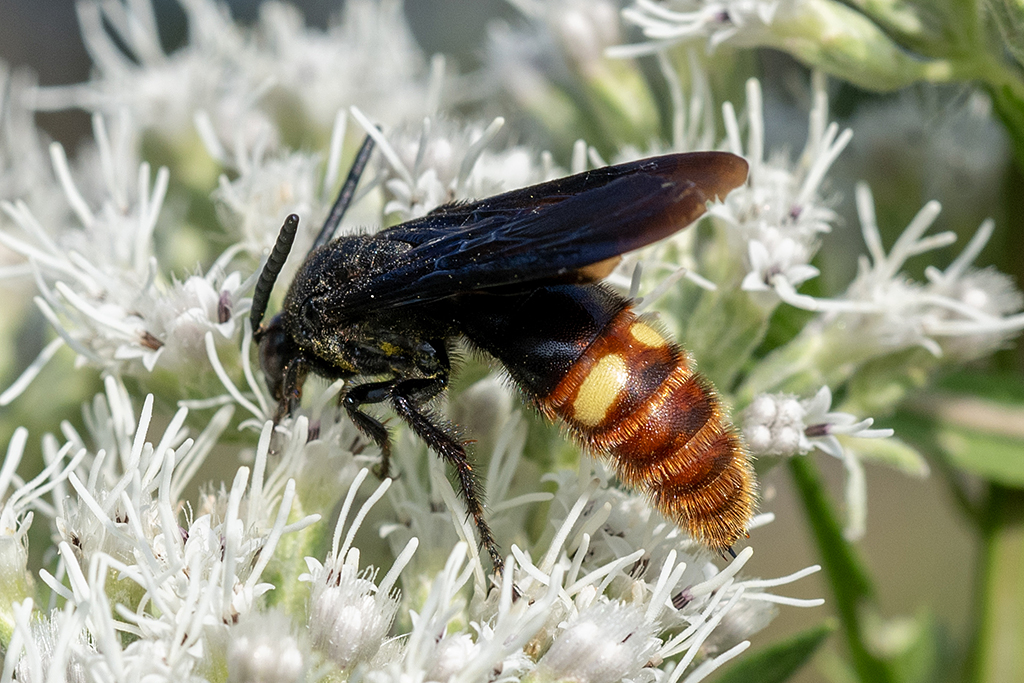
blue-winged wasp (Scolia dubia)
A blue-winged wasp on tall boneset in Bobolink Meadow. In addition to the iridescent blue wings, the two large yellow spots on the first segment of the abdomen are characteristic of the species.
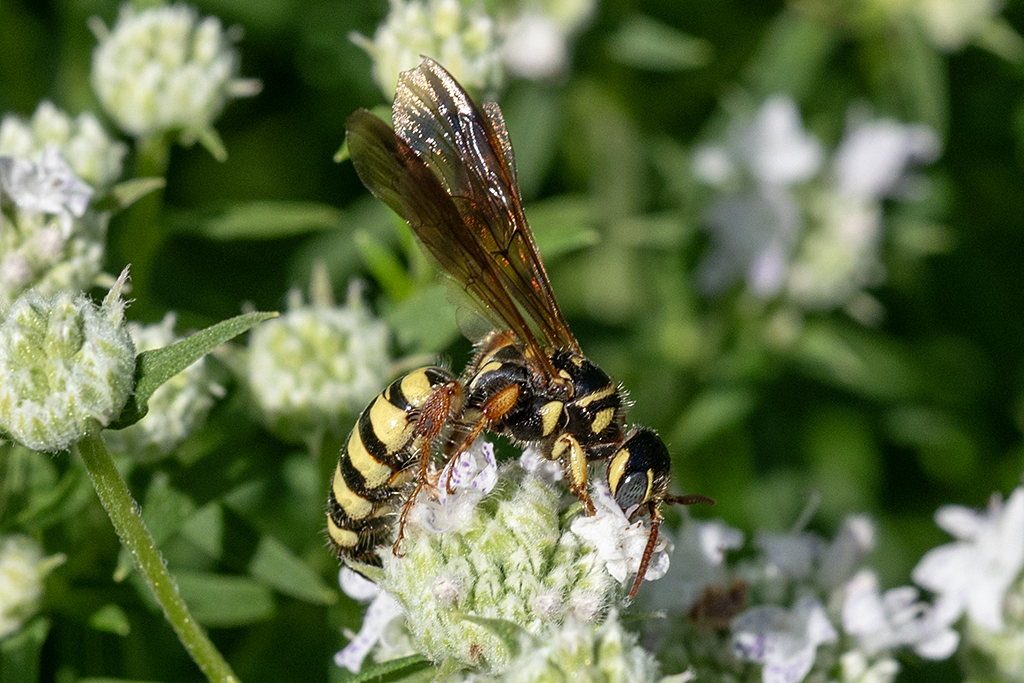
A female five-banded thynnid wasp (Myzinum quinquecinctum)
Myzinum is a common pollinator of mountain mints, both Virginia and narrow-leaved mountain mints. (Here on the east shore of East Lagoon.) The five bright-yellow abdominal bands are characteristic.
Pollinators: Flower flies (syrphids)
Syrphid flower flies are a delight to find and watch in action; it’s just a shame they aren’t a bit bigger so they would be easier to see. There are about 400 species of flower flies in the northeastern U.S. (including the upper Midwest), many of which are mimics of bees and wasps. Despite their tiny size, they are important pollinators — the adults feed mainly on nectar and pollen.
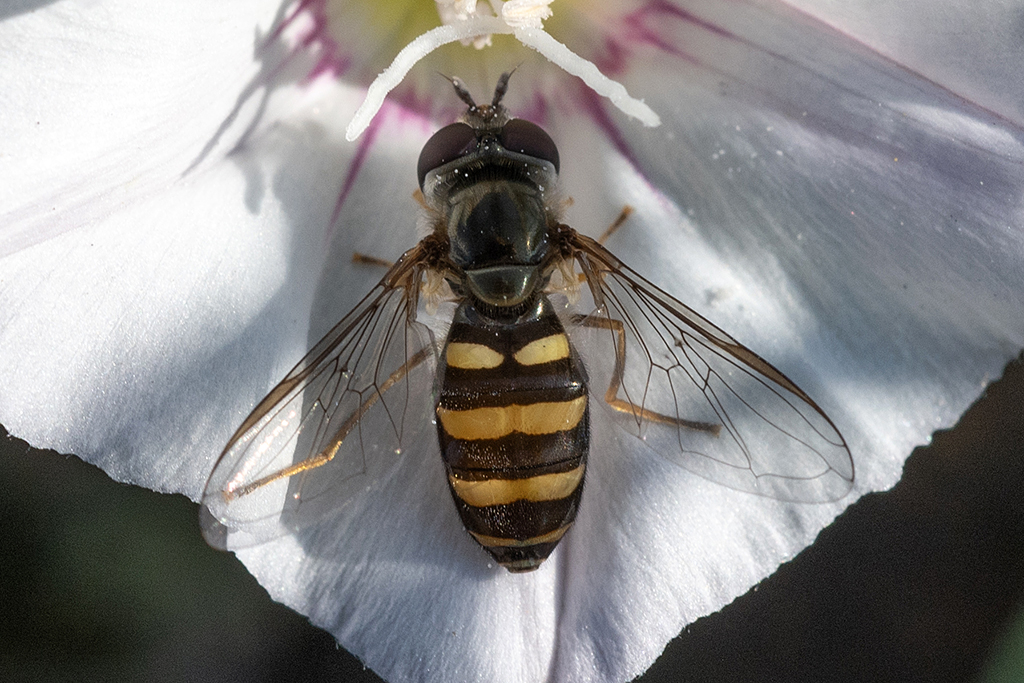
common flowerfly (Syrphus ribesii)
A common flowerfly on the trumpet-shaped bloom of field bindweed (Convolvulus arvensis) on the west shore of West Lagoon.
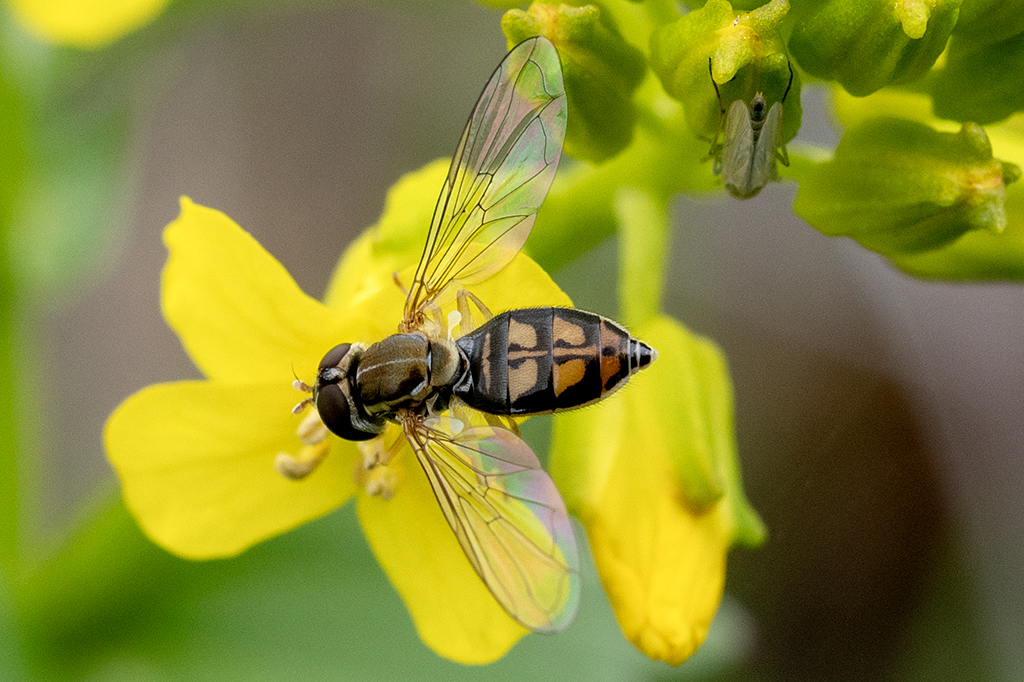
margined calligrapher (Toxomerus marginatus)
A margined calligrapher in Bobolink Meadow on a yellow rocket (Barbarea vulgaris) flower.
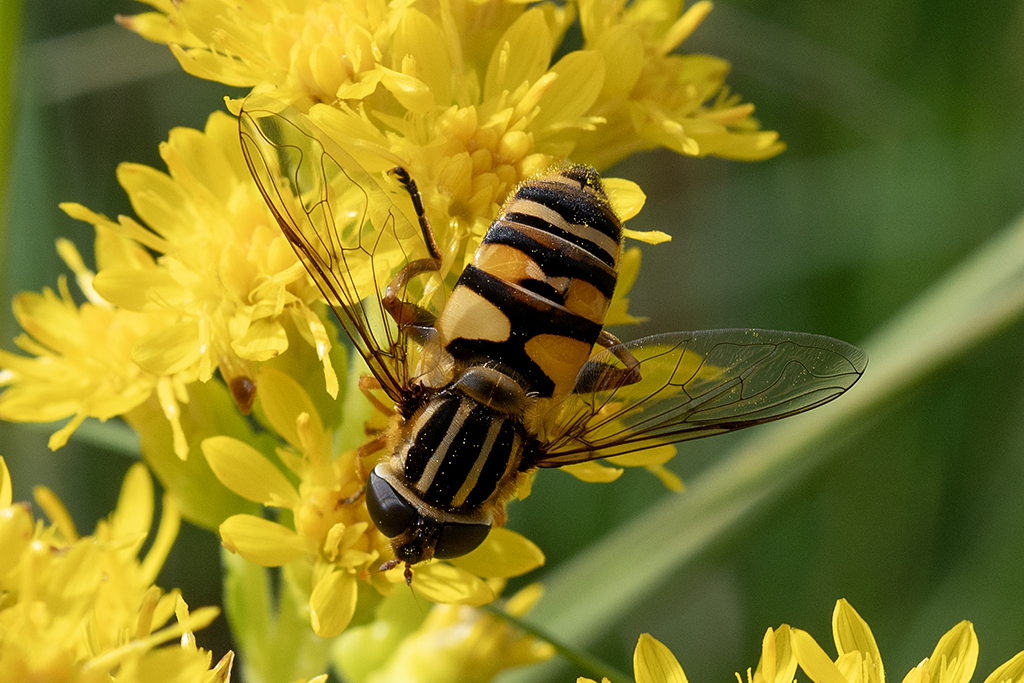
narrow-headed marsh fly (Helophilus fasciatus)
A narrow-headed marsh fly on an inflorescence of stiff goldenrod (Solidago rigida) at 63rd St. Beach.
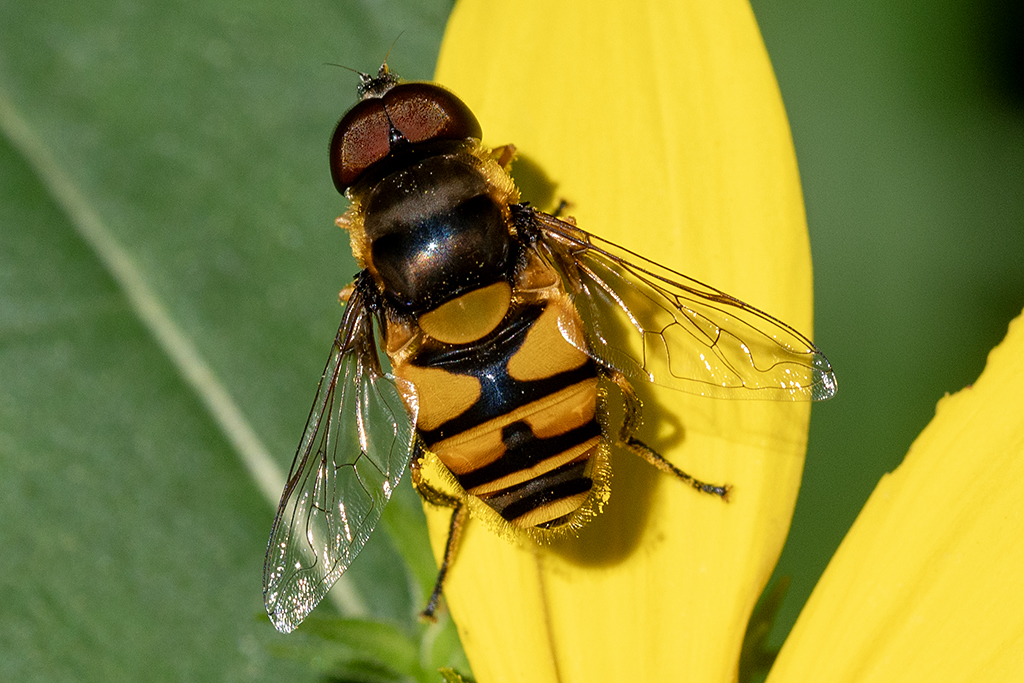
transverse-banded flower fly (Eristalis transversa)
Transverse-banded flower fly; east side of Wooded Island.
Pollinators: Beetles
Beetles (Order Coleoptera) are the most diverse group among insects (about 400,000 species). Insects primitively have two pairs of wings. Beetles have taken the first pair of wings and thickened and hardened them to form both a protective covering for the thorax and abdomen and to function as a fixed pair of lift-generating wings like the wings on an airplane. Beetles do just about everything, including pollinating flowers.
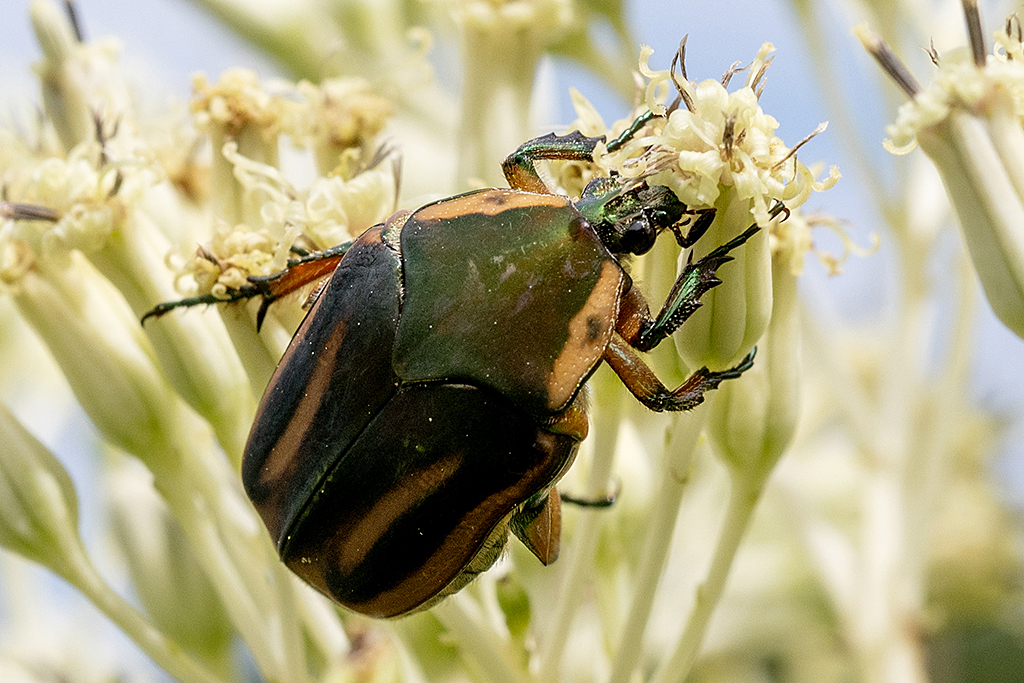
green June beetle (Cotinis nitida)
A green June beetle exploring pale Indian plantain flowers (Cotinis nitida); east side of Wooded Island.
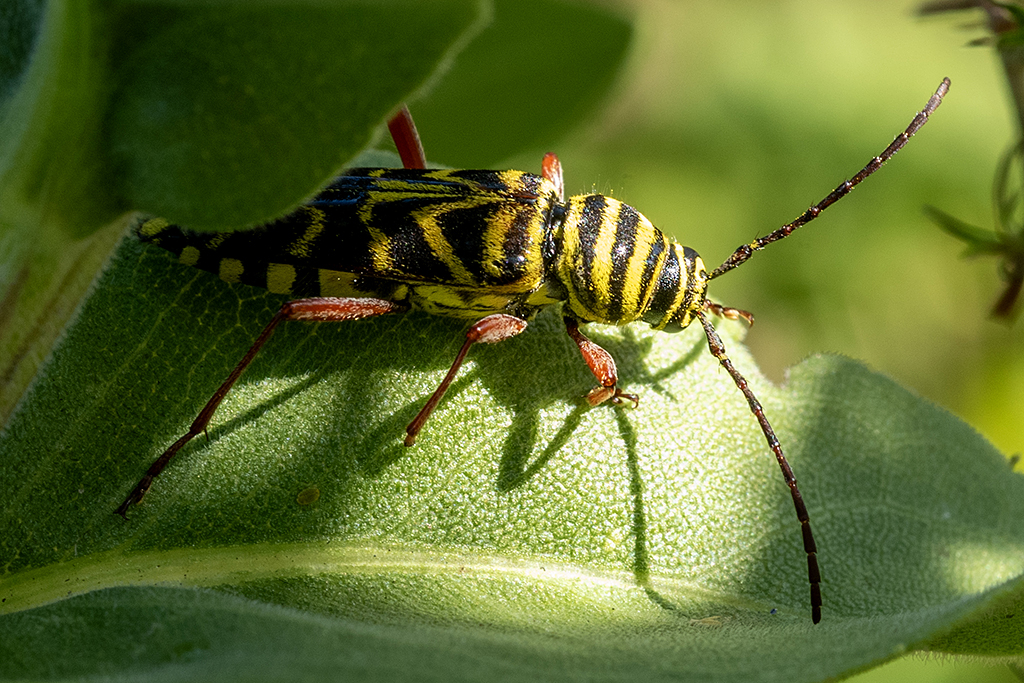
locust borer (Megacyllene robiniae)
A locust borer on stiff goldenrod (Solidago rigida); west side of West Lagoon.
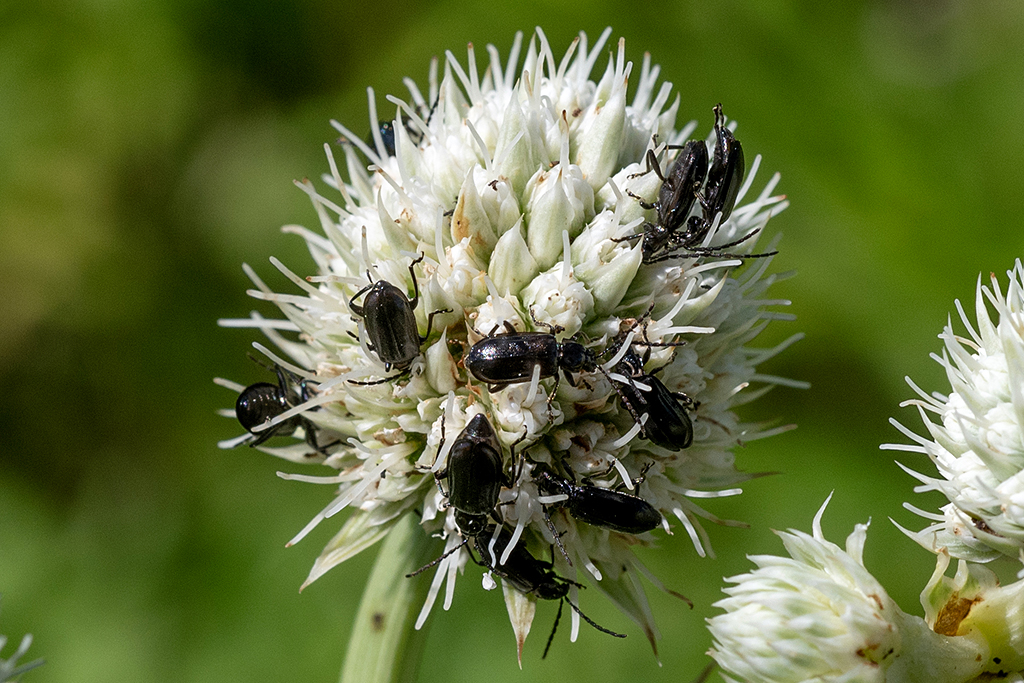
black blister beetles (Epicauta pensylvanica)
Black blister beetles on the inflorescence of rattlesnake master (Eryngium yuccifolium); Bobolink Meadow.
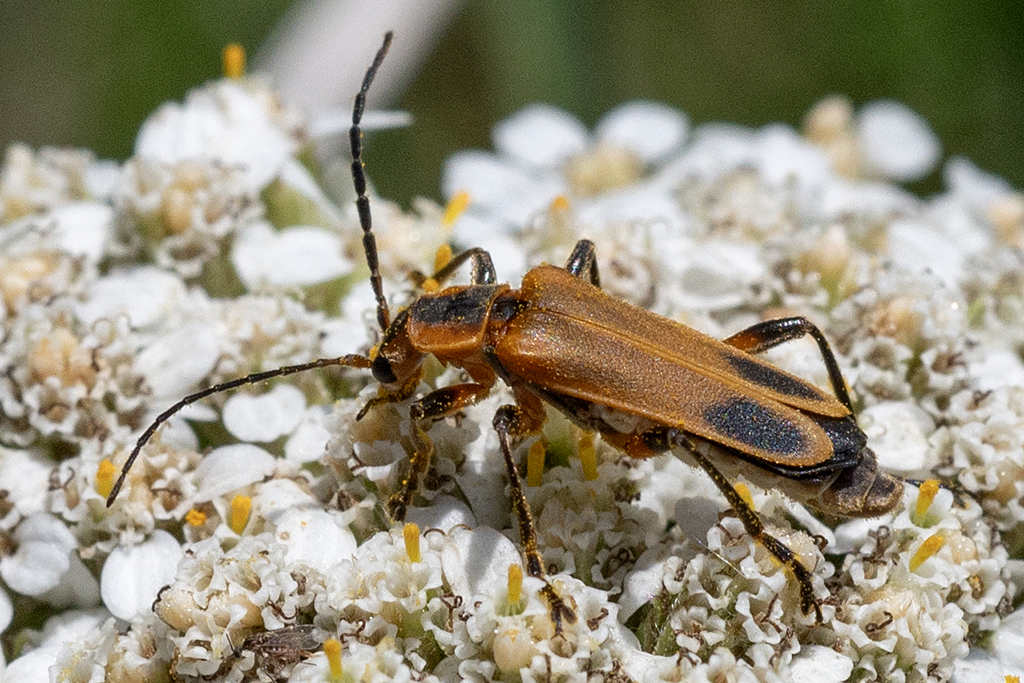
Pennsylvania leatherwing (Chauliognathus pensylvanicus)
A yarrow (Achillea millefolium) inflorescence with a Pennsylvania leatherwing beetle exploring individual florets; south side of Bobolink Meadow.
Pollinators: Butterflies and moths
The Class Lepidoptera (butterflies and moths) are highly important pollinators; a number of flowering plants are specialized to specifically attract butterflies and moths. The moths tend to be very strong fliers that can hover in front of a flower and, using a proboscis that may be longer than the body, extract nectar without landing. Butterflies tend to be less acrobatic, so often need a “landing pad” in the form of a horizontal flat surface (think of coneflowers or coreopsis) to rest on while they extract nectar with their proboscis.
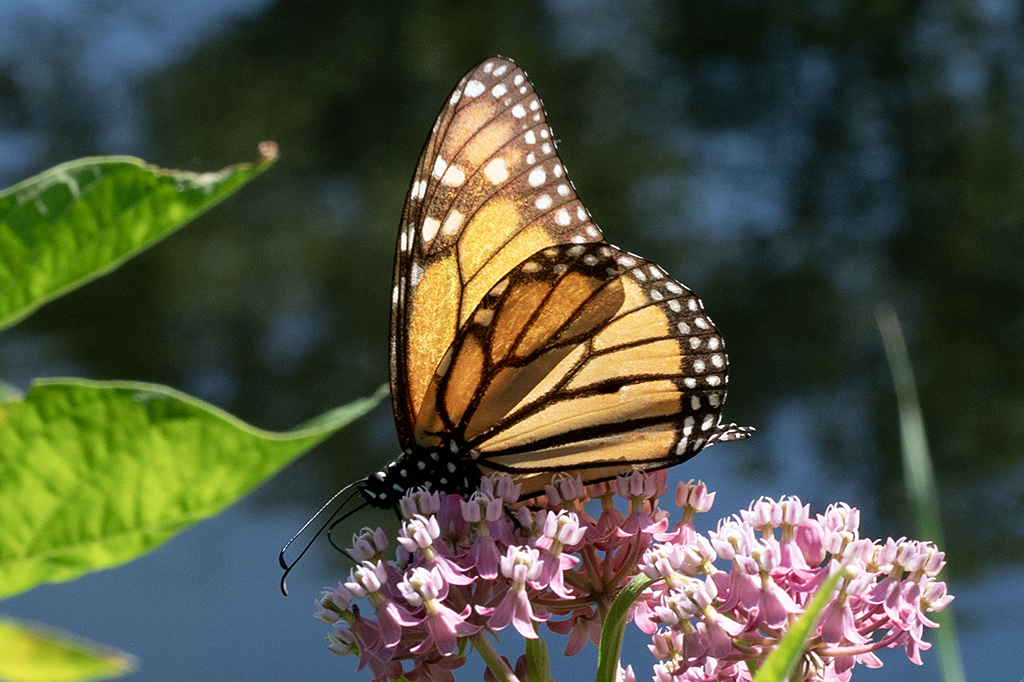
monarch butterfly (Danaus plexippus)
A female monarch butterfly taking nectar from a swamp milkweed (Asclepias incarnata); south shore of Columbia Basin.
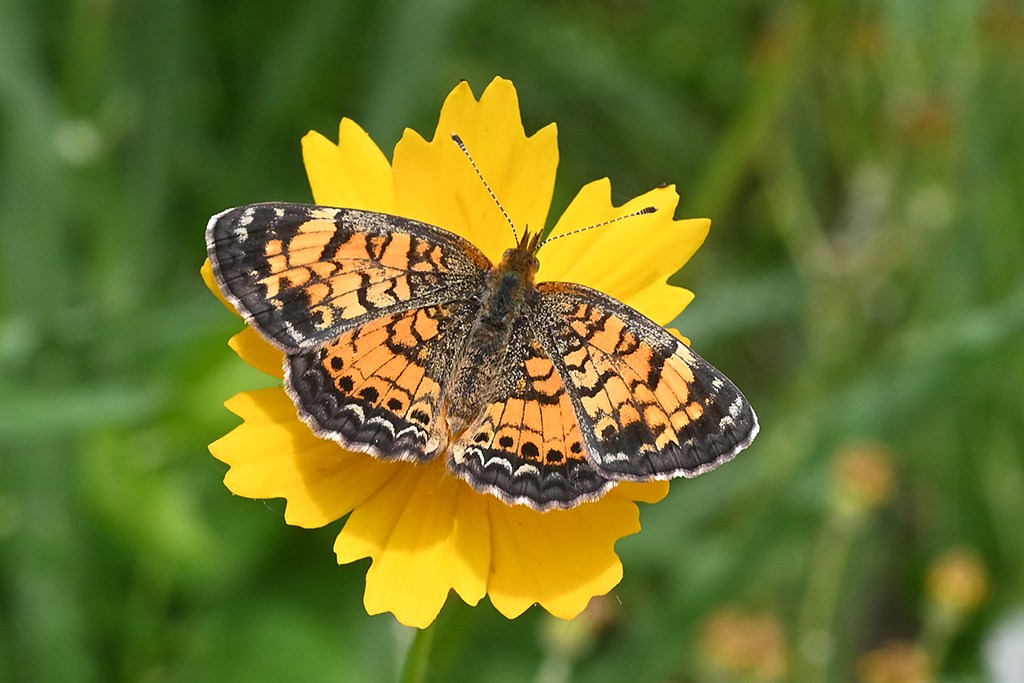
pearl crescent butterfly (Phyciodes tharos)
Pearl crescent butterfly resting on a lance-leafed coreopsis flower. (Southeast shore of East Lagoon.)
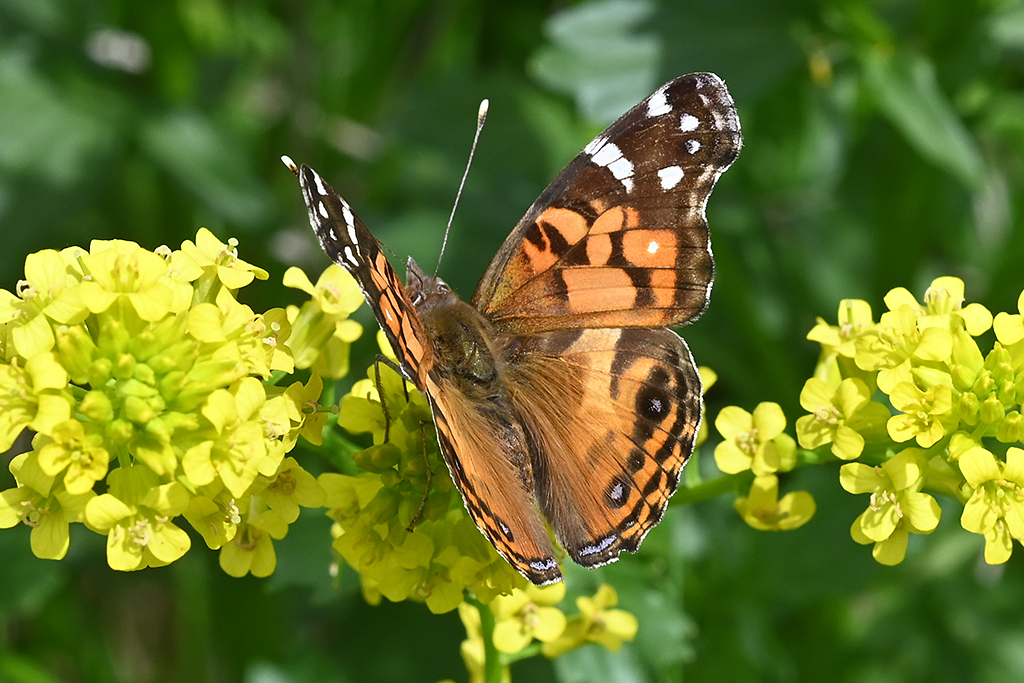
American lady (Vanessa virginiensis)
Yellow rocket (Barbarea vulgaris) flowers being pollinated by (and giving nectar to) an American lady butterfly in Bobolink Meadow.
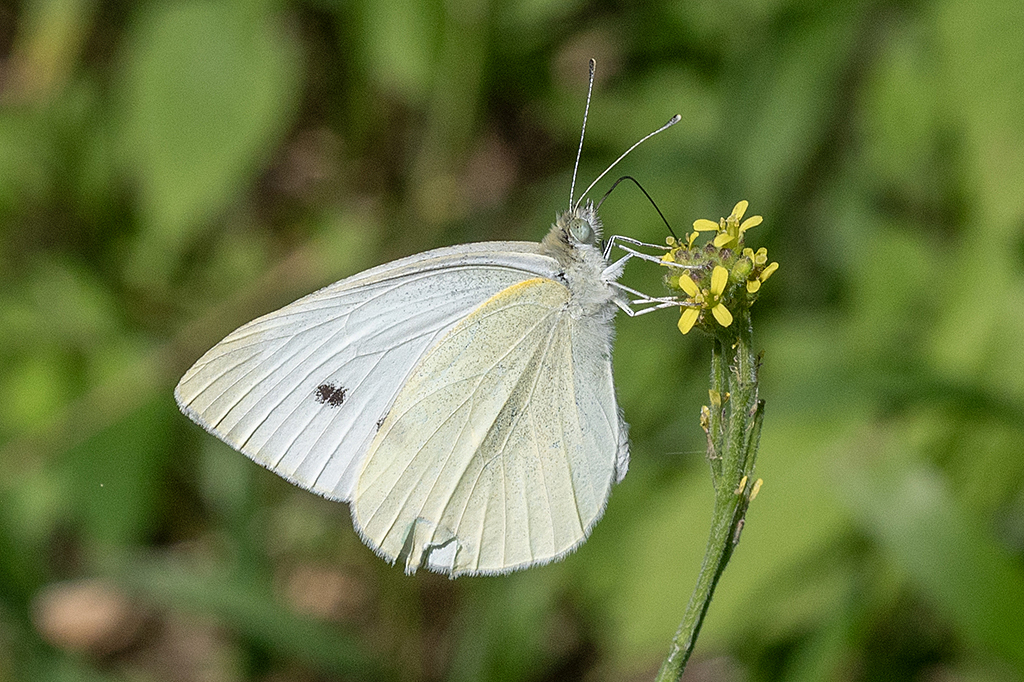
small cabbage white butterfly (Pieris rapae)
A female small cabbage white butterfly extracting nectar from hedge mustard flowers (Sisymbrium officinale). (Southwest side of Wooded Island.) The two dark dots on the forewing (one partially hidden) indicate that this is a female; the damage to the hindwing indicates that this butterfly was attacked by (and escaped from) a bird.
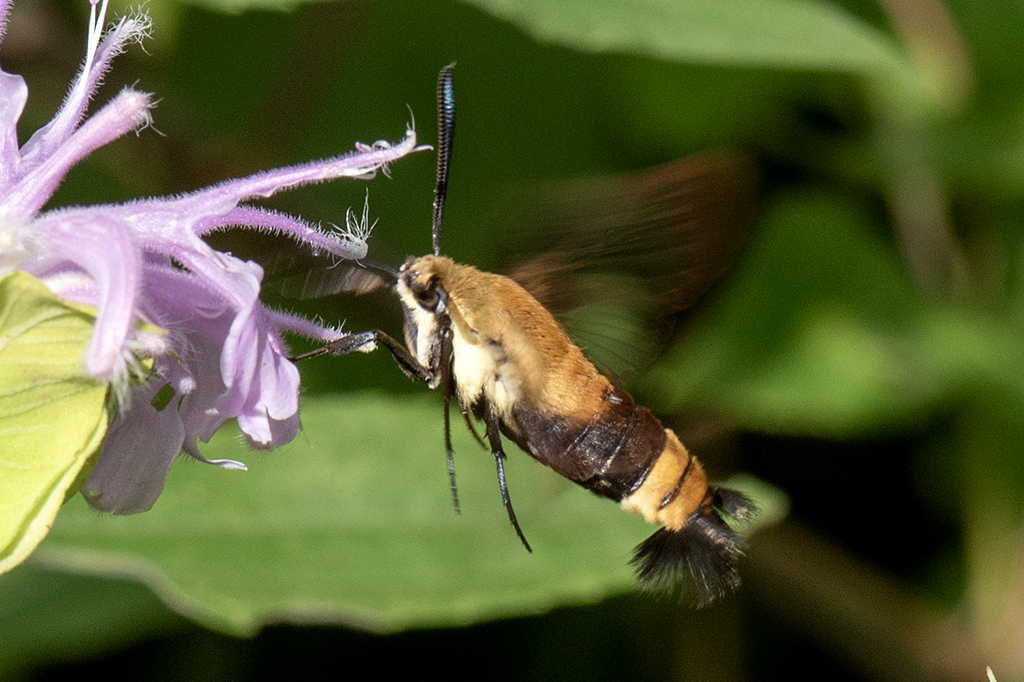
snowberry clearwing moth (Hemaris diffinis)
A snowberry clearwing moth hovering while probing the nectaries of a wild bergamot (Monarda fistulosa) inflorescence.
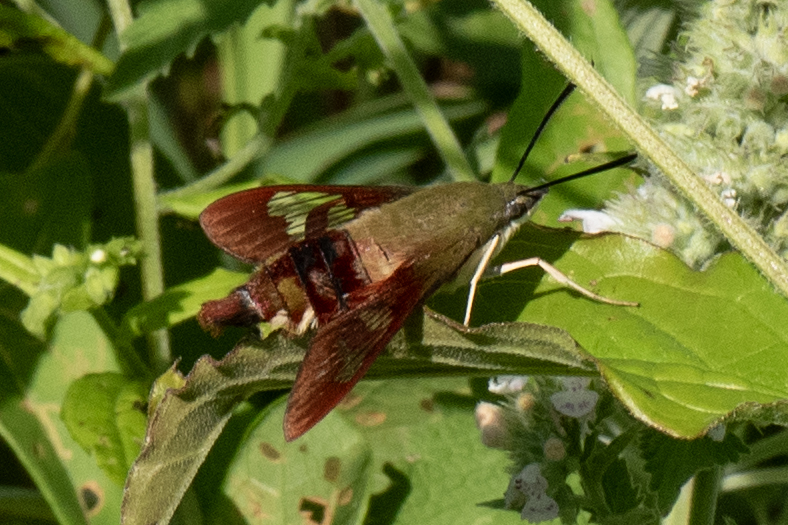
hummingbird clearwing moth (Hemaris thysbe)
A hummingbird clearwing moth resting in Bobolink Meadow.
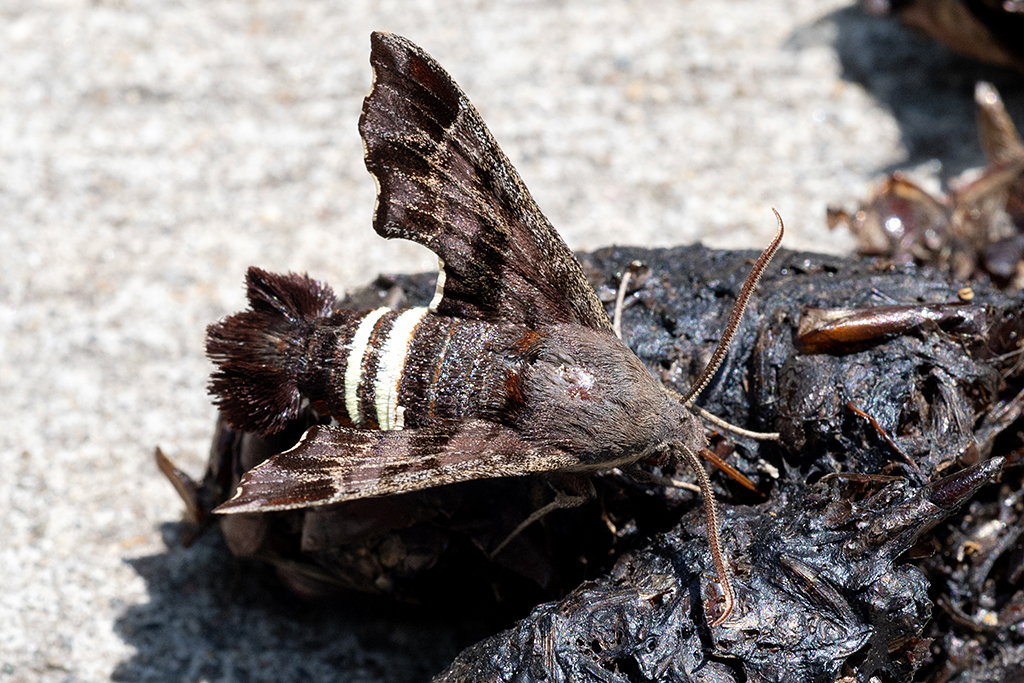
Nessus sphinx moth (Amphion floridensis)
A Nessus sphinx moth (a.k.a., hummingbird moth) feeding from some fresh coyote scat. Adult hummingbird moths are typically hovering nectar feeders but are known to feed from scat. It’s not definitively known why they do this, but it seems likely that they are trying to get salts.
Pollinators: Birds
A number of birds probably accidentally pollinate flowers as they go about their business but the only flower specialist in Jackson Park is the ruby-throated hummingbird. Hummingbirds will visit a wide variety of flowers to meet their energetic demands (met by sugar-rich nectar), but flowers that specialize on attracting hummingbirds often are bright red (a color that birds see well but that appears black to most insects) and produce nectar with a higher sugar content (too thick for butterflies to suck up) and higher amino acid content (to help meet the bird’s protein requirement). The most obvious hummingbird specialists in Jackson Park are cardinal flowers and royal catchfly.
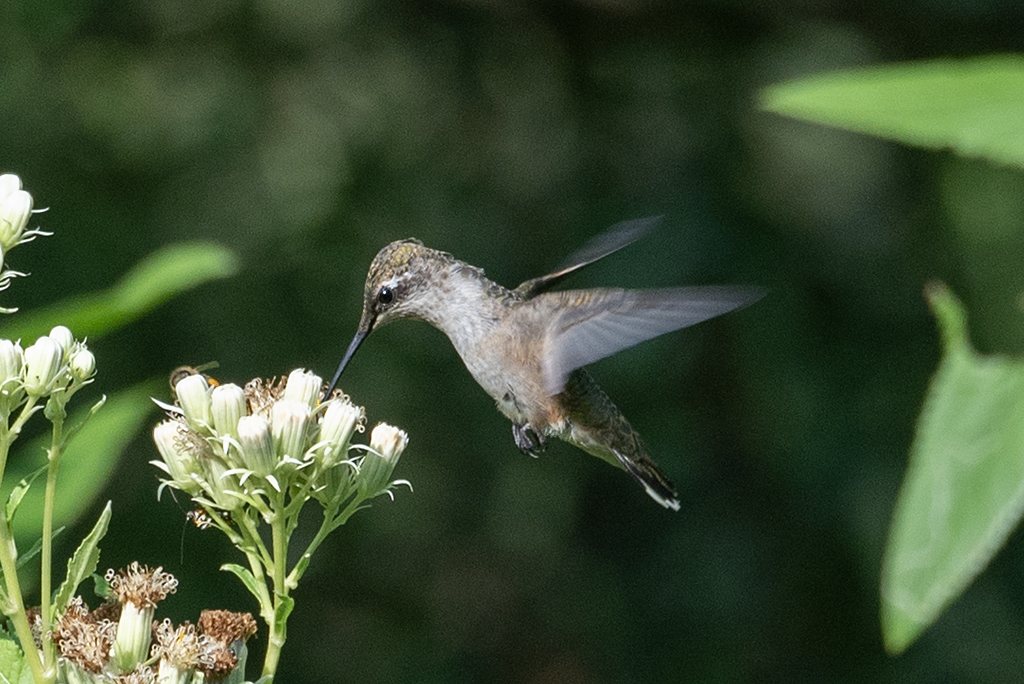
ruby-throated hummingbird (Archilochus colubris)
A female ruby-throated hummingbird visiting the inflorescence of a boneset (not a hummingbird specialist) — note the white color and the honeybee on the opposite side of the inflorescence.
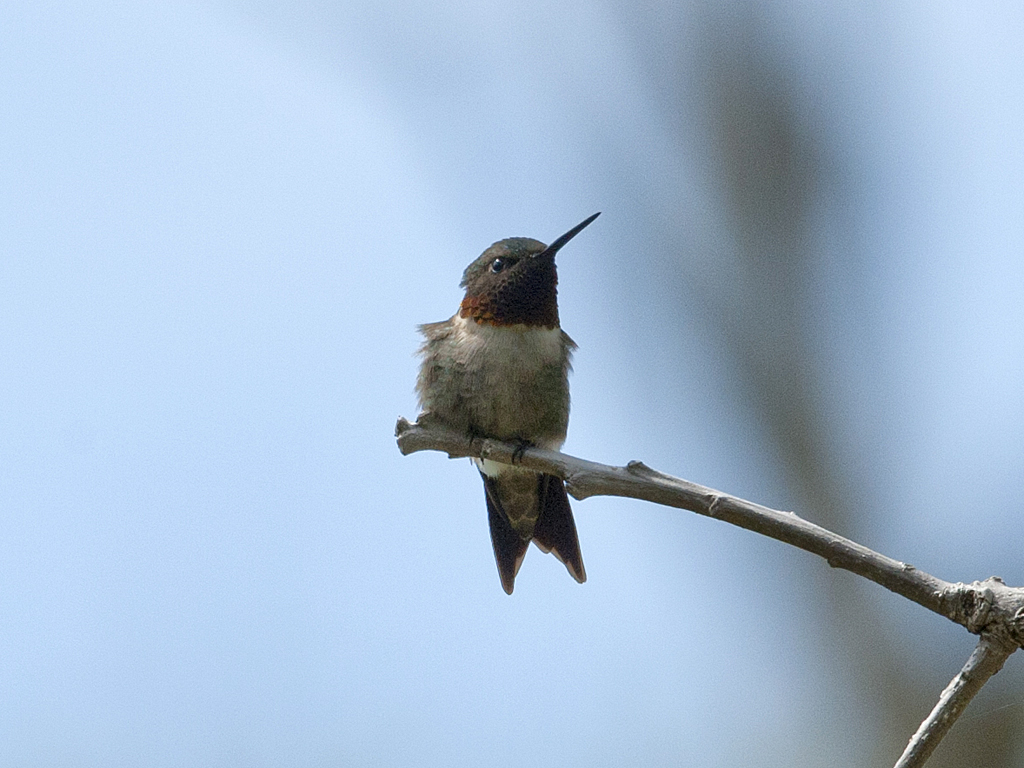
ruby-throated hummingbird, male (A. colubris)
Other animals
The following is just a taste of the other animals that share Jackson Park with the wildflowers this website highlights. I’ll add to to the images here from time to time; if I add something especially fun I’ll highlight it on the Home page.
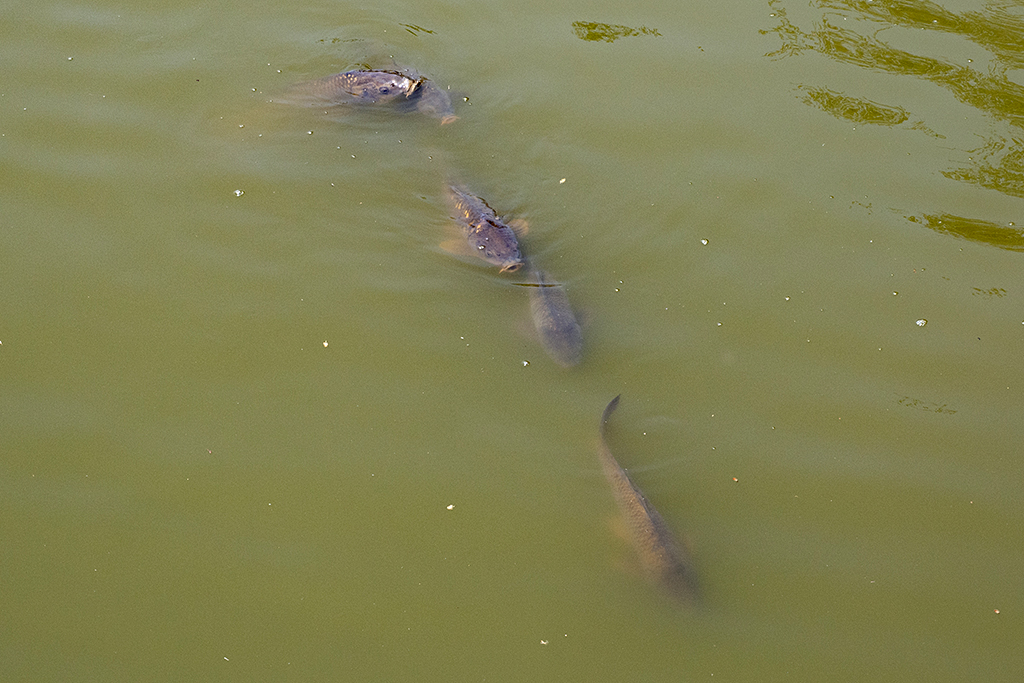
common carp (Cyprinus carpio)
Common carp were introduced to the US in 1831 and are now ubiquitous; they are (still) considered invasive. (West of Stephen’s Bridge in West Lagoon.) They get very randy in the spring and I’ve been startled more than once by the vigorous mating of carp in the shallows of the lagoons in Jackson Park.
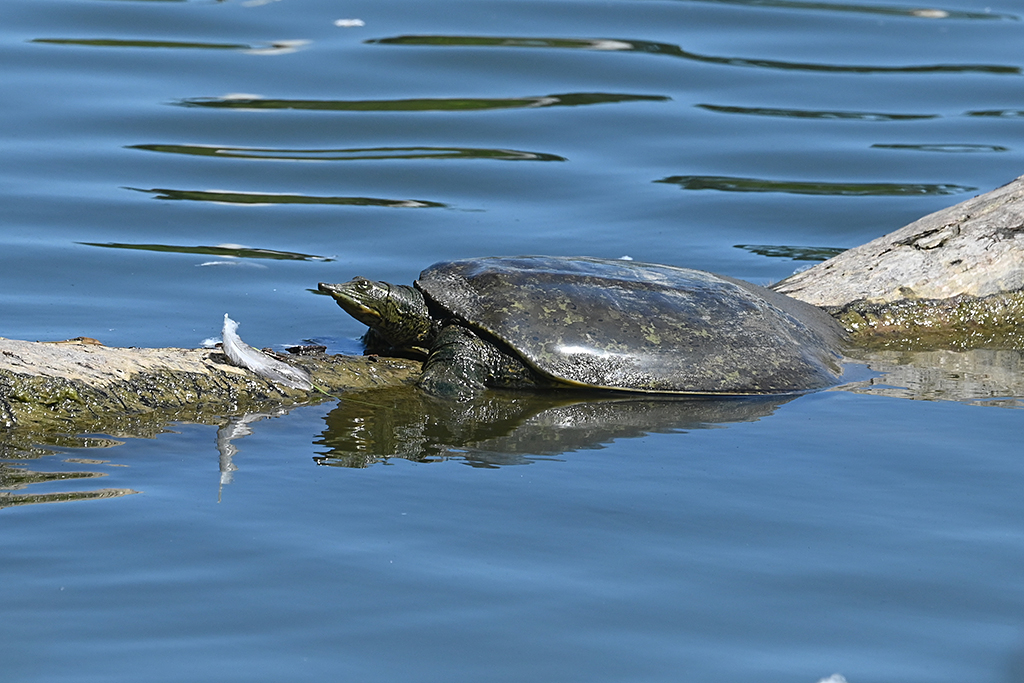
spiny softshell turtle (Apalone spinifera)
Spiny softshells are less common than the other turtles in Jackson Park (red-eared sliders and painted turtles), but they have a healthy population and a certain antediluvian charm. (East Lagoon.)
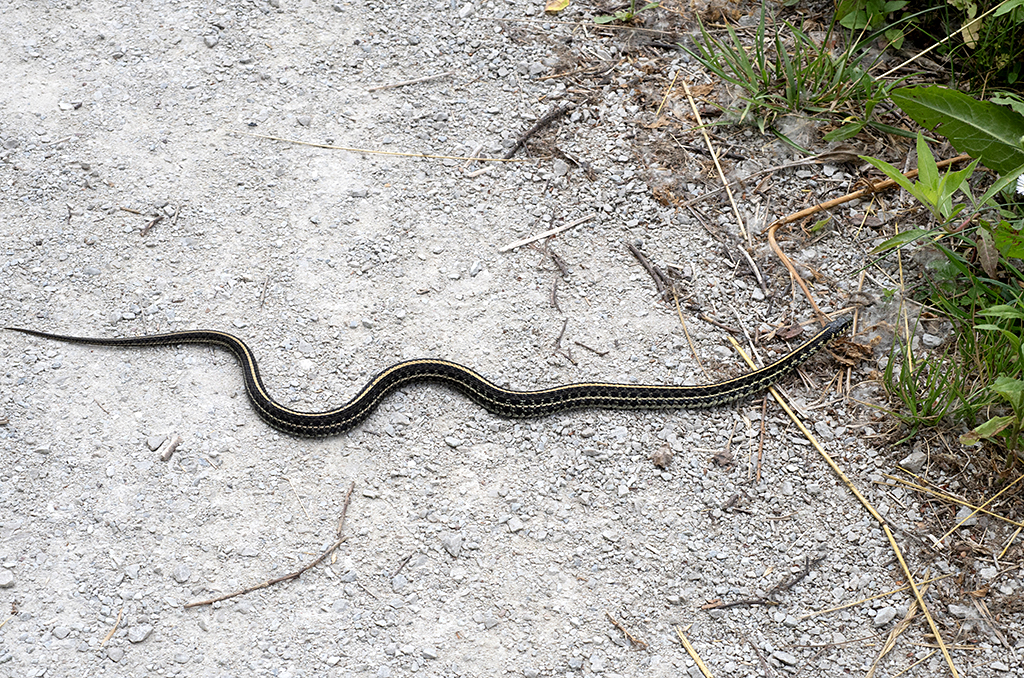
plains gartersnake (Thamnophis radix)
A male (?) plains gartersnake crossing the path on the south end of Bobolink Meadow. These are not dangerous unless you happen to be an earthworm, slug, or small amphibian.
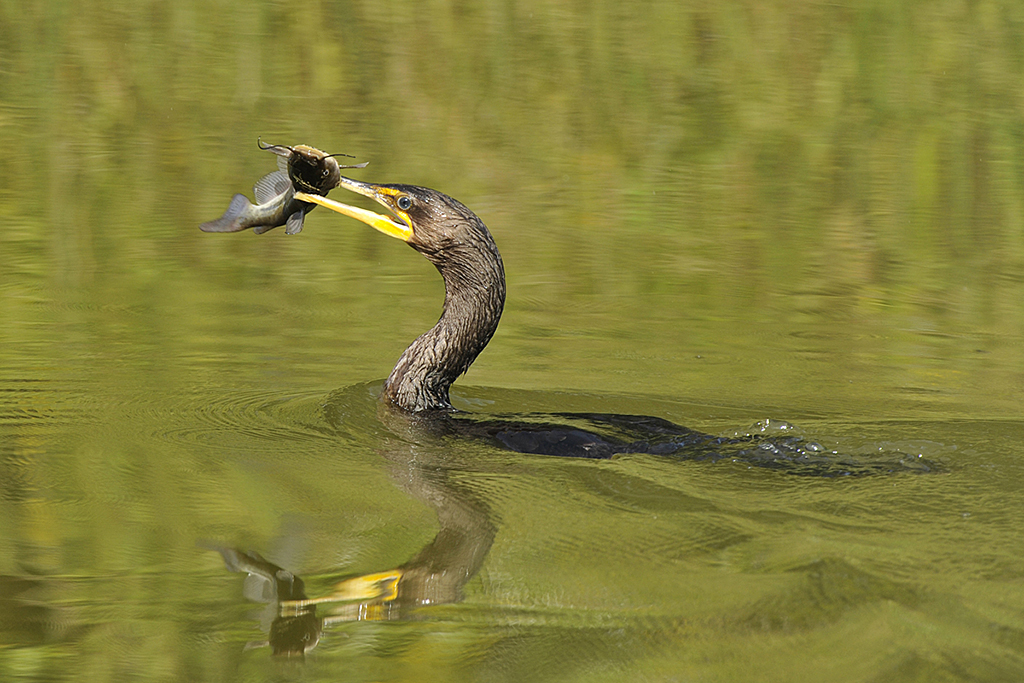
double-crested cormorant (Phalacrocorax auritus)
A double-crested cormorant in East Lagoon with a catfish that is about to be it’s dinner. The catfish is already dead, pierced by the hook on the upper bill of the cormorant. These birds are amazingly effective predators, catching fish as effortlessly as river otters.
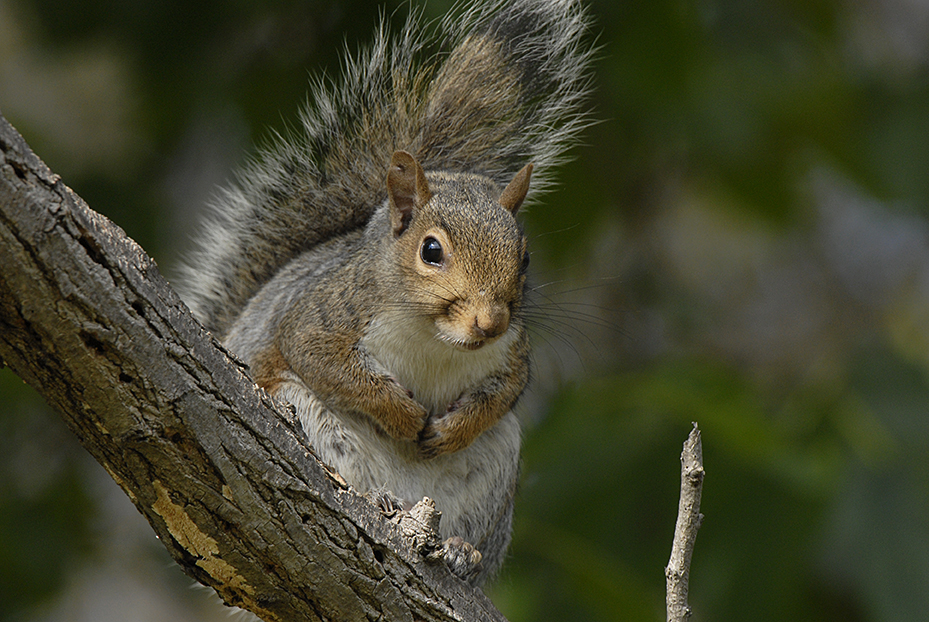
gray squirrel (Sciurus carolinensis)
A gray squirrel surveys his (her?) domain at the south edge of Columbia Basin. Gray squirrels tend to out compete other sciurids but share Jackson Park with a healthy population of chipmunks.
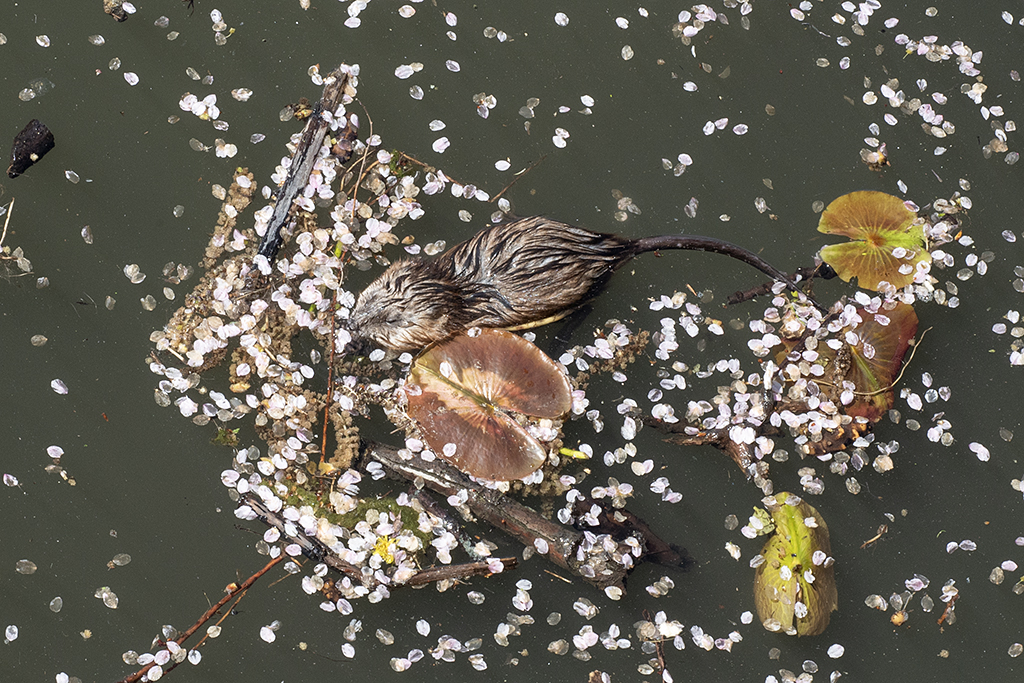
muskrat (Ondatra zibethicus)
An aerial view (no drones involved) of a gourmet muskrat eating cherry blossom petals in the spring in Columbia Basin. Even muskrats enjoy a treat now and then.
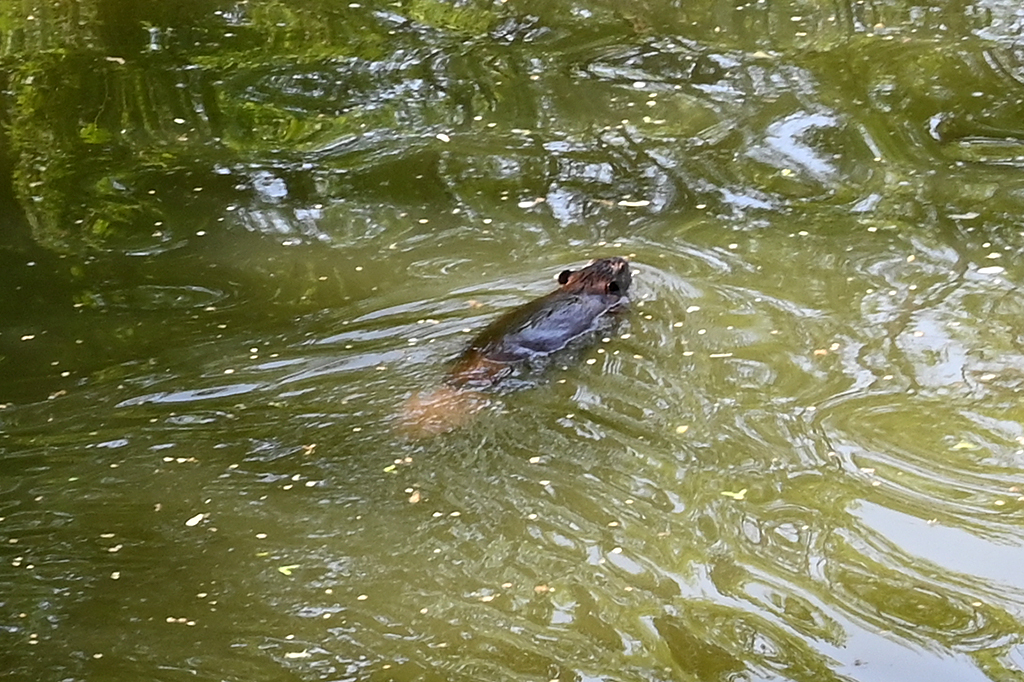
North American beaver (Castor canadensis)
A North American (as opposed to a Eurasian) beaver. Beavers, at up to 100 lbs., are the largest living rodents (other than capybaras), but the extinct Pleistocene giant beaver (genus Castoroides) reached 300 lbs. and 7 feet long. (South end of West lagoon just west of Stephen’s Bridge.) Beavers are shy and it is rare to see one this unconcerned. Note the paddle-like tail just visible as a submerged tan structure behind the animal.