Skip to content
Jackson Park WildflowersJackson Park Wildflowers
  • Home
  • Discover
    • Get Started
    • Plant Finder
    • Glossary
    • Browse by Genera
    • Other Biota — lower plants and Fungi
    • Other Biota — animals
  • Explore
    • Jackson Park — Scoreboard
  • About
  • Glossary
  • Plant Finder
  • 0
    Cart

    No products in the cart.

    Return to shop

Home / Plant Finder / Ambrosia
Filter

Showing the single result

Sorting
Filtered (1)
Filter Plants
  • Reset all×
  • Radial×
  • Spikelet×
  • 0×
Filter Plants

1 product found

Show (1)
Cancel
  • Reset all×
  • Radial×
  • Spikelet×
  • 0×
Filtered (1)
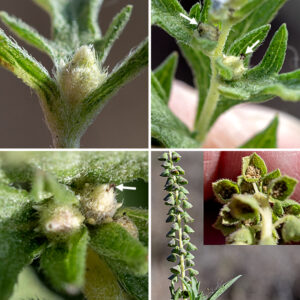
Male (staminate) and female (pistillate) flowers are physically separated on Western ragweed plants with the male flowers on spike-like racemes 1-6" long that arise from the upper stems, while female flowers occur more basally in small clusters at the base of the spike, along stems, or from leaf axils. Individual staminate flowerheads occur along the entire length of the spike, facing in all directions. They are 2-5 mm across, drooping from 1-4 mm long peduncles and developing a short, bell-like shape as they mature; they are covered by 3-5 oval, fuzzy phyllaries (bracts) in a single series where the lower half of each phyllary is fused to the other phyllaries. Beneath the phyllaries are approximately four staminate florets, each bearing five stamens with pale yellow anthers. The pistillate flowerheads are egg shaped and occur in clusters with a basal bract up to 1.25" long; pairs of smaller bracts lie just below each individual pistillate flowerhead. Pistillate flowerheads each sit in a cup of fused phyllaries 8 mm long and 3 mm across that has several tooth-like projections; each cup holds a single pistillate floret with a bifurcated style protruding from the apex of the floret. The florets are wind pollinated. Like other Ambrosia species in Jackson Park (common ragweed and giant ragweed), Western ragweed may contribute to hay fever symptoms. Western and common ragweed are similar to each other, but Western ragweed (almost always) has simple-pinnate leaves while common ragweed has double-pinnate leaves that are more deeply lobed and fern-like; Western ragweed is the hairier of the two.
Quick View

Ambrosia

Ambrosia psilostachya

Western ragweed [Blooms: ?-Nov]
Plant Finder Glossary
Discover
Explore
About

I want to acknowledge the work of a friend and colleague, Dr. Fred Donner. We both share a passion for the flowers in Jackson Park. Fred's website (jacksonparkwildflowers.org) inspired me to build my own website and database; use and enjoy them both.

I am also pleased to thank my ninja web gurus and coders, Lindsey Young and Stefanie Engstrom. This site would not exist without their herculean labors.

Copyright 2026 © Michael LaBarbera

  • Home
  • Discover
    • Get Started
    • Plant Finder
    • Glossary
    • Browse by Genera
    • Other Biota — lower plants and Fungi
    • Other Biota — animals
  • Explore
    • Jackson Park — Scoreboard
  • About
  • Login
  • Newsletter
  • Plant Finder