Skip to content
Jackson Park WildflowersJackson Park Wildflowers
  • Home
  • Discover
    • Get Started
    • Plant Finder
    • Glossary
    • Browse by Genera
    • Other Biota — lower plants and Fungi
    • Other Biota — animals
  • Explore
    • Jackson Park — Scoreboard
  • About
  • Glossary
  • Plant Finder
  • 0
    Cart

    No products in the cart.

    Return to shop

Home / Plant Finder / Packera
Filter

Showing the single result

Sorting
Filtered (1)
Filter Plants
  • Reset all×
  • 6×
  • 7×
  • Alternate×
Filter Plants

1 product found

Show (1)
Cancel
  • Reset all×
  • 6×
  • 7×
  • Alternate×
Filtered (1)
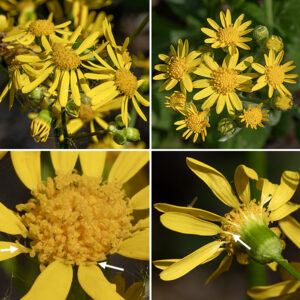
Butterweed stems produce a flattened panicle of flowers about 6" across with a single series of bracts (phyllaries) surrounding the base of the flowerhead. Individual flowerheads are 1/2" across with 5-15 yellow, narrowly-oblong pistillate ray florets and 35-50+ yellow, tubular disk florets with five apical lobes a single style that extends just past the anthers, and five stamens attached to the inside of the tubular corolla; the disk is 4-5 mm across. The fruit is a single, five-angled seed with a tuft of white hairs (like a dandelion). Butterweed contains toxic compounds (probably pyrrolizidine alkaloids) which deter most mammalian herbivores (although some domestic herbivores do eat it and suffer the consequences). According to ILW, butterweed was typically restricted to southern Illinois, with a few recent occurrences in central Illinois. Apparently, it has now made its way to Cook County. Butterweed (Packera glabella), balsam ragwort (Packera paupercula), and prairie ragwort (Packera plattensis) are easy to confuse — all bloom in the late spring/early summer and all are weedy-looking plants with yellow/golden-yellow, daisy-like flowers. With one exception, the flowers don't help to distinguish them; however,  the petals of butterweed, seen from behind, have a strap-shaped blade with 2-3 teeth at the distal end and a narrow tube (the corolla tube) about a quarter the length of the strap connecting the strap to the rest of the flower (not present in the ragworts). In general, you'll need to look carefully at the leaf shape and presence/absence and quantity of wooly fine white hairs on the leaves and stems. Butterweed has large (10" long) basal leaves; the leaves are pinnatifid with multiple semicircular lobes and a circular terminal lobe. Balsam ragwort (Packera paupercula) basal leaves are no longer than 3", the flowerheads have 0, 8, or 13 ray florets, the phyllaries behind the flowerhead are purple-tipped, and wooly hairs are usually found in the leaf axils. Prairie ragwort (Packera plattensis) is extensively covered with white wooly hairs on the stems, leaves, leaf axils, and on the phyllaries behind the flowerheads.
Quick View

Packera

Packera glabella

butterweed [Blooms: May-Jun]
Plant Finder Glossary
Discover
Explore
About

I want to acknowledge the work of a friend and colleague, Dr. Fred Donner. We both share a passion for the flowers in Jackson Park. Fred's website (jacksonparkwildflowers.org) inspired me to build my own website and database; use and enjoy them both.

I am also pleased to thank my ninja web gurus and coders, Lindsey Young and Stefanie Engstrom. This site would not exist without their herculean labors.

Copyright 2026 © Michael LaBarbera

  • Home
  • Discover
    • Get Started
    • Plant Finder
    • Glossary
    • Browse by Genera
    • Other Biota — lower plants and Fungi
    • Other Biota — animals
  • Explore
    • Jackson Park — Scoreboard
  • About
  • Login
  • Newsletter
  • Plant Finder