Skip to content
Jackson Park WildflowersJackson Park Wildflowers
  • Home
  • Discover
    • Get Started
    • Plant Finder
    • Glossary
    • Browse by Genera
    • Other Biota — lower plants and Fungi
    • Other Biota — animals
  • Explore
    • Jackson Park — Scoreboard
  • About
  • Glossary
  • Plant Finder
  • 0
    Cart

    No products in the cart.

    Return to shop

Home / Plant Finder / Potamogeton
Filter

Showing the single result

Sorting
Filtered (1)
Filter Plants
  • Reset all×
  • Brown×
  • Green×
  • Alternate×
Filter Plants

1 product found

Show (1)
Cancel
  • Reset all×
  • Brown×
  • Green×
  • Alternate×
Filtered (1)
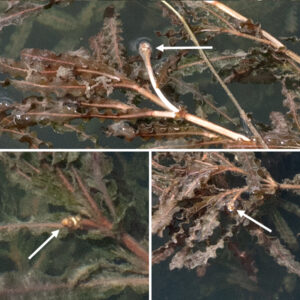
In late spring and early summer, curly pondweed produces both flowers and turions (a detachable, dormant bud, a.k.a. a "winter bud"). Cylindrical flower spikes 1-1.5" long arise from the tips of the stems or the axils of upper leaves; peduncles up to 3" long hold the flower spikes just above the water. Each flower spike may have 3-5 whorls of flowers. Individual flowers are tiny (3 mm across); they consist of four greenish-brown or greenish-red sepals, four stamens with a ladle-shaped appendage, and four ovules topped by a four-part style. Flowers may be pollinated by either wind or water. Fertilized ovules produce a dry seed (a maximum of four per flower) that is generally oval but asymmetrical in detail with a knobby keel along one edge and a long, curved beak or tooth at the opposite end. Seed germination has never been observed. Simultaneously, the plant produces turions — rosettes of small, holly-like leaves that overall have a cone-like appearance — from the tips of stems and leaf axils. After the fruits and the turions are released, the rest of the plant degenerates over the course of the summer. The turions sink to the bottom of the water body and root, forming small plants that overwinter.
Quick View

Potamogeton

Potamogeton crispus

curly pondweed [Blooms: May-?]
Plant Finder Glossary
Discover
Explore
About

I want to acknowledge the work of a friend and colleague, Dr. Fred Donner. We both share a passion for the flowers in Jackson Park. Fred's website (jacksonparkwildflowers.org) inspired me to build my own website and database; use and enjoy them both.

I am also pleased to thank my ninja web gurus and coders, Lindsey Young and Stefanie Engstrom. This site would not exist without their herculean labors.

Copyright 2026 © Michael LaBarbera

  • Home
  • Discover
    • Get Started
    • Plant Finder
    • Glossary
    • Browse by Genera
    • Other Biota — lower plants and Fungi
    • Other Biota — animals
  • Explore
    • Jackson Park — Scoreboard
  • About
  • Login
  • Newsletter
  • Plant Finder