Skip to content
Jackson Park WildflowersJackson Park Wildflowers
  • Home
  • Discover
    • Get Started
    • Plant Finder
    • Glossary
    • Browse by Genera
    • Other Biota — lower plants and Fungi
    • Other Biota — animals
  • Explore
    • Jackson Park — Scoreboard
  • About
  • Glossary
  • Plant Finder
  • 0
    Cart

    No products in the cart.

    Return to shop

Home / Plant Finder / Salix
Filter

Showing the single result

Sorting
Filtered (1)
Filter Plants
  • Reset all×
  • Green×
  • Red×
  • Alternate×
Filter Plants

1 product found

Show (1)
Cancel
  • Reset all×
  • Green×
  • Red×
  • Alternate×
Filtered (1)
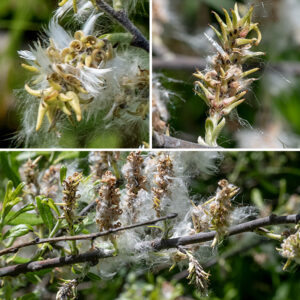
Prairie willow is dioecious — plants produce either all male or all female inflorescences in the form of short catkins produced from one-year-old branches before the leaves emerge; a tiny black or bicolored bract covered in long, dense white hairs is present at the base of both male and female catkins. The florets lack both sepals and petals but both have a basal, hairy bract (regardless of sex). Male catkins are 1/4-1.25" long, elongating as they mature. Initially the male catkins are silvery (from long hairs) but become yellow or reddish from the numerous anthers. Individual male florets consist of a hairy, basal bract and a pair of stamens with cylindrical anthers initially purple, turning yellow, red, or orange. Female catkins are 1/2-3" long, also elongating as they mature. Individual female florets consist of the hairy bract and a hairy green ovary 4-8 mm long with an elongate beak densely covered with wooly hairs; a pair of stigmas protrude from the tip. After fertilization, the female florets transform into 1/4-1/2" long capsules, light brown at maturity, that split in two to release seeds surrounded by long, cottony hairs.
Quick View

Salix

Salix humilis

prairie willow [Blooms: Apr-May]
Plant Finder Glossary
Discover
Explore
About

I want to acknowledge the work of a friend and colleague, Dr. Fred Donner. We both share a passion for the flowers in Jackson Park. Fred's website (jacksonparkwildflowers.org) inspired me to build my own website and database; use and enjoy them both.

I am also pleased to thank my ninja web gurus and coders, Lindsey Young and Stefanie Engstrom. This site would not exist without their herculean labors.

Copyright 2026 © Michael LaBarbera

  • Home
  • Discover
    • Get Started
    • Plant Finder
    • Glossary
    • Browse by Genera
    • Other Biota — lower plants and Fungi
    • Other Biota — animals
  • Explore
    • Jackson Park — Scoreboard
  • About
  • Login
  • Newsletter
  • Plant Finder