Skip to content
Jackson Park WildflowersJackson Park Wildflowers
  • Home
  • Discover
    • Get Started
    • Plant Finder
    • Glossary
    • Browse by Genera
    • Other Biota — lower plants and Fungi
    • Other Biota — animals
  • Explore
    • Jackson Park — Scoreboard
  • About
  • Glossary
  • Plant Finder
  • 0
    Cart

    No products in the cart.

    Return to shop

Home / Plant Finder / Xanthium
Filter

Showing the single result

Sorting
Filtered (1)
Filter Plants
  • Reset all×
  • White×
  • Alternate×
Filter Plants

1 product found

Show (1)
Cancel
  • Reset all×
  • White×
  • Alternate×
Filtered (1)
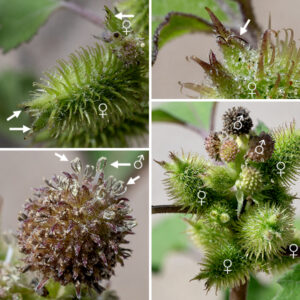
Common cocklebur produces a spike-like raceme of compound flowerheads, shorter than the leaf petioles, that arises from the axils of each upper leaf and from the tip of the central stem. Each raceme produces exclusively male flowerheads in its upper parts and exclusively female flowerheads in the lower regions. The male flowerheads are about 1/4-3/4" across, elevated on a short pedicel on top of 1-3 series of white floral bracts. Each of the approximately 20 tiny, brownish-green staminate florets (nominally disk florets) consist of a tubular 1-2 mm long corolla; a minute, non-functional ovary; and five stamens with fused filaments (like a tree trunk) but with their white anthers free, positioned in a ring like a little palm tree or, possibly, a hand. The staminate florets quickly shed their pollen and drop off. The female flowerheads (also nominally disk florets) are 3/4-1.5" long and two-thirds as wide, stalkless, each (usually) containing two female florets nearly enclosed by floral bracts covered with curly white hairs that have a bur-like appearance from the dense, hooked prickles covering their surface. At the tip of the flowerhead are two spines, longer and much stouter than the prickles, each with a hole from which protrudes the divided style of a female floret. There is no corolla in the female florets. The florets are wind pollinated, and their styles quickly wither away after fertilization. Each female floret produces a single, oblong, dark gray to black seed 3/8-1/2" long, tapering to a point at each end and covered by dark membranes, all buried in the bur-like bract. The female flowerhead stiffens through the autumn, turns brown, and overwinters. The seeds are highly poisonous, containing toxic diterpene glycosides. One of the contained seeds germinates the following year; the other delays germination for two years. Common cocklebur prefers wet, sandy soils.
Quick View

Xanthium

Xanthium strumarium

common cocklebur [Blooms: Sep-?]
Plant Finder Glossary
Discover
Explore
About

I want to acknowledge the work of a friend and colleague, Dr. Fred Donner. We both share a passion for the flowers in Jackson Park. Fred's website (jacksonparkwildflowers.org) inspired me to build my own website and database; use and enjoy them both.

I am also pleased to thank my ninja web gurus and coders, Lindsey Young and Stefanie Engstrom. This site would not exist without their herculean labors.

Copyright 2026 © Michael LaBarbera

  • Home
  • Discover
    • Get Started
    • Plant Finder
    • Glossary
    • Browse by Genera
    • Other Biota — lower plants and Fungi
    • Other Biota — animals
  • Explore
    • Jackson Park — Scoreboard
  • About
  • Login
  • Newsletter
  • Plant Finder