Skip to content
Jackson Park WildflowersJackson Park Wildflowers
  • Home
  • Discover
    • Get Started
    • Plant Finder
    • Glossary
    • Browse by Genera
    • Other Biota — lower plants and Fungi
    • Other Biota — animals
  • Explore
    • Jackson Park — Scoreboard
  • About
  • Glossary
  • Plant Finder
  • 0
    Cart

    No products in the cart.

    Return to shop

Home / Plant Finder / Silene
Filter

Showing the single result

Sorting
Filtered (1)
Filter Plants
  • Reset all×
  • Pink×
  • White×
  • Opposite×
Filter Plants

1 product found

Show (1)
Cancel
  • Reset all×
  • Pink×
  • White×
  • Opposite×
Filtered (1)
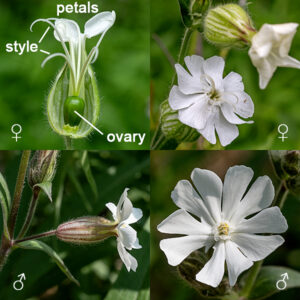
Evening campion is an exotic from Europe that grows to be 2-3' tall. It is nominally a night-blooming species, but I've observed it in bloom throughout the day in shady areas. Male and female plants are separate. The upper stems end in clusters of one or more 1-1.5" long flowers. The "bladder" (the calyx) is covered with a fuzz of fine hairs and has dark green or reddish-purple lines running from pole to pole (10 lines in male flowers, 20 in female). The five petals are heart shaped (with the point towards the center of the flower) and are deeply cleft into two lobes; the petals form a fringe that makes a distinct collar around the opening to the floral tube. Female flowers have five emergent styles (rarely four or six); male flowers have 10 yellow stamens that barely emerge from the collar at the center of the flower. (Other local Silene sp. have three styles.) The fruit is brown, urn-shaped, and has 10 small teeth on the distal end (or five pairs if you prefer). (Five or six teeth total in S. noctiflora, S. stellata, and S. vulgaris.) Evening campion evolved a dioecious life history (separate male and female plants) about 11 million years ago. (Other species in the genus have "perfect" flowers with both male and female organs present and functional in the flowers.) The evolution and genomic history of the sex-determining Y chromosome (XX = female, XY = male) has been of considerable interest for the light it shines on the evolution of Y chromosomes in both plants and animals (Moraga et al. 2025. Science 387:630–636; Akagi et al. 2025. Science 387:637–643).
Quick View

Silene

Silene latifolia

evening campion [Blooms: May-Aug]
Plant Finder Glossary
Discover
Explore
About

I want to acknowledge the work of a friend and colleague, Dr. Fred Donner. We both share a passion for the flowers in Jackson Park. Fred's website (jacksonparkwildflowers.org) inspired me to build my own website and database; use and enjoy them both.

I am also pleased to thank my ninja web gurus and coders, Lindsey Young and Stefanie Engstrom. This site would not exist without their herculean labors.

Copyright 2026 © Michael LaBarbera

  • Home
  • Discover
    • Get Started
    • Plant Finder
    • Glossary
    • Browse by Genera
    • Other Biota — lower plants and Fungi
    • Other Biota — animals
  • Explore
    • Jackson Park — Scoreboard
  • About
  • Login
  • Newsletter
  • Plant Finder