Silene latifolia

evening campion [Blooms: May-Aug]
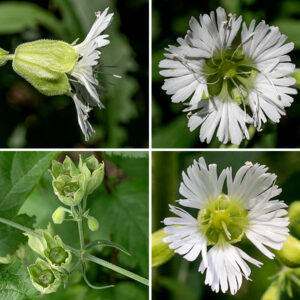
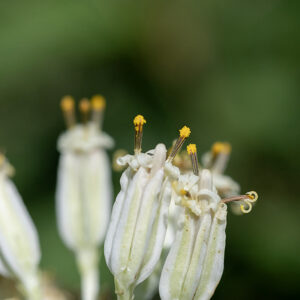
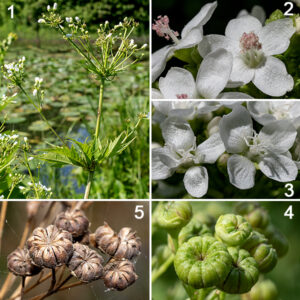
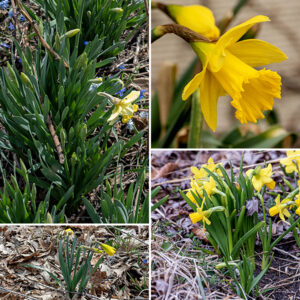
Evening campion is an exotic from Europe that grows to be 2-3' tall. It is nominally a night-blooming species, but I've observed it in bloom throughout the day in shady areas. Male and female plants are separate. The upper stems end in clusters of one or more 1-1.5" long flowers. The "bladder" (the calyx) is covered with a fuzz of fine hairs and has dark green or reddish-purple lines running from pole to pole (10 lines in male flowers, 20 in female). The five petals are heart shaped (with the point towards the center of the flower) and are deeply cleft into two lobes; the petals form a fringe that makes a distinct collar around the opening to the floral tube. Female flowers have five emergent styles (rarely four or six); male flowers have 10 yellow stamens that barely emerge from the collar at the center of the flower. (Other local Silene sp. have three styles.) The fruit is brown, urn-shaped, and has 10 small teeth on the distal end (or five pairs if you prefer). (Five or six teeth total in S. noctiflora, S. stellata, and S. vulgaris.) Evening campion evolved a dioecious life history (separate male and female plants) about 11 million years ago. (Other species in the genus have "perfect" flowers with both male and female organs present and functional in the flowers.) The evolution and genomic history of the sex-determining Y chromosome (XX = female, XY = male) has been of considerable interest for the light it shines on the evolution of Y chromosomes in both plants and animals (Moraga et al. 2025. Science 387:630–636; Akagi et al. 2025. Science 387:637–643).
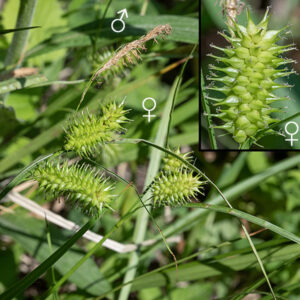
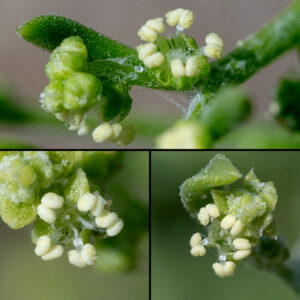
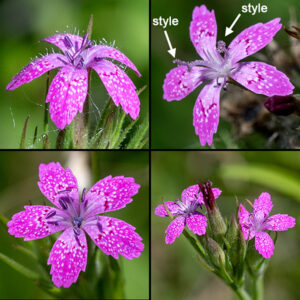
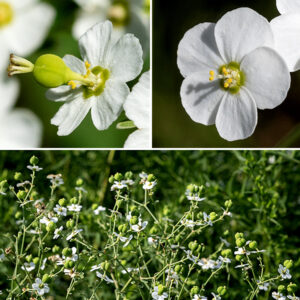
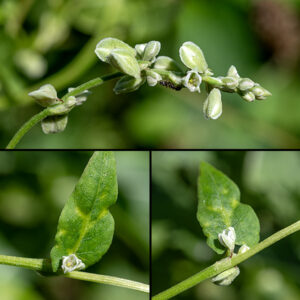
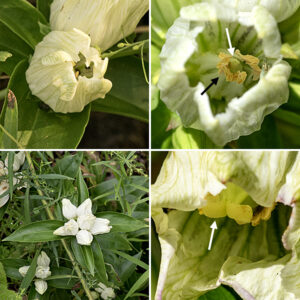
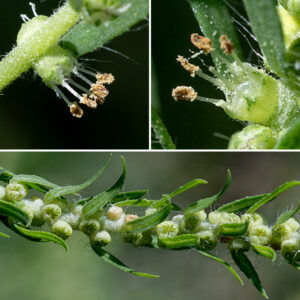
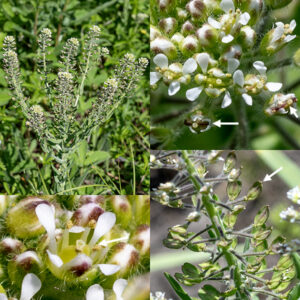
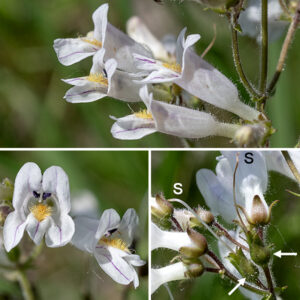
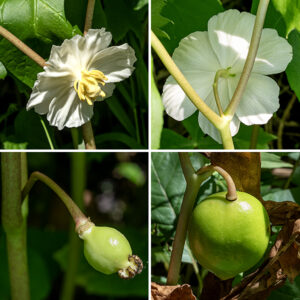
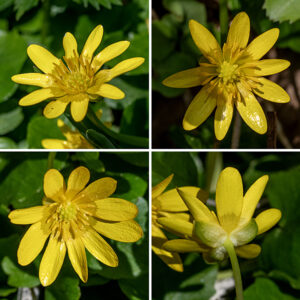
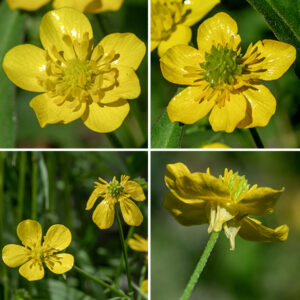
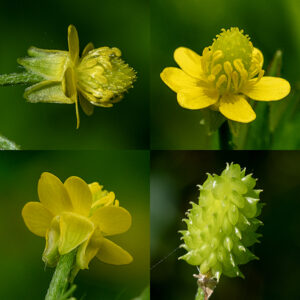
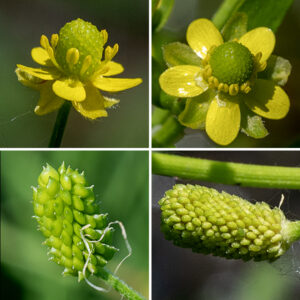
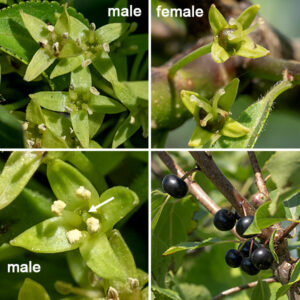
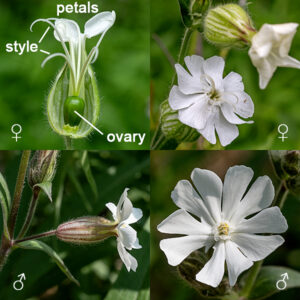
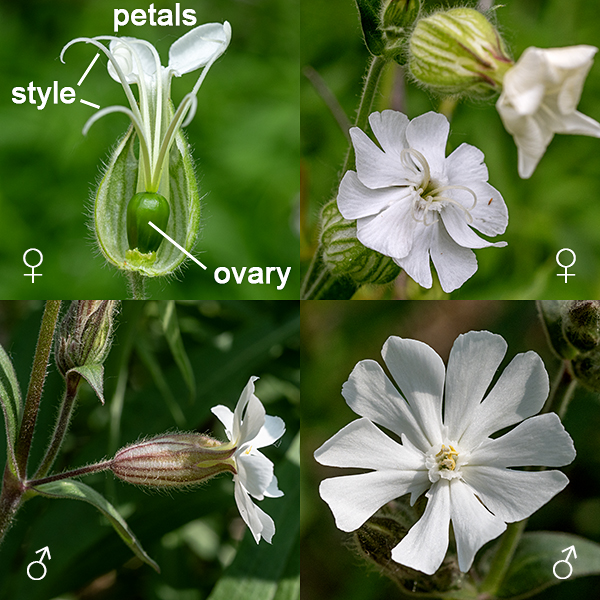
Evening campion (Silene latifolia) flowers. Bottom: frontal view (right) and lateral view (left) of male evening campion flowers. In the image on the right, note the yellow anthers just barely emerging from the throat of the flower. Top right: three-quarters view of a female evening campion flower with a lateral view of another flower in the background. The flower in the foreground has narrow, cylindrical styles emerging well outside the throat of the flower. (This flower is an unusual case — it has six rather than the usual five styles.) Top left: a female evening campion flower with half the bladder dissected away to show the ovary and the styles emerging from the apex of the ovary.
Evening campion is an exotic from Europe that grows to be 2-3 feet tall. It is nominally a night-blooming species, but I’ve observed it in bloom throughout the day in shady areas. Male and female plants are separate. The upper stems end in clusters of one or more 1-1.5″ long flowers. The “bladder” (the calyx) is covered with a fuzz of fine hairs and has dark green or reddish-purple lines running from pole to pole (10 lines in male flowers, 20 in female). The five petals are heart shaped (with the point towards the center of the flower) and are deeply cleft into two lobes; the petals form a fringe that makes a distinct collar around the opening to the floral tube. Female flowers have five emergent styles (rarely four or six); male flowers have 10 yellow stamens that barely emerge from the collar at the center of the flower. (Other local Silene sp. have three styles.) The fruit is brown, urn-shaped, and has 10 small teeth on the distal end (or five pairs if you prefer). (Five or six teeth total in S. noctiflora, S. stellata, and S. vulgaris.) Evening campion evolved a dioecious life history (separate male and female plants) about 11 million years ago. (Other species in the genus have “perfect” flowers with both male and female organs present and functional in the flowers.) The evolution and genomic history of the sex-determining Y chromosome (XX = female, XY = male) has been of considerable interest for the light it shines on the evolution of Y chromosomes in both plants and animals (Moraga et al. 2025. Science 387:630-€“636; Akagi et al. 2025. Science 387:637-€“643).
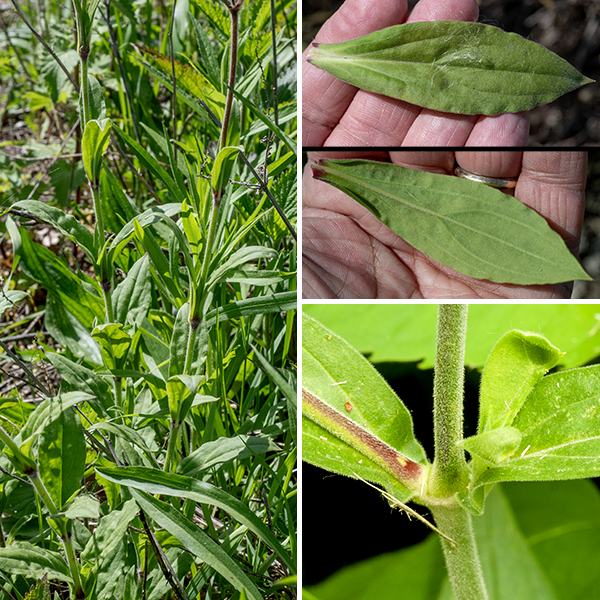
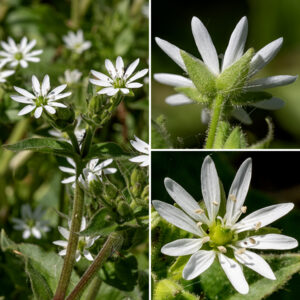
Evening campion is an exotic from Europe that grows to be 2-3' tall. It is nominally a night-blooming species, but I've observed it in bloom throughout the day in shady areas. The stems are round in section, light green, and covered with fine, white hairs. The basal leaves have a long petiole but usually wither before blooming begins. The stem leaves are opposite, light to medium green, oval to lance-shaped, up to 4" long and 2.25" across. The stem leaves are more or less sessile, covered with short, fine hairs, and with smooth margins. (Silene noctiflora has similar hairs on its stem and leaves, S. vulgaris lacks them.)
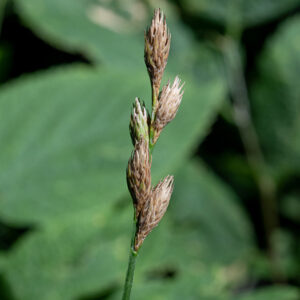
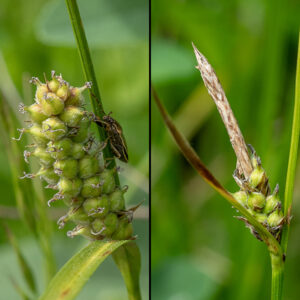
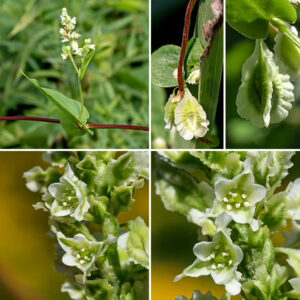
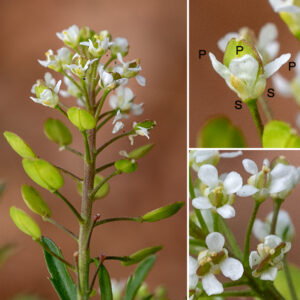
Evening campion (Silene latifolia) stems and leaves. Left: two evening campion plants with their attached stem leaves. Bottom right: close-up of a leaf node. Note the short but dense white hairs on both the stem and the branch on the left. Top right: a single leaf showing the top surface of the leaf (upper image) and the underside of the same leaf (lower image). Note that the white thread-like filaments on the middle of the leaf in the upper image is cottonwood fluff; it has nothing to do with evening campion.
Evening campion is an exotic from Europe that grows to be 2-3 feet tall. It is nominally a night-blooming species, but I’ve observed it in bloom throughout the day in shady areas. The stems are round in section, light green, and covered with fine, white hairs. The basal leaves have a long petiole but usually wither before blooming begins. The stem leaves are opposite, light to medium green, oval to lance-shaped, up to 4″ long and 2.25″ across. The stem leaves are more or less sessile, covered with short, fine hairs, and with smooth margins. (Silene noctiflora has similar hairs on its stem and leaves; S. vulgaris lacks them.)
Evening campion is an exotic from Europe that grows to be 2-3' tall. It is nominally a night-blooming species, but I've observed it in bloom throughout the day in shady areas. The stems are round in section, light green, and covered with fine, white hairs. The basal leaves have a long petiole but usually wither before blooming begins. The stem leaves are opposite, light to medium green, oval to lance-shaped, up to 4" long and 2.25" across. The stem leaves are more or less sessile, covered with short, fine hairs, and with smooth margins. (Silene noctiflora has similar hairs on its stem and leaves, S. vulgaris lacks them.) Male and female plants are separate. The upper stems end in clusters of one or more 1-1.5" long flowers. The "bladder" (the calyx) is covered with a fuzz of fine hairs and has dark green or reddish-purple lines running from pole to pole (10 lines in male flowers, 20 in female). The five petals are heart shaped (with the point towards the center of the flower) and are deeply cleft into two lobes; the petals form a fringe that makes a distinct collar around the opening to the floral tube. Female flowers have five emergent styles (rarely four or six); male flowers have 10 yellow stamens that barely emerge from the collar at the center of the flower. (Other local Silene sp. have three styles.) The fruit is brown, urn-shaped, and has 10 small teeth on the distal end (or five pairs if you prefer). (Five or six teeth total in S. noctiflora, S. stellata, and S. vulgaris.) Evening campion evolved a dioecious life history (separate male and female plants) about 11 million years ago. (Other species in the genus have "perfect" flowers with both male and female organs present and functional in the flowers.) The evolution and genomic history of the sex-determining Y chromosome (XX = female, XY = male) has been of considerable interest for the light it shines on the evolution of Y chromosomes in both plants and animals (Moraga et al. 2025. Science 387:630–636; Akagi et al. 2025. Science 387:637–643).
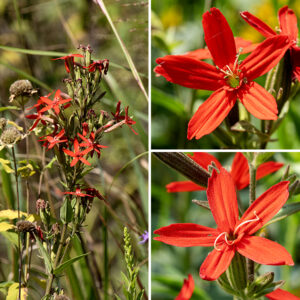
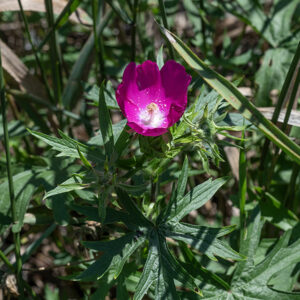
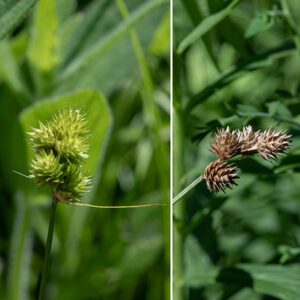
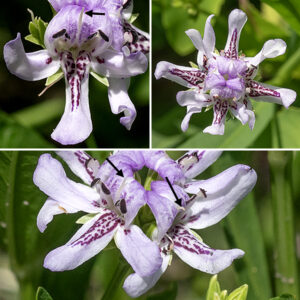
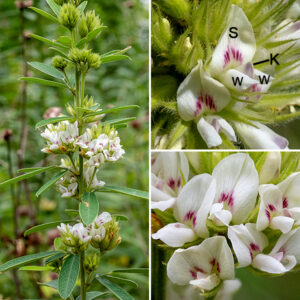
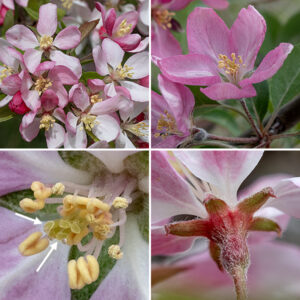
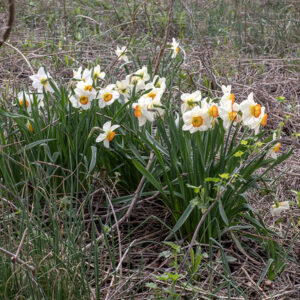
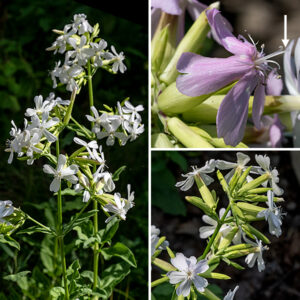
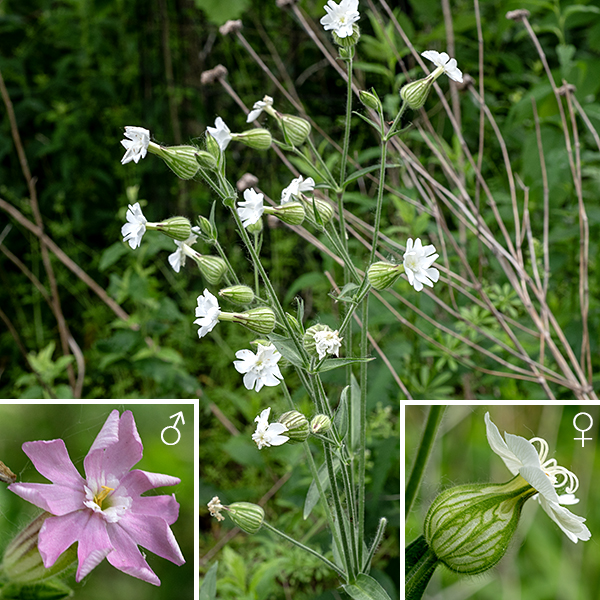
An evening campion (Silene latifolia) plant growing on the west side of Wooded Island. This is a female plant with all-female flowers. The inserts show a lateral view of a female flower with arching styles emerging from the flower (lower right) and a three-quarters view of a male flower (lower left) with yellow anthers just outside the throat. The petals of this unusual variant are pink rather than the much more common white.
Evening campion is an exotic from Europe that grows to be 2-3 feet tall. It is nominally a night-blooming species, but I’ve observed it in bloom throughout the day in shady areas. The stems are round in section, light green, and covered with fine, white hairs. The basal leaves have a long petiole but usually wither before blooming begins. The stem leaves are opposite, light to medium green, oval to lance-shaped, up to 4″ long and 2.25″ across. The stem leaves are more or less sessile, covered with short, fine hairs, and with smooth margins. (Silene noctiflora has similar hairs on its stem and leaves; S. vulgaris lacks them.) Male and female plants are separate. The upper stems end in clusters of one or more 1-1.5″ long flowers. The “bladder” (the calyx) is covered with a fuzz of fine hairs and has dark green or reddish-purple lines running from pole to pole (10 lines in male flowers, 20 in female). The five petals are heart shaped (with the point towards the center of the flower) and are deeply cleft into two lobes; the petals form a fringe that makes a distinct collar around the opening to the floral tube. Female flowers have five emergent styles (rarely four or six); male flowers have 10 yellow stamens that barely emerge from the collar at the center of the flower. (Other local Silene sp. have three styles.) The fruit is brown, urn-shaped, and has 10 small teeth on the distal end (or five pairs if you prefer). (Five or six teeth total in S. noctiflora, S. stellata, and S. vulgaris.) Evening campion evolved a dioecious life history (separate male and female plants) about 11 million years ago. (Other species in the genus have “perfect” flowers with both male and female organs present and functional in the flowers.) The evolution and genomic history of the sex-determining Y chromosome (XX = female, XY = male) has been of considerable interest for the light it shines on the evolution of Y chromosomes in both plants and animals (Moraga et al. 2025. Science 387:630-€“636; Akagi et al. 2025. Science 387:637-€“643).
Browse more plants
Want to keep exploring more plants? You can view other plants like this one by selecting a characteristic from the list below, or 'browse more plants' to go back to the Plant Finder.
Click me

velvetleaf [Blooms: Jul-Sep]

boxelder [Blooms: Apr-May]

red maple [Blooms: Apr–?]

yarrow [Blooms: May-Jun]

American sweet-flag [Blooms: May-Jun]

Aesculus

Aesculus glabra

Ohio buckeye [Blooms: Apr/May–?]

bottlebrush buckeye [Blooms: Jul-Aug]

slender false foxglove [Blooms: Aug-Sep]

blue giant hyssop [Blooms: Jul-Aug]

yellow giant hyssop [Blooms: Jul-?]

purple giant hyssop [Blooms: Jul-Aug]

white snakeroot [Blooms: Jul-Nov]

swamp agrimony [Blooms: Aug-?]

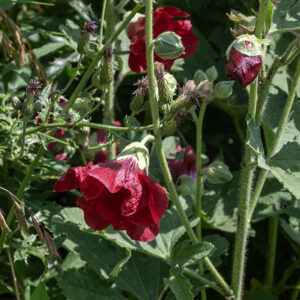
hollyhock [Blooms: Jul-?]

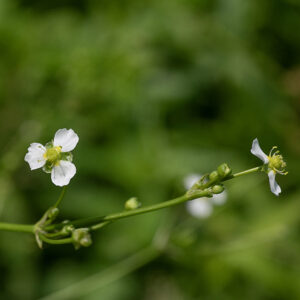
northern water-plantain [Blooms: Jun-Aug]

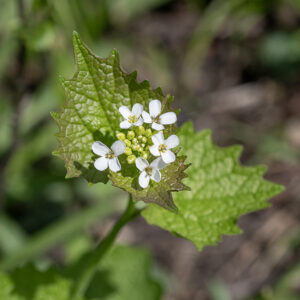
garlic mustard [Blooms: Apr-Jul]

wild garlic [Blooms: Jun-?]

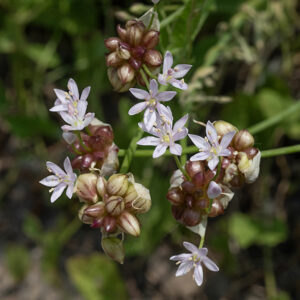
nodding onion [Blooms: Jul/Aug–?]

green/red amaranth [Blooms: Sep-?]

Amaranthus

Amaranthus palmeri

Palmer's amaranth [Blooms: Aug–?]

redroot amaranth [Blooms: Aug-Oct]

common ragweed [Blooms: Aug-?]

Western ragweed [Blooms: ?-Nov]

great ragweed [Blooms: Aug-Sep]

Amelanchier

Amelanchier arborea

downy serviceberry [Blooms: Apr-May]

Wiegand's shadbush [Blooms: Apr-May]

marram grass [Blooms: Jul-?]

lead plant [Blooms: Jun-Sep]

sharp-lobed hepatica [Blooms: Apr]

Canada anemone [Blooms: May–Oct]

thimbleweed [Blooms: Jun-Jul]

wood anemone [Blooms: Apr–May]

tall anemone [Blooms: Jun–?]

field pussytoes [Blooms: Apr-May]

plaintain-leafed pussytoes [Blooms: Apr-May]

common dogbane [Blooms: Jun-Aug]

red columbine [Blooms: Apr-Jun]

common columbine [Blooms:May-Jun]

Aralia

Aralia elata

Japanese angelica tree [Blooms: Jul/Aug–?]

spikenard [Blooms: Jul-Aug]

devil's walking stick [Blooms: Aug-Sep]

Arctium

Arctium minus

burdock [Blooms: Jul-Oct]

Arctostaphylos

Arctostaphylos uva-ursi

bearberry [Blooms: April]

thyme-leaved sandwort [Blooms: Apr-Jun]

Jack-in-the-pulpit [Blooms: Apr-Jun]

pale Indian-plantain [Blooms: Jun-Aug]

prairie Indian-plantain [Blooms: Jun-Jul]

red chokeberry [Blooms: Apr-May]

black chokeberry [Blooms: May-?]

beach wormwood [Blooms: Aug-Sep]

mugwort [Blooms: Jul-Oct]

wild ginger [Blooms: Apr/May-?]

prairie milkweed [Blooms: Jun-Aug]

swamp milkweed [Blooms: Jul-Aug]

Sullivant's milkweed [Blooms: Jul-Aug]

common milkweed [Blooms: Jun-Aug]

butterfly milkweed [Blooms: Jun-Sep]

whorled milkweed [Blooms: Jul-Sep]

Canada milkvetch [Blooms: Jun-Aug]

Baptisia

Baptisia alba

white wild-indigo [Blooms: May-Aug]

cream wild-indigo [Blooms: May-Jun]

yellow rocket [Blooms: Apr-May]

Betula

Betula nigra

river birch [Blooms: Apr-Jun]

Spanish needles [Blooms: Aug-Sep]

nodding bur-marigold [Blooms: Aug-Oct]

devil's beggar-tick [Blooms: Aug-Oct]

crowned beggar-tick [Blooms: Sep-Oct]

hairy wood mint [Blooms: Jun-Aug]

false boneset [Blooms: Jul-Aug]

butterfly-bush [Blooms: Aug-Sep]

American searocket [Blooms: Jun-Aug]

purple poppy-mallow [Blooms: ?-Jul]

Calystegia

Calystegia sepium

hedge bindweed [Blooms: May-Sep]

wild hyacinth [Blooms: May-Jun]

American bellflower [Blooms: Jul-Aug]

creeping bellflower [Blooms: Aug-Sep]

shepard's purse [Blooms: Apr-May]

cutleaf toothwort [Blooms: Apr-May]

hairy bitter-cress [Blooms: April]

Pennsylvania bitter-cress [Blooms: April]

nodding thistle [Blooms: Jun-Jul]

woodland sedge [Blooms: Apr-May]

capitate sedge [Blooms: May-Jun]

bottlebrush sedge [Blooms: May-Jun]

Gray's sedge [Blooms: May-Jul]

wood gray sedge [Blooms: May-Jun]

porcupine sedge [Blooms: May-Jul]

troublesome sedge [Blooms: May-Jun]

palm sedge [Blooms: Jun-Jul]

woolly sedge [Blooms: Apr-May]

Pennsylvania sedge [Blooms: Apr]

cyperus sedge [Blooms: Jun-Jul]

star sedge [Blooms: May-?]

longbeaked sedge [Blooms: Apr-May]

prickly sedge [Blooms: May-Jun]

brown fox sedge [Blooms: May-Jul]

pecan [Blooms: Jun-Aug]

Northern catalpa [Blooms: Jun-Jul]

blue cohosh [Blooms: Apr-May]

New Jersey tea [Blooms: Jun-Jul]

American bittersweet [Blooms: Jun-Jul]

common hackberry [Blooms: Apr-May]

sandbur [Blooms: Aug-?]

Centaurea

Centaurea stoebe

spotted knapweed [Blooms: Jun-Sep]

buttonbush [Blooms: Jun-Jul]

mouse-ear chickweed [Blooms: Apr-May]

Eastern redbud [Blooms: Apr-May]

wild chervil [Blooms: May-?]

partridge pea [Blooms: Jul-Oct]

white turtlehead [Blooms: Sep-Oct]

Chenopodium

Chenopodium album

lamb's quarters [Blooms: Jul-Sep]

glory-of-the-snow [Blooms: Mar-Apr]

chicory [Blooms: Jun-Sep]

enchanter's nightshade [Blooms: Jun-Jul]

Canada thistle [Blooms: May-Sep]

field thistle [Blooms: Aug-Sep]

bull thistle [Blooms: Jun-Aug]

spring beauty [Blooms: Apr-May]

asiatic dayflower [Blooms: Jun-Oct]

poison hemlock [Blooms: May-Jun]

Convallaria

Convallaria majalis

lily-of-the-valley [Blooms: Apr-May]

field bindweed [Blooms: May-Aug]

horseweed [Blooms: Jul-Aug]

lance-leafed coreopsis [Blooms: May-Jun]

prairie coreopsis [Blooms: Jun-Jul]

plains coreopsis [Blooms: Jun-Oct]

tall coreopsis [Blooms: Aug-Sep]

whorled coreopsis [Blooms: Jun-Sep]

silky dogwood [Blooms: May-Jun]

rough-leaved dogwood [Blooms: ?]

Cornus

Cornus mas

Cornelian cherry dogwood [Blooms: Apr-?]

swamp dogwood [Blooms: Apr-Jun]

gray dogwood [Blooms: May-Jun]

red-osier dogwood [Blooms: Apr-Sep]

American hazelnut [Blooms: Mar-Apr]

cockspur hawthorn [Blooms: May-Jun]

Crataegus

Crataegus mollis

downy hawthorn [Blooms: Apr-May]

common hawthorn [Blooms: May-?]

narrow-leaf hawksbeard [Blooms: May-?]

spring crocus [Blooms: Mar-Apr]

honewort [Blooms: May-Jun]

winged pigweed [Blooms: Jul-Aug]

shining flatsedge [Blooms: Aug-Sep]

yellow nut sedge [Blooms: Aug-?]

rusty flatsedge [Blooms: Aug-Sep]

white prairie-clover [Blooms: Jun-Jul]

purple prairie-clover [Blooms: Jun-Aug]

shrubby cinquefoil [Blooms: May-Jul]

mullein foxglove [Blooms: Jul-Aug]

Queen Anne's lace [Blooms: Jun-Aug]

swamp loosestrife [Blooms: Jul-Aug]

Illinois bundleflower [Blooms: Jun-Aug]

showy tick-trefoil [Blooms: Jun-Jul]

pointed-leaf tick-trefoil [Blooms: Jun-Sep]

panicled tick-trefoil [Blooms: Aug]

Deptford pink [Blooms: Jun-Aug]

Dutchman's breeches [Blooms: Apr-May]

northern bush honeysuckle [Blooms: May-Jul]

Diplotaxis

Diplotaxis muralis

annual wallrocket [Blooms: May-Oct]

wild teasel [Blooms: Jul-?]

cut-leaved teasel [Blooms: Jul-Aug]

flat-topped aster [Blooms: Jul – Sep]

whitlow-grass [Blooms: Apr-May]

Drymocallis

Drymocallis arguta

prairie cinquefoil [Blooms: Jun-Jul]

Duchesnea

Duchesnea indica

mock strawberry [Blooms: Apr-Sep]

pale purple coneflower [Blooms: Jun-Jul]

purple coneflower [Blooms: Jul-Aug]

yerba de tajo [Blooms: Aug-Sep]

common spike-rush [Blooms: May-Jul]

Aunt Lucy [Blooms: Apr-Jun]

cinnamon willowherb [Blooms: Jul-Sep]

broad-leaved helleborine [Blooms: Jul]

Erigeron

Erigeron annuus

annual fleabane [Blooms: May-Aug]

Philadelphia fleabane [Blooms: May-Sep]

Robin's plantain [Blooms: Apr-May]

daisy fleabane [Blooms: Jun-Sep]

storksbill [Blooms: Apr-Jun]

rattlesnake master [Jun-Sep]

wormseed mustard [Blooms: Apr-?]

Erythronium

Erythronium albidum

troutlily [Blooms: Apr-May]

Euonymus

Euonymus alatus

winged Euonymus [Blooms: May-Jun]

European spindletree [Blooms: Apr-Jun]

Hamilton's spindletree [Blooms: Maay-Jun]

tall boneset [Blooms: Aug-Oct]

common boneset [Blooms: Jul-Aug]

late boneset [Blooms: Aug-Oct]

flowering spurge [Blooms: Jun-Oct]

seaside sandmat [Blooms: Jul-Sep]

lance-leafed goldenrod [Blooms: Jul-Sep]

spotted Joe-Pye weed [Blooms: Jun-Sep]

sweet Joe-Pye weed [Blooms: Jul-Aug]

black bindweed [Blooms: Jun-Jul]

climbing false-buckwheat [Blooms: Aug-Sep]

Filipendula

Filipendula rubra

queen-of-the-prairie [Blooms: Jul-Aug]

wild strawberry [Blooms: Apr-May]

Indian blanket [Blooms: Jul-Oct]

greater snowdrop [Blooms: Mar-Apr]

snowdrop [Blooms: Feb-Mar]

gallant-soldier [Blooms: Aug-Sep]

galinsoga [Blooms: Jun-Oct]

cleavers [Blooms: Apr/May-?]

dyer's greenweed [Blooms: Oct]

Gentiana

Gentiana alba

cream gentian [Blooms: Jul-Oct]

Carolina crane's-bill [Blooms: May-Jun]

cut-leaved crane's-bill [Blooms: May-Jun]

wild geranium [Blooms: Apr-Jun]

white avens [Blooms: Jun-Jul]

rough avens [Blooms: June]

prairie smoke [Blooms: Apr-Jun]

ground ivy [Blooms: Apr-May]

honey locust [Blooms: May-Jun]

Gymnocladus

Gymnocladus dioicus

Kentucky coffeetree [Blooms: May-Jun]

stickseed [Blooms: Jul-Aug]

sneezeweed [Blooms: Aug-Oct]

woodland sunflower [Blooms: Jul-Oct]

sawtooth sunflower [Blooms: Jul-Sep]

Helianthus

Helianthus mollis

downy sunflower [Blooms: Aug-Sep]

western sunflower [Blooms: Aug-Sep]

Jerusalem artichoke [Blooms: Aug – Oct]

ox-eye sunflower [Blooms: May-Jul]

Hemerocallis

Hemerocallis fulva

day lily [Blooms: Jun-Jul]

cow parsnip [Blooms: May/Jun-?]

dame's rocket [Blooms: Apr-May]

common alumroot [Blooms: May – ?]

Hibiscus

Hibiscus laevis

halberd-leaved rose-mallow [Blooms: Jul-Aug]

swamp rose-mallow [Blooms: Jul-Aug]

flower-of-an-hour [Blooms: Jul-Sep]

American hops [Blooms: Jul-Sep]

wild hydrangea [Blooms: Jun-Aug]

Virginia waterleaf [Blooms: May]

giant St. John's wort [Blooms: Jun-Aug]

Kalm's St. John's wort [Blooms: Jun-Aug]

common St. John's wort [Blooms: Jun-Aug]

shrubby St. John's wort [Blooms: Jun-Aug]

round-fruited St. John's wort [Blooms: Jun-Jul]

orange jewelweed [Blooms: Jul-Nov]

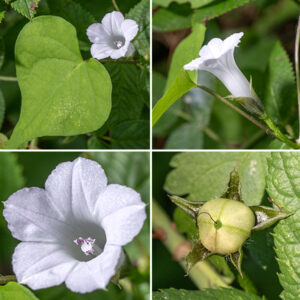
ivy-leaved morning-glory [Blooms: Aug-Sep]

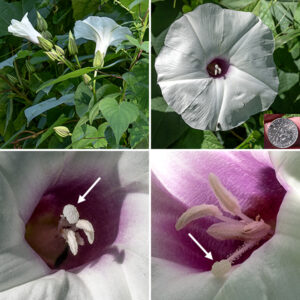
small white morning-glory [Blooms: Aug-Sep]

wild sweet-potato [Blooms: Jun-Aug]

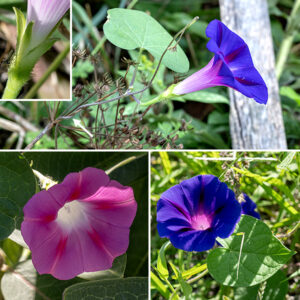
common morning-glory [Blooms: Aug-Sep]

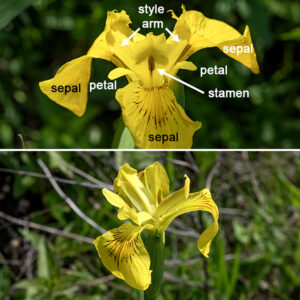
yellow iris [Blooms: May-Jun]

blue flag iris [Blooms: May-Jun]

Juglans

Juglans nigra

black walnut [Blooms: May?-Jun]

Dudley's rush [Blooms: May-Jun]

soft rush [Blooms: May-Jun]

path rush [Blooms: ?-Jun]

Torrey's rush [Blooms: Jul-Aug]

American water-willow [Blooms: Jun-Aug]

kochia [Blooms: Jul-Aug]

two-flowered cynthia [Blooms: Jun-?]

Canada lettuce [Blooms: Jul-Sep]

prickly lettuce [Blooms: Jul-Sep]

henbit [Blooms: Apr-May]

purple dead-nettle [Blooms: Apr-?]

wood nettle [Blooms: Aug-Sep]

duckweed [Blooms: ?]

motherwort [Blooms: Jun-Aug]

field peppergrass [Blooms: May-?]

peppergrass [Blooms: Oct-Nov]

round-headed bush-clover [Blooms: Aug-Sep]

violet bush-clover [Blooms: Aug-Sep]

Leucanthemum

Leucanthemum vulgare

ox-eye daisy [Blooms: May-Jul]

summer snowflake [Blooms: Apr-May]

Lyme grass [Blooms: May-Jun]

rough blazing-star [Blooms: Aug-Sept]

cylindrical blazing-star [Blooms: Jul-Aug]

Rocky Mountain blazing-star [Blooms: Aug-Sep]

prairie blazing-star [Blooms: Jul-Aug]

savanna blazing-star [Blooms: Aug]

marsh blazing-star [Blooms: Aug]

Michigan lily [Blooms: Jun-Jul]

butter-and-eggs [Blooms: Jul-Oct]

spicebush [Blooms: Mar-Apr]

tulip tree [Blooms: June]

creeping lilyturf [Blooms: Aug-Sep]

hairy puccoon [Blooms: May-Jun]

cardinal flower [Blooms: Jul-Sep]

great blue lobelia [Blooms: Aug-Oct]

amur honeysuckle [Blooms: Apr-Jun]

Morrow's honeysuckle [Blooms: Apr-May]

grape honeysuckle [Blooms: Jun]

tatarian honeysuckle [Blooms: Apr-May]

bird's-foot trefoil [Blooms: Jun-Sep]

wild lupine [Blooms: May-Jun]

American bugleweed [Blooms: Jul-Sep]

gypsywort [Blooms: Aug-Sep]

northern bugleweed [Blooms: Jul-Aug]

Lysimachia

Lysimachia ciliata

fringed loosestrife [Blooms: Jun-Jul]

winged loosestrife [Blooms: Jun-Aug]

purple loosestrife [Blooms: Jun-Sep]

false Solomon's seal [Blooms: Apr-Jun]

starry false Solomon's seal [Blooms: Apr-May]

prairie crabapple [Blooms: Apr-May]

common mallow [Blooms: May-Oct]

wild chamomile [Blooms: May-Jun]

pineapple-weed [Apr-Jul]

black medic [Blooms: May-?]

Melilotus

Melilotus albus

white sweetclover [Blooms: Jun-Sep]

yellow sweetclover [Blooms: Jun-Jul]

field mint [Blooms: Jun-Sep]

Virginia bluebells [Blooms: Apr-May]

square-stemmed monkeyflower [Blooms: Jul-Sep]

wild four-o'clock [Blooms: Jun-Sep]

twoleaf miterwort [Blooms: Apr-May]

wild bergamot [Blooms: Jul-Aug]

spotted beebalm [Blooms: Jul-Aug]

Morus

Morus alba

white mulberry [Blooms: Apr-May]

red mulberry [Blooms: ??]

grape hyacinth [Blooms: Apr]

water chickweed [Blooms: May-Jun]

glade mallow [Blooms: Jun-Aug]

poet's daffodil [Blooms: Apr-May]

wild daffodil [Blooms: Mar-May]

catnip [Blooms: Jun-Aug]

spatterdock [Blooms: Jun-Sep]

fragrant water-lily [Blooms: May-Aug]

evening primrose [Blooms: Jul-Oct]

smallflowered gaura [Blooms: Jul-Sep]

Oenothera

Oenothera gaura

biennial gaura [Blooms: Jul-Sep]

northern evening primrose [Blooms: Jun-Jul]

prairie sundrop [Blooms: Jun]

hairy evening primrose [Blooms: Aug-Oct]

Eastern prickly-pear [Blooms: Jun-Jul]

French-grass [Blooms: Jun-Jul]

star of Bethlehem [Blooms: May]

aniseroot [Blooms: Apr – Jun]

hop hornbeam [Blooms: Apr-May]

yellow wood-sorrel [Blooms: May-Sep]

cowbane [Blooms: May-June]

butterweed [Blooms: May-Jun]

balsam ragwort [Blooms: Apr-May]

prairie ragwort [Blooms: Apr-Jun]

wild quinine [Blooms: May-Aug]

Virginia creeper [Blooms: ?]

Boston ivy [Blooms: ??]

Parthenocissus

Parthenocissus vitacea

woodbine [Blooms: ??]

Pastinaca

Pastinaca sativa

wild parsnip [Blooms: May-Jun]

wood betony [Blooms: Apr-Jun]

calico penstemon [Blooms: Jun-Jul]

foxglove beardtongue [Blooms: May-Jul]

slender beardtongue [Blooms: Jun-Jul]

large-flowered penstemon [Blooms: May-Jul]

hairy beardtongue [Blooms: May-Jul]

pale beardtongue [Blooms: May-Jun]

ditch stonecrop [Blooms: Aug-?]

waterpepper [Blooms: Aug-Sep]

pale smartweed [Blooms: Jul-Oct]

creeping smartweed [Blooms: May-Oct]

lady's-thumb [Blooms: Jun-Sep]

Pennsylvania smartweed [Blooms: Jul-Sep]

dotted smartweed [Blooms: Aug-Sep]

jumpseed [Blooms: Jul-Aug]

reed canary-grass [Blooms: May-?]

sweet mock-orange [Blooms: May-Jun]

cleft phlox [Blooms: Apr-?]

woodland phlox [Blooms: Apr-May]

smooth phlox [Blooms: Jun-Aug]

prairie phlox [Blooms: Apr-Jun]

giant reed [Blooms: ?early-midsummer]

clammy groundcherry [Blooms: Jul-Aug]

smooth groundcherry [Blooms: Jun-Aug]

ninebark [Blooms: May-Jun]

obedient plant [Blooms: Jul-Oct]

pokeweed [Blooms: Jun-Oct]

English plantain [Blooms: May-Aug]

Plantago

Plantago major

common plantain [?-Aug]

mayapple [Blooms: Apr-May]

Polemonium

Polemonium reptans

Jacob's ladder [Blooms: Apr-May]

Soloman's seal [Blooms: May-Jul]

prostrate knotweed [Blooms: Jun-Sep]

Pontederia

Pontederia cordata

pickerel weed [Blooms: Jun-Sep]

Eastern cottonwood [Blooms: Apr-May]

common purslane [Blooms: Jun-Sep]

Potamogeton

Potamogeton crispus

curly pondweed [Blooms: May-?]

silverweed [Blooms: Jun-Aug]

rough cinquefoil [Blooms: Jun-Sep]

Potentilla

Potentilla recta

sulfur cinquefoil [Blooms: May-Jul]

Potentilla

Potentilla simplex

common cinquefoil [Blooms: May-Jul]

shooting star [Blooms: Apr-May]

heal-all [Blooms: Jun-Aug]

American plum [Blooms: Apr-May]

Prunus

Prunus padus

European bird cherry [Blooms: Apr-May]

peach [Blooms: Apr-May]

sand cherry [Blooms: Apr-May]

black cherry [Blooms: May-June]

Japanese cherry [Blooms: Apr-May]

chokecherry [Blooms: Apr-May]

hoptree [Blooms: May-Jun]

striped squill [Blooms: Mar-Apr]

slender mountain-mint [Blooms: Jun-Aug]

Virginia mountain-mint [Blooms: Jul-Aug]

small-flowered buttercup [Blooms: Apr-May]

Ranunculus

Ranunculus ficaria

lesser celadine [Blooms: Apr-May]

hispid buttercup [Blooms: May-Jul]

Pennsylvania buttercup [Blooms: Jul-?]

cursed crowfoot [Blooms: May-Jul]

upright prairie coneflower [Blooms: Jul]

grey-headed coneflower [Blooms: Jun-Oct]

Japanese knotweed [Blooms: Aug-Sep]

buckthorn [Blooms: May-Jun]

jetbead [Blooms: Apr-May]

fragrant sumac [Blooms: Apr-May]

smooth sumac [Blooms: May-Jul]

staghorn sumac [Blooms: May-Jul]

wild black currant [Blooms: Apr-May]

golden currant [Blooms: Apr-May]

Missouri gooseberry [Blooms: Apr-May]

black locust [Blooms: May-Jun]

marsh yellow-cress [Blooms: Jun-Aug]

prairie rose [Blooms: May-Jul]

pasture rose [Blooms: Jun-?]

multiflora rose [Blooms: May-Jun]

swamp rose [Blooms: May-Jun]

rugosa rose [Blooms: May-Jul]

climbing wild rose [Blooms: Jun -Jul]

common blackberry [Blooms: May-June]

common dewberry [Blooms: May-Jun]

purple-flowered raspberry [Blooms: Apr/May-Aug]

Pennsylvania blackberry [Blooms: May-Jun]

orange coneflower [Blooms: Jul-Aug]

Rudbeckia

Rudbeckia hirta

black-eyed susan [Blooms: Jun-Oct]

cutleaf coneflower [Blooms: Jul-Sep]

sweet coneflower [Blooms: Jul-Aug]

brown-eyed susan [Blooms: Jun-Sep]

hairy wild petunia [Blooms: Jun-Sep]

pale dock [Blooms: May-Jun]

curly dock [Blooms: May-Jun]

bitter dock [Blooms: May-Jul]

common arrowhead [Blooms: Aug – Sep]

weeping willow [Blooms: Apr]

Missouri River willow [Blooms: Apr]

prairie willow [Blooms: Apr-May]

narrowleaf willow [Blooms: Apr-Jul]

black willow [Blooms: ??]

Sambucus

Sambucus nigra

elderberry [Blooms: May-Jul]

bloodroot [Blooms: Mar-Apr]

Canadian black snakeroot [Blooms: Jun-Jul]

black snakeroot [Blooms: May-Jun]

soapwort [Blooms: Jun-Jul]

Schoenoplectus

Schoenoplectus acutus

hardstem bulrush [Blooms: Jun-Jul]

Schoenoplectus

Schoenoplectus pungens

three-square bulrush [Blooms: May-Jul]

great bulrush [Blooms: May-Jul]

alpine squill [Blooms: Mar-Apr]

Siberian squill [Blooms: Mar-Apr]

dark green bulrush [Blooms: May-Jul]

early figwort [Blooms: May-Jul]

late figwort [Blooms: Jul-Aug]

mad-dog skullcap [Blooms: Jul-Aug]

Securigera

Securigera varia

crown vetch [Blooms: Jun-Sep]

Sedum

Sedum acre

biting stonecrop [Blooms: Jun]

common groundsel [Blooms: May-Jul]

Maryland senna [Blooms: Jul]

prickly sida [Blooms: Aug-Sep]

evening campion [Blooms: May-Aug]

Silene

Silene regia

royal catchfly [Blooms: Jul-Aug]

starry campion [Blooms: Jun-Jul]

rosinweed [Blooms: Jul-Sep]

compass plant [Blooms: Jun-Sep]

cup plant [Blooms: Jul-Sep]

prairie dock [Blooms: Jun-Sep]

wild mustard [Blooms: May-Jun]

hedge mustard [Blooms: May-Jul]

Sisyrinchium

Sisyrinchium albidum

white blue-eyed grass [Blooms: May-?]

water parsnip [Blooms: Jul-Aug]

horsenettle [Blooms: Jun-Aug]

bittersweet nightshade [Blooms: May-Aug]

black nightshade [Blooms: Jul-Sep]

tall goldenrod [Blooms: Sep-Oct]

Solidago

Solidago caesia

woodland goldenrod [Blooms: Sep-Oct]

Canada goldenrod [Blooms: Jul-Oct]

broad-leaved goldenrod [Blooms: Jul-Sep]

tall goldenrod [Blooms: Jul-Sep]

Solidago

Solidago juncea

early goldenrod [Blooms: Jul/Aug-?]

field goldenrod [Blooms: Aug-Oct]

upland white goldenrod [Blooms: Aug-Sep]

Solidago

Solidago rigida

stiff goldenrod [Blooms: Aug-Oct]

seaside goldenrod [Blooms: Sep-Oct]

showy goldenrod [Blooms: Jul-Oct]

elmleaf goldenrod [Blooms: Jul-Oct]

perennial sowthistle [Blooms: Jun-Oct]

Sonchus

Sonchus asper

prickly sowthistle [Blooms: Jun-Oct]

prickly sowthistle [Blooms: Jun-Oct]

giant bur-reed [Blooms: May-Jul]

Spergularia

Spergularia salina

saltmarsh sand-spurry [Blooms: May-Aug]

Spiraea

Spiraea alba

white meadowsweet [Blooms: Jul-Sep]

Great Plains ladies'-tresses [Blooms: Sep]

bladdernut [Blooms: Apr-May]

Stellaria

Stellaria media

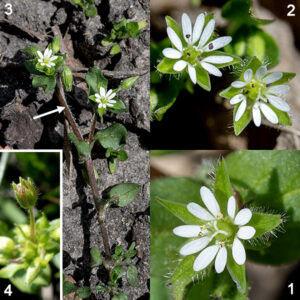
common chickweed [Blooms: Apr-May]

Strophostyles

Strophostyles helvola

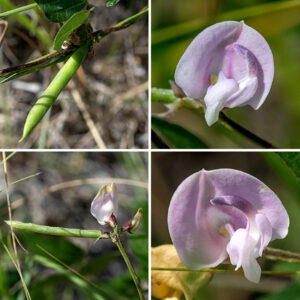
trailing wild-bean [Blooms: Aug-Sep]

Symphoricarpos

Symphoricarpos albus

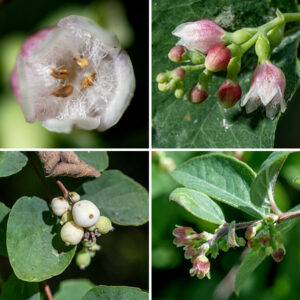
snowberry [Blooms: Jul-Sep]

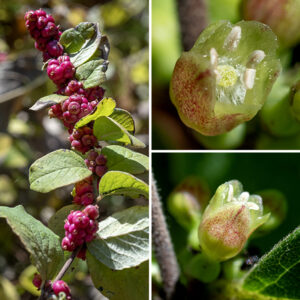
coralberry [Blooms: Aug-?]

Drummond's aster [Blooms: Sep – ?]

Symphyotrichum

Symphyotrichum ericoides

heath aster [Blooms: Sep – Nov]

Symphyotrichum

Symphyotrichum laeve

smooth blue aster [Blooms: Aug – Sep]

panicled aster [Blooms: Aug – Oct]

calico aster [Blooms: Sep – ?]

New England aster [Blooms: Aug – Nov]

skyblue aster [Blooms: Sep – Oct]

Symphyotrichum

Symphyotrichum pilosum

hairy aster [Blooms: Aug – Nov]

Symphyotrichum

Symphyotrichum shortii

Short's aster [Blooms: Aug – Nov]