Alcea rosea
hollyhock [Blooms: Jul-?]
More information
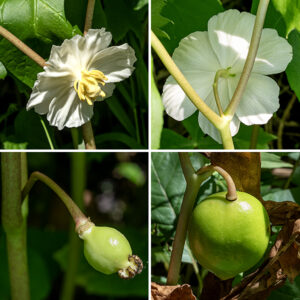
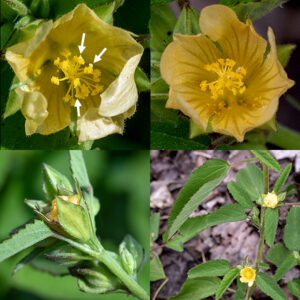
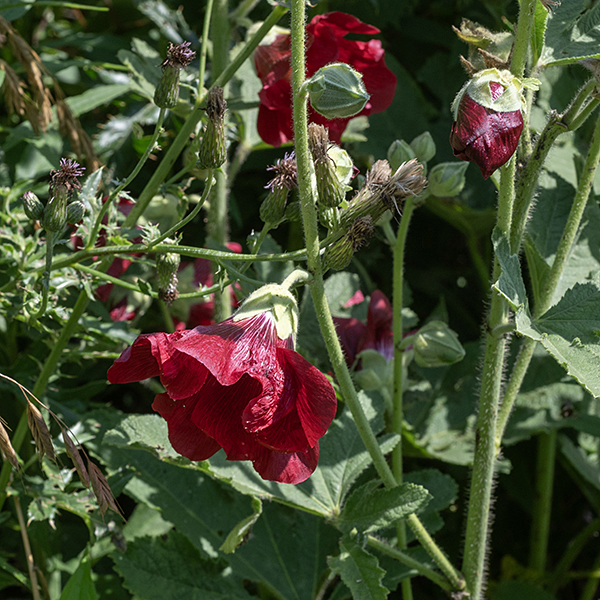
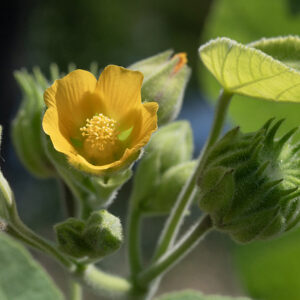
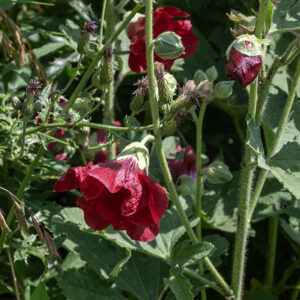
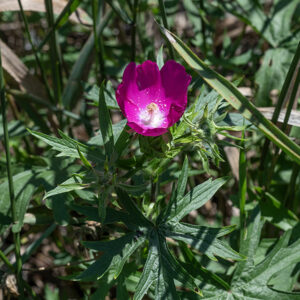
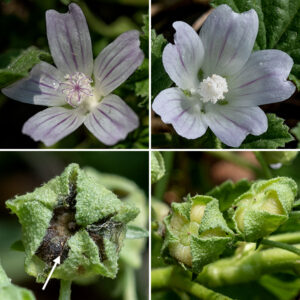
Hollyhock flowers are bowl-shaped and large (3-5″ across) with a prominent stalk-like central structure that contains the stamens apically and styles basally. There are five petals, five sepals, and 6-9 sepal-like bracts; color can vary from white to deep purple.
More information
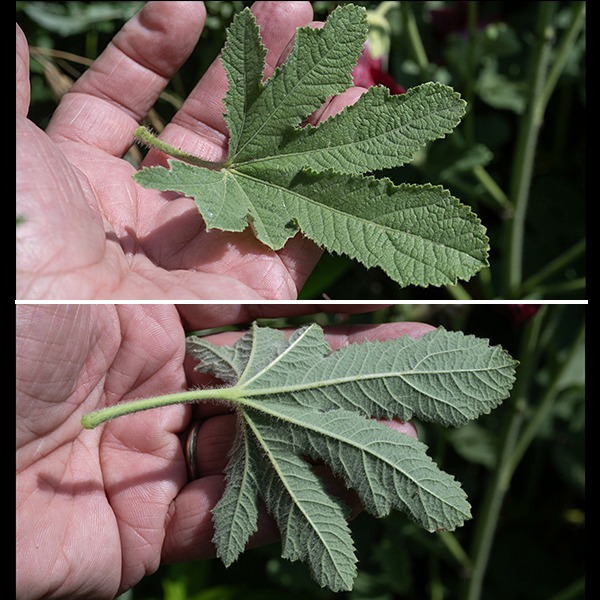
Hollyhock leaves are alternate, lobed to differing degrees, about 8″ long and across, with an indentation where the petiole joins the leaf blade. The underside of the blade is light green while the upper side is darker; the leaves are conspicuously wrinkled.
More Information
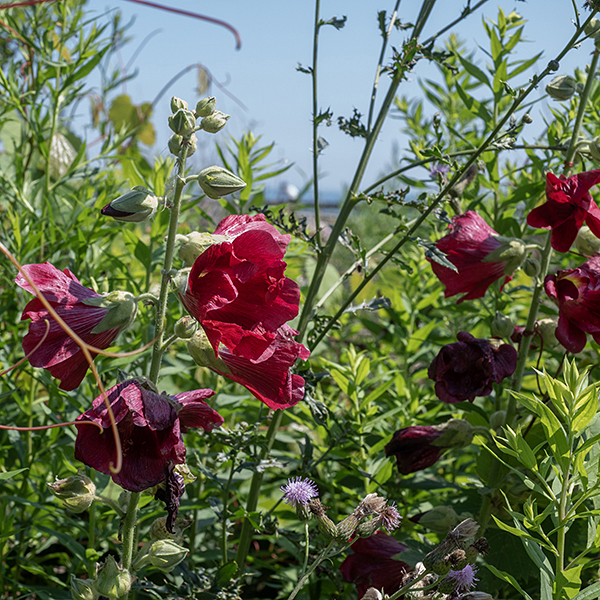
Hollyhock is an exotic with a long history. It was imported to Europe from what is now China sometime in the 15th century. It is not clear when hollyhock was introduced to North America where it repeatedly escapes from cultivation, but it is not an aggressive plant so probably does little damage to native ecosystems. Hollyhock is a tall plant (up to 6-8 feet), light green, with hairy stems, usually unbranched, and is not woody despite its size.
Browse more plants
Want to keep exploring more plants? You can view other plants like this one by selecting a characteristic from the list below, or 'browse more plants' to go back to the Plant Finder.
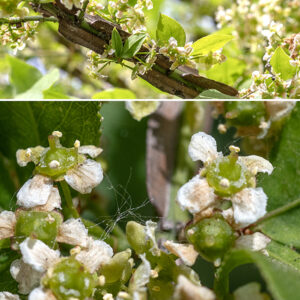
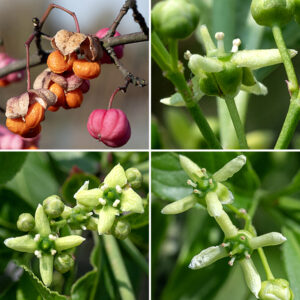
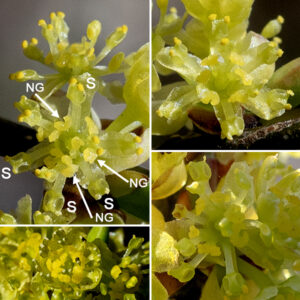
![The flowers of amur maple occur in oblong clusters circular in section about 1.5" long and 1" across on the tips of the branches; flower clusters don't appear until after the leaves have emerged. There are two kinds of flowers in each cluster, both yellowish white in color, about 1/8" across, both with five sepals and five petals (each 1.5-2 mm long); the petals' tips curve in over the central parts of the flower. One flower type is staminate with eight stamens (no ovary or style) within the ring of sepals and petals. The other flower type is "perfect" with both eight stamens tipped with light yellow anthers and with a distinct central style rising above the stamens that bears a split tip that curls back. Minnesota Wildflowers [https://www.minnesotawildflowers.info/tree/amur-maple] states that the style splits in two, but the amur maple present in Jackson Park has perfect flowers whose styles either split in two or split in three — both morphs are present in the same flower cluster. Fertilized perfect flowers produce a fruit that is a pair of winged seeds (samaras) joined seed-to-seed with the wings making an angle of less than 30° (much less than most maples). Initially green in color, the samaras develop reddish highlights before turning bright reddish pink in mid to late summer. When the fruit matures in early to mid-autumn, each samara is 1-1.5" long and turns light brown.](https://jacksonparkwildflowers.info/wp-content/uploads/2026/08/Acer_ginnala-1ta-300x300.jpg)













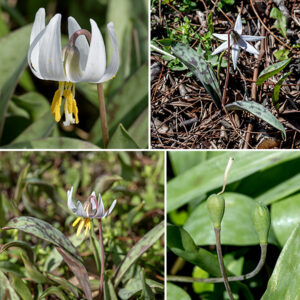







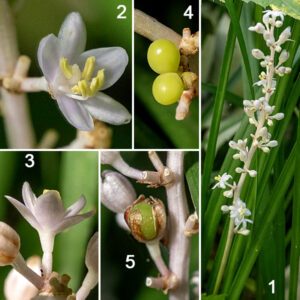
![Wild leeks (Allium tricoccum) (a.k.a., "ramps") is an herbaceous native perennial found in the north-east quarter of the U.S. and the eastern provinces of Canada. It is most common in moist hardwood forests but is threatened by over-harvesting. It is listed as "Vulnerable in Illinois" [https://explorer.natureserve.org/Taxon/ELEMENT_GLOBAL.2.138691/Allium_tricoccum_var_tricoccum]. In early spring, the bulb of a wild leek produces 2-3 leaves that are each 4-9" long and 1.5-3.5" across with petioles that are reddish to maroon, hairless, and wrapped in a sheath basally. The leaves wither by early summer (before flowering). Later (early to mid-summer) the bulb produces a naked flower stalk 6-18" tall; the stalk is hairless, circular in section, and pale green to maroon with a papery sheath at its base. At the apex of the stalk is a single, spherical umbel, 1-2" across, of 20-40 white flowers, with a pair of bracts at the base of the umbel when fresh. Individual flowers are about 1/4" across; the flowers contain six white to translucent tepals (6-7 mm long, three with a reddish tip); a light green to pale yellow ovary; six, 6 mm long, stamens with pale yellow anthers that extend beyond the tips of the tepals; and a single, white 3-4 mm long style that extends past the three lobes of the ovary but not beyond the anthers. The stigma tiny and spherical. Fertilized flowers produce a three-celled seed capsule, each cell containing a single globoid seed that turns glossy black at maturity. Wild leeks are denizens of hardwood forests with rich, loamy soils. The leaves and bulbs are edible, but you really shouldn't — this plant depends on only a couple of weeks of photosynthesis to produce its leaves and flowers and is highly vulnerable to overexploitation by humans. If you see one of these plants, smile and know that you have been blessed. Then walk away.](https://jacksonparkwildflowers.info/wp-content/uploads/2026/08/Allium_tricoccum-2t-300x300.jpg)


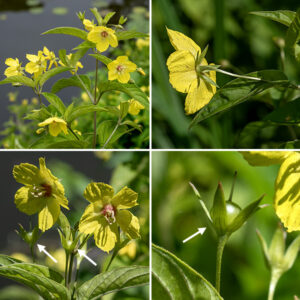

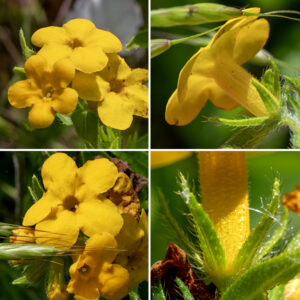
![Evening primrose — clusters of yellow flowers occur at the apex of the plant. The flowers are 1-2" across, with four 1/2-1" long green sepals strongly reflected over a long (3/4-2"), green, cylindrical floral tube (the ovary is located just above the leaf axil), four heart-shaped yellow petals, eight stamens, and a single style with an X-shaped stigma. The sepals typically remain connected (in pairs) along one edge until the flower opens. The seedpods develop within the ovary (the base of the elongate floral tube); they are hairy, urn-shaped with rounded edges, and have four or eight small lobes on the apex. The seeds are claimed to remain viable in the soil for up to 70 years. The flowers open at dusk and close early in the day. — — — There are (at least) three evening primroses in Jackson Park — common evening primrose (Oenothera biennis), northern evening primrose (Oenothera parviflora), and hairy evening primrose (Oenothera villosa). They are easily confused with each other. (Judging by the conflicts between the accounts on Illinois Wildflowers [https://www.illinoiswildflowers.info/], Minnesota Wildflowers [https://www.minnesotawildflowers.info/], and Missouri Plants [http://www.missouriplants.com/], even the experts are confused.) All three species have yellow flowers with an X-shaped stigma, reflected sepals, petals with a small notch in their apex, stems that may be red or green, and lance-shaped leaves with short, widely-spaced teeth. Northern evening primrose is distinguished by (1) the presence of a knob or ridge at the tip of each sepal which the other two species lack (2) a seed capsule with four robust, flaring lobes with rounded tips at the apex of the seed capsule, and (3) a stigma that is very robust and almost fills the opening of the flower. Northern evening primrose has green to yellowish-green sepals. Hairy evening primrose (often but not always) has (1) striped or reddish-tinged sepals (check the buds where this character is often easier to see), (2) flowers that turn orange as they begin to senesce (although the reliability of this character is uncertain), and (3) always has glandular hairs covering the ovary that have "pimple-like" bright-red bases; these red pimples may also occur on the stems. All three species are somewhat similar to prairie sundrop (O. pilosella); the latter has very hairy stems and leaves, and translucent lines that radiate from the base of the petals in the flowers.](https://jacksonparkwildflowers.info/wp-content/uploads/2025/03/Oenothera_biennis-1t-300x300.jpg)
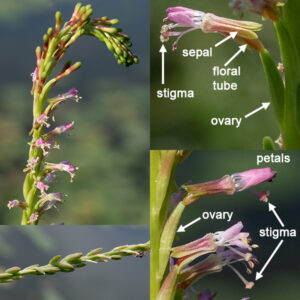
![Northern evening primrose flowers are 3/4-1.5" across, have four yellow, heart-shaped petals, eight yellow stamens, and a cross-shaped stigma on a modest style; the stamens are as long or longer than the petals and the stigma is nearly fills the floral opening. At the base of the flower are four sepals 1/2-1" long, that bend back along the 3/4-1.5" long floral tube as the flower develops with pairs of sepals attached along one edge until the flower opens. Only northern evening primrose with a distinct ridge or knob near the tips of the sepals. The seed capsule develops from the ovary; it is 3/4-1.5" long, cylindrical but tapering slightly towards the tip, with four robust, flaring lobes at the tip. — — — There are (at least) three evening primroses in Jackson Park — common evening primrose (Oenothera biennis), northern evening primrose (Oenothera parviflora), and hairy evening primrose (Oenothera villosa). They are easily confused with each other. (Judging by the conflicts between the accounts on Illinois Wildflowers [https://www.illinoiswildflowers.info/], Minnesota Wildflowers [https://www.minnesotawildflowers.info/], and Missouri Plants [http://www.missouriplants.com/], even the experts are confused.) All three species have yellow flowers with an X-shaped stigma, reflected sepals, petals with a small notch in their apex, stems that may be red or green, and lance-shaped leaves with short, widely-spaced teeth. Northern evening primrose is distinguished by (1) the presence of a knob or ridge at the tip of each sepal which the other two species lack (2) a seed capsule with four robust, flaring lobes with rounded tips at the apex of the seed capsule, and (3) a stigma that is very robust and almost fills the opening of the flower. Northern evening primrose has green to yellowish-green sepals and is the only one of the three evening primroses to (sometimes) have reddish color on some or all of the midvein of the leaves. Hairy evening primrose (often but not always) has (1) striped or reddish-tinged sepals (check the buds where this character is often easier to see), (2) flowers that turn orange as they begin to senesce (although the reliability of this character is uncertain), and (3) always has glandular hairs covering the ovary that have "pimple-like" bright-red bases; these red pimples may also occur on the stems. All three species are somewhat similar to prairie sundrop (O. pilosella); the latter has very hairy stems and leaves, and translucent lines that radiate from the base of the petals in the flowers.](https://jacksonparkwildflowers.info/wp-content/uploads/2025/03/Oenothera_parviflora-1t-300x300.jpg)
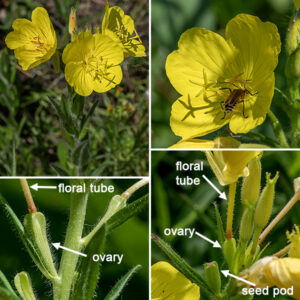
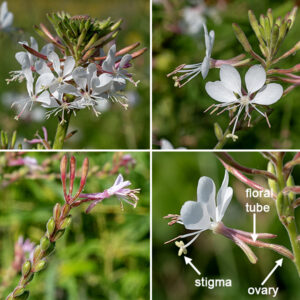
![Hairy evening primrose produves an elongating spike of flowers arises from the apex of the stem; flowers bloom near the tip while older flowers and seed capsules develop below. Individual flowers are 3/4-1.5" across; they sit on a long floral tube with the ovary at its base (attached to a leaf axil). The flowers have four yellow, heart-shaped petals, eight yellow stamens, and a cross-shaped stigma on a modest style; at the base of the flower are four sepals 3/8-3/4" long, reflected back along the floral tube as the flower develops with pairs of sepals attached along one edge until the flower opens. The sepals are often red-striped or red-tinged. Note the long, hairy floral tube below the sepals, the reddish stem, and glandular hairs with red bases on the ovary. The seed capsule develops from the ovary; it is up to 1.75" long, cylindrical but tapering slightly towards the tip, with four tiny lobes at the tip. — — — There are (at least) three evening primroses in Jackson Park — common evening primrose (Oenothera biennis), northern evening primrose (Oenothera parviflora), and hairy evening primrose (Oenothera villosa). They are easily confused with each other. (Judging by the conflicts between the accounts on Illinois Wildflowers [https://www.illinoiswildflowers.info/], Minnesota Wildflowers [https://www.minnesotawildflowers.info/], and Missouri Plants [http://www.missouriplants.com/], even the experts are confused.) All three species have yellow flowers with an X-shaped stigma, reflected sepals, petals with a small notch in their apex, stems that may be red or green, and lance-shaped leaves with short, widely-spaced teeth. Northern evening primrose is distinguished by (1) the presence of a knob or ridge at the tip of each sepal which the other two species lack (2) a seed capsule with four robust, flaring lobes with rounded tips at the apex of the seed capsule, and (3) a stigma that is very robust and almost fills the opening of the flower. Northern evening primrose has green to yellowish-green sepals. Hairy evening primrose (often but not always) has (1) striped or reddish-tinged sepals (check the buds where this character is often easier to see), (2) flowers that turn orange as they begin to senesce (although the reliability of this character is uncertain), and (3) always has glandular hairs covering the ovary that have "pimple-like" bright-red bases; these red pimples may also occur on the stems. All three species are somewhat similar to prairie sundrop (O. pilosella); the latter has very hairy stems and leaves, and translucent lines that radiate from the base of the petals in the flowers.](https://jacksonparkwildflowers.info/wp-content/uploads/2025/03/Oenothera_villosa-1t-300x300.jpg)