Skip to content
Jackson Park WildflowersJackson Park Wildflowers
  • Home
  • Discover
    • Get Started
    • Plant Finder
    • Glossary
    • Browse by Genera
    • Other Biota — lower plants and Fungi
    • Other Biota — animals
  • Explore
    • Jackson Park — Scoreboard
  • About
  • Glossary
  • Plant Finder
  • 0
    Cart

    No products in the cart.

    Return to shop

Home / Plant Finder / Symphytum
Filter

Showing the single result

Sorting
Filtered (1)
Filter Plants
  • Reset all×
  • Alternate×
  • Opposite×
Filter Plants

1 product found

Show (1)
Cancel
  • Reset all×
  • Alternate×
  • Opposite×
Filtered (1)
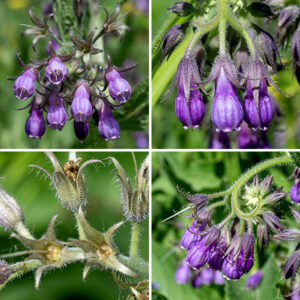
The inflorescences of common comfrey are nodding cymes or racemes of flowers that arise from the tips of the stems and the lateral branches. The flowers are bell-shaped, about 1/4" across and 1/2-5/8" long. Each flower has a hairy, green calyx with five lance-like teeth that is half the length of the corolla; a purple, pink or white funnel- or bell-shaped corolla with five small, recurved lobes at its lip; five stamens that do not extend past the margin of the corolla; and a pistil with a single white style that barely protrudes past the corolla margin. The fruits are a cluster of four, 4-5 mm long, nutlets nestled in the remnants of the flower calyx; the nutlets are dark brown or black when mature, oval and slightly flattened at one end. The remnants of the style protrude from the center of the fruit. Extracts of common comfrey are sometimes sold as herbal remedies but be aware that the plant is mildly toxic; it contains pyrrolizidine alkaloids that can be absorbed through the skin or gastric system and may cause (potentially fatal) liver toxicity and may be carcinogenic. Comfrey products for internal use or for use on open wounds are banned in the U.S. by the F.D.A. Supplements containing common comfrey probably should be avoided.
Quick View

Symphytum

Symphytum officinale

common comfrey [Blooms: Apr-Jul]
Plant Finder Glossary
Discover
Explore
About

I want to acknowledge the work of a friend and colleague, Dr. Fred Donner. We both share a passion for the flowers in Jackson Park. Fred's website (jacksonparkwildflowers.org) inspired me to build my own website and database; use and enjoy them both.

I am also pleased to thank my ninja web gurus and coders, Lindsey Young and Stefanie Engstrom. This site would not exist without their herculean labors.

Copyright 2026 © Michael LaBarbera

  • Home
  • Discover
    • Get Started
    • Plant Finder
    • Glossary
    • Browse by Genera
    • Other Biota — lower plants and Fungi
    • Other Biota — animals
  • Explore
    • Jackson Park — Scoreboard
  • About
  • Login
  • Newsletter
  • Plant Finder