Parthenocissus quinquefolia
Virginia creeper [Blooms: ?]
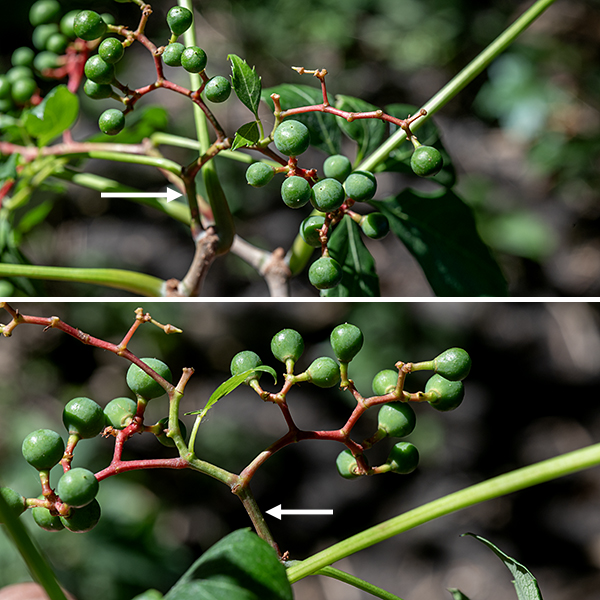
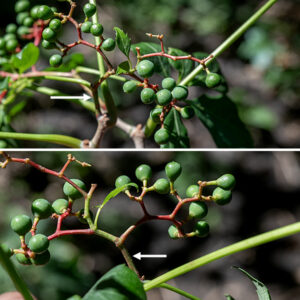
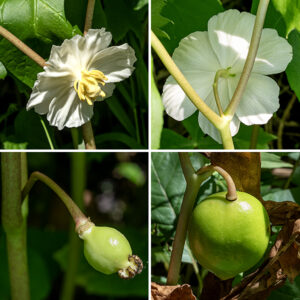
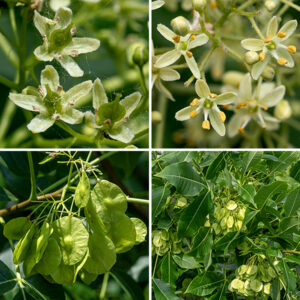
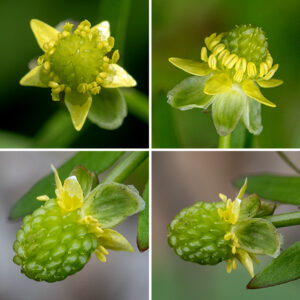
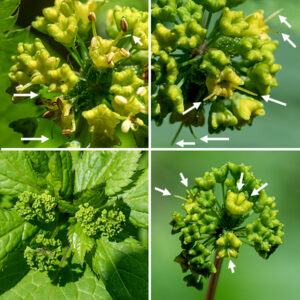
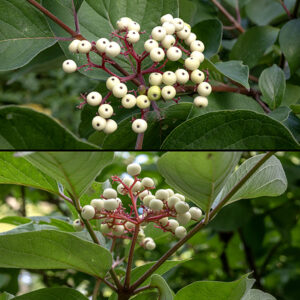
Virginia creeper (Parthenocissus quinquefolia) flowers and fruit. Sadly, I have yet to catch a Virginia creeper in bloom — the flowers are inconspicuous — but have high hopes for this summer. However, I have found plants bearing fruit. Both images here show what had been an inflorescence that is now bearing unripe fruit. (Ripe fruit would be dark blue.) Note that the inflorescence has a distinct central stalk (arrows), a feature not present in Virginia creeper’s close relative, woodbine (Parthenocissus vitacea).
Virginia creeper produces panicles of 80-150 flowers opposite leaf nodes; the panicles are broader than long and have a distinct central axis. Individual flowers are 1/4″ across, green, with five petals, five white stamens with yellow anthers, and a single stout, cone-shaped style. Flowers may have only stamens, only pistils, or both pistils and stamens. The petals have a raised margin (less so than woodbine) and are reflected backwards around the flower stalk. The fruit is a fleshy berry that is initially green but becomes blue-black with maturation; the flower stalks become orange-red or red as the fruit matures. The clusters of the fruit are reminiscent of a bunch of grapes. Opposite the leaf nodes are tendrils with as many as 10 branches; the tendrils end in distinct (adhesive) pads. Virginia creeper plants growing on trees produce aerial roots with a distinct “beard” of rootlets. Woodbine (Parthenocissus vitacea) also has palmate leaves with five leaflets, very similar to Virginia creeper (P. quinquefolia), but lacks the distinctive “bearded” aerial roots with short rootlets that are present in Virginia creeper. Opposite the base of the leaf petiole on the stem, woodbine produces a thin filament that branches 2-3 times, anchoring the vine by twining around objects. In Virginia creeper, the equivalent filaments are stouter, branch up to ten times, and end in robust, egg-shaped pads that attach to the substrate. The inflorescence of woodbine lacks a central axis; the inflorescence of Virginia creeper has a distinct central axis. Wikipedia lists other differences between the two species. Illinois Wildflowers, USDA Plants, and and World Flora Online consider the two species to be one; Minnesota Wildflowers considers them to be separate and distinct. Flora of North America indicates the correct scientific name for woodbine is Parthenocissus vitacea (not P. inserta), as does ITIS and MissouriPlants.com, implying woodbine and Virginia creeper are distinct species. Both woodbine and Virginia creeper have 40 chromosomes. Lu et al.’s (2012, 2023) molecular and morphological analyses indicate that woodbine and Virginia creeper are very closely related but distinct species and I’ll consider that to be correct here.
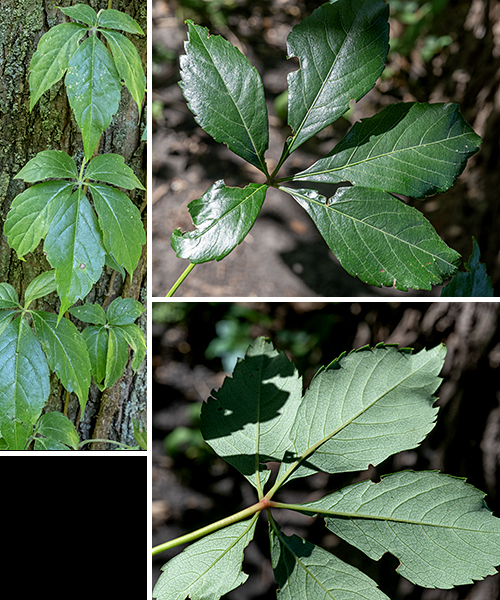
Virginia creeper (Parthenocissus quinquefolia) leaves. Left: leaves attached to a Virginia creeper vine using a tree as a substrate. Right: a single leaf showing the upper side of the leaf in the upper image and the underside of the leaf in the lower image. Note the five asymmetric leaflets.
Virginia creeper is a woody vine that grows over and up trees and fences; it can reach lengths of 60 feet. The leaves are palmately compound with five (sometime 4, rarely 3 or 7) leaflets up to 6″ long and 2.5″ across with coarse serrations along the distal margins; the compound leaf itself has a slender, 6-8″ long petiole. Virginia creeper plants growing on trees produce aerial roots with a distinct “beard” of rootlets. Woodbine (Parthenocissus vitacea) has palmate leaves with five leaflets, very similar to Virginia creeper (P. quinquefolia), but lacks the distinctive “bearded” aerial roots with short rootlets that are present in Virginia creeper. Opposite the base of the leaf petiole on the stem, woodbine produces a thin filament that branches 2-3 times, anchoring the vine by twining around objects. In Virginia creeper, the equivalent filaments are stouter, branch up to ten times, and end in robust, egg-shaped pads that attach to the substrate. The inflorescence of woodbine lacks a central axis; the inflorescence of Virginia creeper has a distinct central axis. Wikipedia lists other differences between the two species. Illinois Wildflowers, USDA Plants, and and World Flora Online consider the two species to be one; Minnesota Wildflowers considers them to be separate and distinct. Flora of North America indicates the correct scientific name for woodbine is Parthenocissus vitacea (not P. inserta), as does ITIS and MissouriPlants.com, implying that woodbine and Virginia creeper are distinct species. Both woodbine and Virginia creeper have 40 chromosomes. Lu et al.’s (2012, 2023) molecular and morphological analyses indicate that woodbine and Virginia creeper are very closely related but distinct species and I’ll consider that to be correct here.
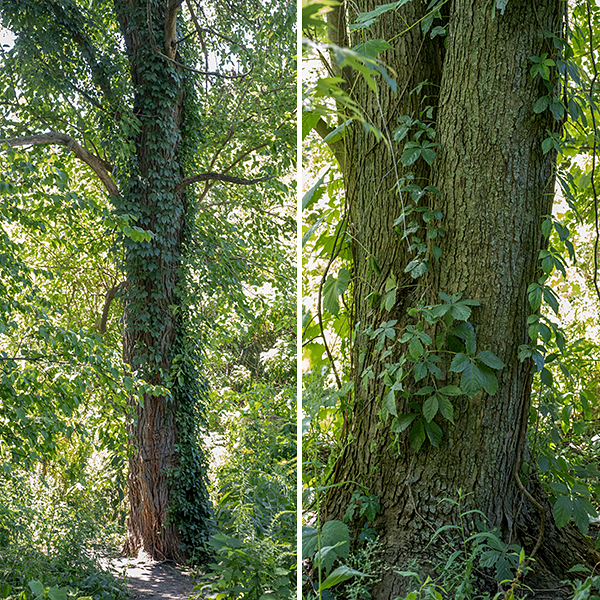
Virginia creeper (Parthenocissus quinquefolia) infesting hardwood trees on Wooded Island. Note the five leaflets on each leaf and how high the Virginia creeper has ascended in the tree on the left.
Virginia creeper is a woody vine that grows over and up trees and fences; it can reach lengths of 60 feet. The leaves are palmately compound with five (sometime 4, rarely 3 or 7) leaflets up to 6″ long and 2.5″ across with coarse serrations along the distal margins; the compound leaf itself has a slender, 6-8″ long petiole. Opposite the leaf nodes are tendrils with as many as 10 branches; the tendrils end in distinct (adhesive) pads. Virginia creeper plants growing on trees produce aerial roots with a distinct “beard” of rootlets. Woodbine (Parthenocissus vitacea) also has palmate leaves with five leaflets, very similar to Virginia creeper (P. quinquefolia), but lacks the distinctive “bearded” aerial roots with short rootlets that are present in Virginia creeper. Opposite the base of the leaf petiole on the stem, woodbine produces a thin filament that branches 2-3 times, anchoring the vine by twining around objects. In Virginia creeper, the equivalent filaments are stouter, branch up to ten times, and end in robust, egg-shaped pads that attach to the substrate. The inflorescence of woodbine lacks a central axis; the inflorescence of Virginia creeper has a distinct central axis. Wikipedia lists other differences between the two species. Illinois Wildflowers, USDA Plants, and and World Flora Online consider the two species to be one; Minnesota Wildflowers considers them to be separate and distinct. Flora of North America indicates the correct scientific name for woodbine is Parthenocissus vitacea (not P. inserta), as does ITIS and MissouriPlants.com, implying that woodbine and Virginia creeper are distinct species. Both woodbine and Virginia creeper have 40 chromosomes. Lu et al.’s (2012, 2023) molecular and morphological analyses indicate that woodbine and Virginia creeper are very closely related but are indeed distinct species and I’ll consider that to be correct here.
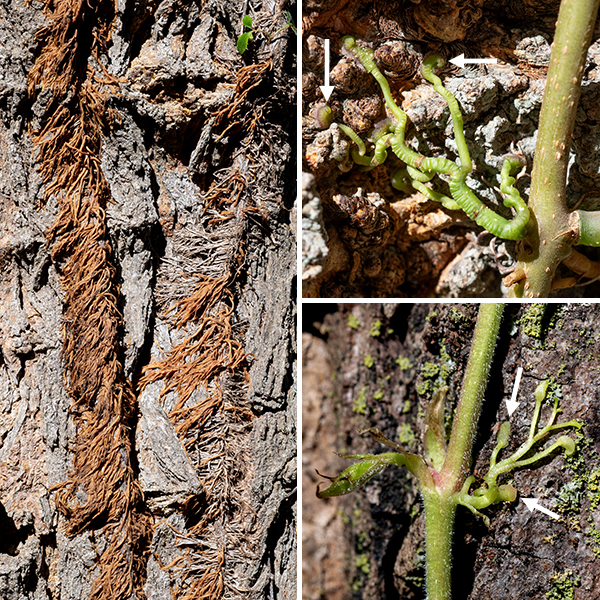
Virginia creeper (Parthenocissus quinquefolia) — distinguishing characters. Two characters that distinguish Virginia creeper from woodbine (Parthenocissus vitacea) are the “bearded’ aerial rootlets (left image) in Virginia creeper and tendrils that arise opposite some leaf nodes with as many as ten branches (right images) that each end in distinct (adhesive) pads (arrows).
Virginia creeper is very similar to woodbine (Parthenocissus vitacea); the two have often been claimed to be the same species. Virginia creeper plants growing on trees produce aerial roots with a distinct “beard” of rootlets. Woodbine (Parthenocissus vitacea) also has palmate leaves with five leaflets, very similar to Virginia creeper (P. quinquefolia), but lacks the distinctive “bearded” aerial roots with short rootlets that are present in Virginia creeper. Opposite the base of the leaf petiole on the stem, woodbine produces a thin filament that branches 2-3 times, anchoring the vine by twining around objects. In Virginia creeper, the equivalent filaments are stouter, branch up to ten times, and end in robust, egg-shaped pads that attach to the substrate. The inflorescence of woodbine lacks a central axis; the inflorescence of Virginia creeper has a distinct central axis. Wikipedia lists other differences between the two species. Illinois Wildflowers, USDA Plants, and World Flora Online consider the two species to be one; Minnesota Wildflowers considers them to be separate and distinct. Flora of North America indicates the correct scientific name for woodbine is Parthenocissus vitacea (not P. inserta), as does ITIS and MissouriPlants.com, implying that woodbine and Virginia creeper are distinct species. Both woodbine and Virginia creeper have 40 chromosomes. Lu et al.’s (2012, 2023) molecular and morphological analyses indicate that woodbine and Virginia creeper are very closely related but are indeed distinct species and I’ll consider that to be correct here.
Browse more plants
Want to keep exploring more plants? You can view other plants like this one by selecting a characteristic from the list below, or 'browse more plants' to go back to the Plant Finder.
Related Plants
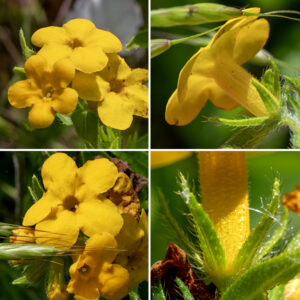
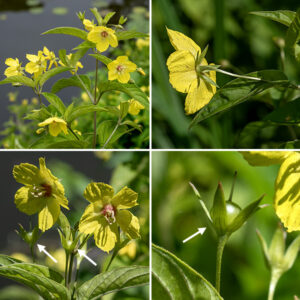
![Evening primrose — clusters of yellow flowers occur at the apex of the plant. The flowers are 1-2" across, with four 1/2-1" long green sepals strongly reflected over a long (3/4-2"), green, cylindrical floral tube (the ovary is located just above the leaf axil), four heart-shaped yellow petals, eight stamens, and a single style with an X-shaped stigma. The sepals typically remain connected (in pairs) along one edge until the flower opens. The seedpods develop within the ovary (the base of the elongate floral tube); they are hairy, urn-shaped with rounded edges, and have four or eight small lobes on the apex. The seeds are claimed to remain viable in the soil for up to 70 years. The flowers open at dusk and close early in the day. — — — There are (at least) three evening primroses in Jackson Park — common evening primrose (Oenothera biennis), northern evening primrose (Oenothera parviflora), and hairy evening primrose (Oenothera villosa). They are easily confused with each other. (Judging by the conflicts between the accounts on Illinois Wildflowers [https://www.illinoiswildflowers.info/], Minnesota Wildflowers [https://www.minnesotawildflowers.info/], and Missouri Plants [http://www.missouriplants.com/], even the experts are confused.) All three species have yellow flowers with an X-shaped stigma, reflected sepals, petals with a small notch in their apex, stems that may be red or green, and lance-shaped leaves with short, widely-spaced teeth. Northern evening primrose is distinguished by (1) the presence of a knob or ridge at the tip of each sepal which the other two species lack (2) a seed capsule with four robust, flaring lobes with rounded tips at the apex of the seed capsule, and (3) a stigma that is very robust and almost fills the opening of the flower. Northern evening primrose has green to yellowish-green sepals. Hairy evening primrose (often but not always) has (1) striped or reddish-tinged sepals (check the buds where this character is often easier to see), (2) flowers that turn orange as they begin to senesce (although the reliability of this character is uncertain), and (3) always has glandular hairs covering the ovary that have "pimple-like" bright-red bases; these red pimples may also occur on the stems. All three species are somewhat similar to prairie sundrop (O. pilosella); the latter has very hairy stems and leaves, and translucent lines that radiate from the base of the petals in the flowers.](https://jacksonparkwildflowers.info/wp-content/uploads/2025/03/Oenothera_biennis-1t-300x300.jpg)
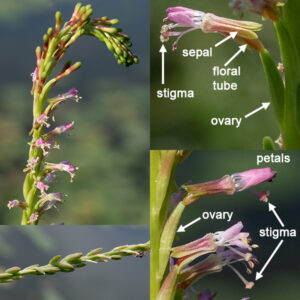
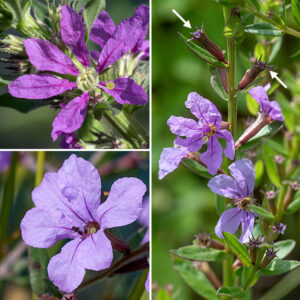
![Northern evening primrose flowers are 3/4-1.5" across, have four yellow, heart-shaped petals, eight yellow stamens, and a cross-shaped stigma on a modest style; the stamens are as long or longer than the petals and the stigma is nearly fills the floral opening. At the base of the flower are four sepals 1/2-1" long, that bend back along the 3/4-1.5" long floral tube as the flower develops with pairs of sepals attached along one edge until the flower opens. Only northern evening primrose with a distinct ridge or knob near the tips of the sepals. The seed capsule develops from the ovary; it is 3/4-1.5" long, cylindrical but tapering slightly towards the tip, with four robust, flaring lobes at the tip. — — — There are (at least) three evening primroses in Jackson Park — common evening primrose (Oenothera biennis), northern evening primrose (Oenothera parviflora), and hairy evening primrose (Oenothera villosa). They are easily confused with each other. (Judging by the conflicts between the accounts on Illinois Wildflowers [https://www.illinoiswildflowers.info/], Minnesota Wildflowers [https://www.minnesotawildflowers.info/], and Missouri Plants [http://www.missouriplants.com/], even the experts are confused.) All three species have yellow flowers with an X-shaped stigma, reflected sepals, petals with a small notch in their apex, stems that may be red or green, and lance-shaped leaves with short, widely-spaced teeth. Northern evening primrose is distinguished by (1) the presence of a knob or ridge at the tip of each sepal which the other two species lack (2) a seed capsule with four robust, flaring lobes with rounded tips at the apex of the seed capsule, and (3) a stigma that is very robust and almost fills the opening of the flower. Northern evening primrose has green to yellowish-green sepals and is the only one of the three evening primroses to (sometimes) have reddish color on some or all of the midvein of the leaves. Hairy evening primrose (often but not always) has (1) striped or reddish-tinged sepals (check the buds where this character is often easier to see), (2) flowers that turn orange as they begin to senesce (although the reliability of this character is uncertain), and (3) always has glandular hairs covering the ovary that have "pimple-like" bright-red bases; these red pimples may also occur on the stems. All three species are somewhat similar to prairie sundrop (O. pilosella); the latter has very hairy stems and leaves, and translucent lines that radiate from the base of the petals in the flowers.](https://jacksonparkwildflowers.info/wp-content/uploads/2025/03/Oenothera_parviflora-1t-300x300.jpg)
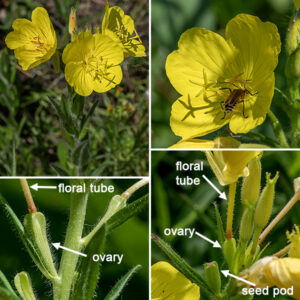
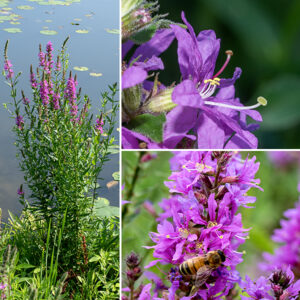
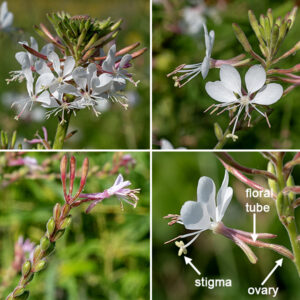
![Hairy evening primrose produves an elongating spike of flowers arises from the apex of the stem; flowers bloom near the tip while older flowers and seed capsules develop below. Individual flowers are 3/4-1.5" across; they sit on a long floral tube with the ovary at its base (attached to a leaf axil). The flowers have four yellow, heart-shaped petals, eight yellow stamens, and a cross-shaped stigma on a modest style; at the base of the flower are four sepals 3/8-3/4" long, reflected back along the floral tube as the flower develops with pairs of sepals attached along one edge until the flower opens. The sepals are often red-striped or red-tinged. Note the long, hairy floral tube below the sepals, the reddish stem, and glandular hairs with red bases on the ovary. The seed capsule develops from the ovary; it is up to 1.75" long, cylindrical but tapering slightly towards the tip, with four tiny lobes at the tip. — — — There are (at least) three evening primroses in Jackson Park — common evening primrose (Oenothera biennis), northern evening primrose (Oenothera parviflora), and hairy evening primrose (Oenothera villosa). They are easily confused with each other. (Judging by the conflicts between the accounts on Illinois Wildflowers [https://www.illinoiswildflowers.info/], Minnesota Wildflowers [https://www.minnesotawildflowers.info/], and Missouri Plants [http://www.missouriplants.com/], even the experts are confused.) All three species have yellow flowers with an X-shaped stigma, reflected sepals, petals with a small notch in their apex, stems that may be red or green, and lance-shaped leaves with short, widely-spaced teeth. Northern evening primrose is distinguished by (1) the presence of a knob or ridge at the tip of each sepal which the other two species lack (2) a seed capsule with four robust, flaring lobes with rounded tips at the apex of the seed capsule, and (3) a stigma that is very robust and almost fills the opening of the flower. Northern evening primrose has green to yellowish-green sepals. Hairy evening primrose (often but not always) has (1) striped or reddish-tinged sepals (check the buds where this character is often easier to see), (2) flowers that turn orange as they begin to senesce (although the reliability of this character is uncertain), and (3) always has glandular hairs covering the ovary that have "pimple-like" bright-red bases; these red pimples may also occur on the stems. All three species are somewhat similar to prairie sundrop (O. pilosella); the latter has very hairy stems and leaves, and translucent lines that radiate from the base of the petals in the flowers.](https://jacksonparkwildflowers.info/wp-content/uploads/2025/03/Oenothera_villosa-1t-300x300.jpg)