Rudbeckia hirta
black-eyed susan [Blooms: Jun-Oct]
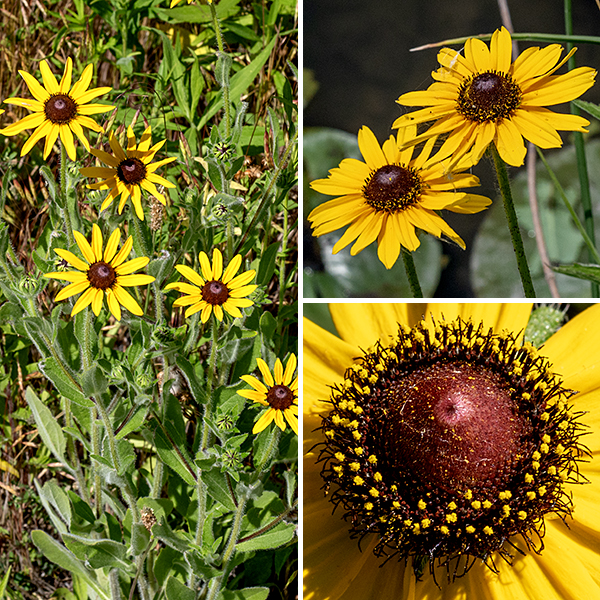
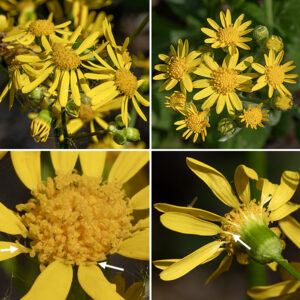
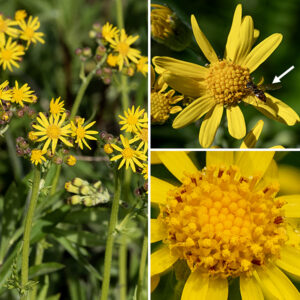
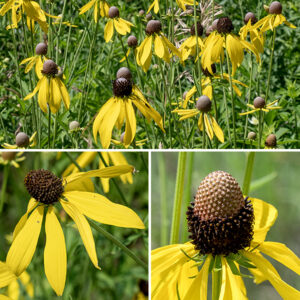
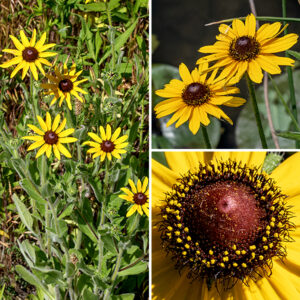
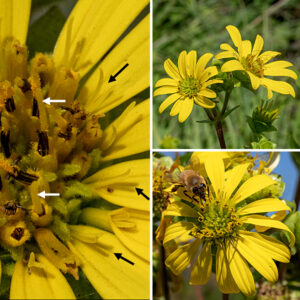
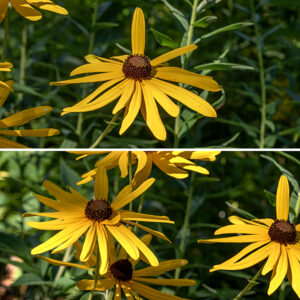
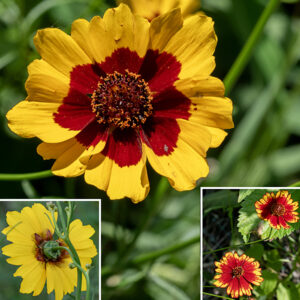
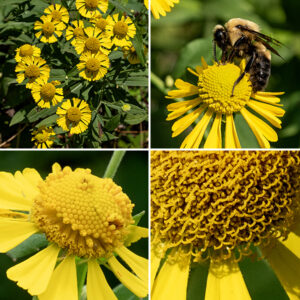
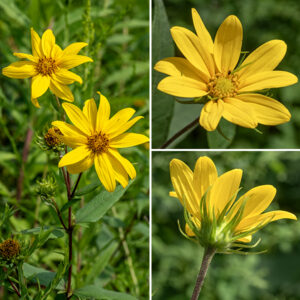
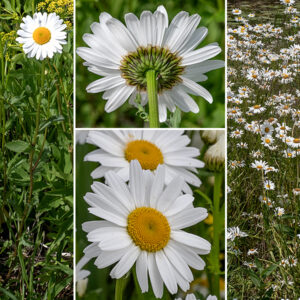
Black-eyed susan (Rudbeckia hirta) flowers. Left: a colony of black-eyed susan. Note the extremely hairy stems and leaves. The contrast between the purple-brown central disc and the bright yellow ray florets is striking. Upper right: two black-eyed susan blooms. The disc florets open progressively from the base of the disc towards the tip; here about half the disc florets have opened. Bottom right: a close-up of the disc on a black-eyed susan. The yellow masses are the anthers on the stamens; the filamentous structures are the styles of the individual disc florets.
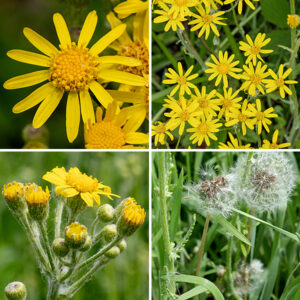
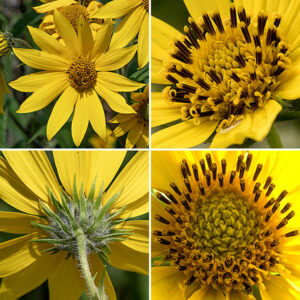
Black-eyed susan flowerheads are 2-3″ across; they have two series (outer longer than inner) of numerous slender, sharply-pointed, green bracts beneath the flowerhead, each densely covered with long, stiff hairs; 8-20 (usually less than 12) yellow-orange, sterile ray florets (rarely with a maroon patch near the base of the petal); and 250 to over 500 dark purplish-brown disk florets, each with slender, sharply pointed styles. The fruit consists of numerous four-sided brown or black seeds that remain embedded in the remnants of the disc flowers (a gumdrop shaped, brown mass).
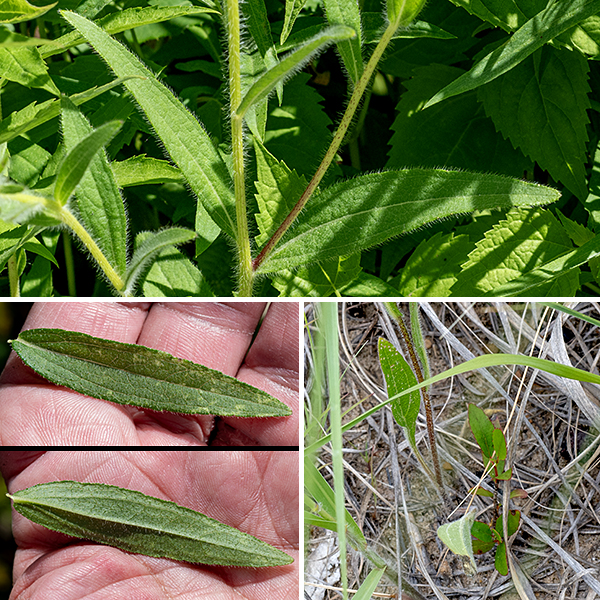
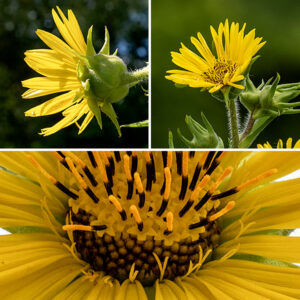
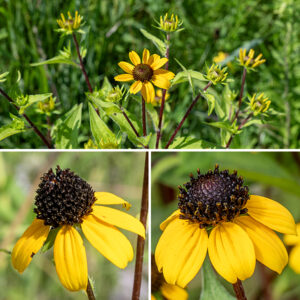
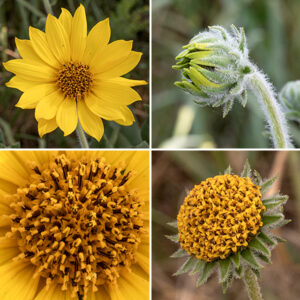
Black-eyed susan (Rudbeckia hirta) stems and leaves. Top: typical stems of black-eyed susan with very long, white, spreading hairs. The leaves are hairy on both upper and lower surfaces and around the margins. Note that the stems are green; the stems of the very similar looking brown-eyed susan are reddish. Bottom left: a typical mid- and upper stem leaf showing the upper surface (top image) and the underside (bottom image); stem leaves are sessile. Bottom right: more basal leaves on the stem have long petioles.
Black-eyed susan is a short (1-2.5 feet), very hairy plant that produces unbranched stems, each of which produces a single flowerhead. Stems are green and densely covered with long white hairs. The leaves are up to 7″ long and 2″ across, gray-green, lance-shaped, with hairy margins, and covered with shorter, stiff hairs that give them a rough texture. The lowest leaves have long, hairy petioles, while the higher leaves have shorter petioles or are sessile; all leaves are restricted to the bottom half of the stem and are alternate. None of the leaves are lobed. Black-eyed susan can be distinguished from brown-eyed susan (Rudbeckia triloba) by the lack of lobed leaves (R. triloba has halberd-shaped lower leaves), generally longer and more numerous ray florets, more than eight bracts behind the flowerheads, and the very long hairs on the green (not reddish), unbranched stem.
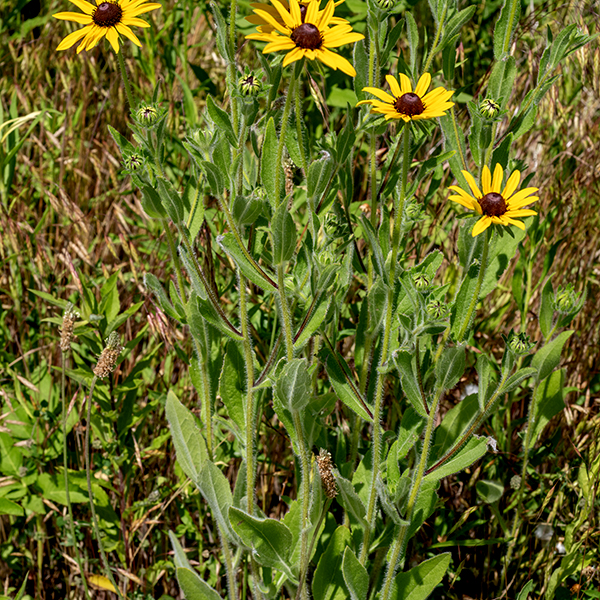
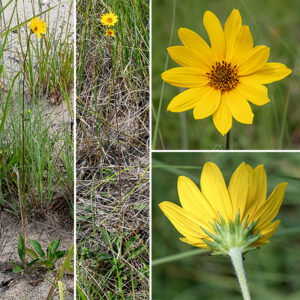
Α colony of black-eyed susan (Rudbeckia hirta) growing on the southeast shore of East Lagoon. Note the extremely hairy stems and leaves.
Black-eyed susan is a short (1-2.5 feet), very hairy plant that produces unbranched stems, each of which produces a single flowerhead. Stems are green and densely covered with long white hairs. The leaves are up to 7″ long and 2″ across, gray-green, lance-shaped, with hairy margins, and covered with shorter, stiff hairs that give them a rough texture. The lowest leaves have long, hairy petioles, while the higher leaves have shorter petioles or are sessile; all leaves are restricted to the bottom half of the stem and are alternate. None of the leaves are lobed. Flowerheads are 2-3″ across; they have two series (outer longer than inner) of numerous slender, sharply-pointed, green bracts beneath the flowerhead, each densely covered with long, stiff hairs; 8-20 (usually less than 12) yellow-orange, sterile ray florets (rarely with a maroon patch near the base of the petal); and 250 to over 500 dark purplish-brown disk florets, each with slender, sharply pointed styles. The fruit consists of numerous four-sided brown or black seeds that remain embedded in the remnants of the disc flowers (a gumdrop shaped, brown mass). Black-eyed susan can be distinguished from brown-eyed susan (Rudbeckia triloba) by the lack of lobed leaves (R. triloba has halberd-shaped lower leaves), generally longer and more numerous ray florets, more than eight bracts behind the flowerheads, and the very long hairs on the green (not reddish), unbranched stem.
Browse more plants
Want to keep exploring more plants? You can view other plants like this one by selecting a characteristic from the list below, or 'browse more plants' to go back to the Plant Finder.
Related Plants
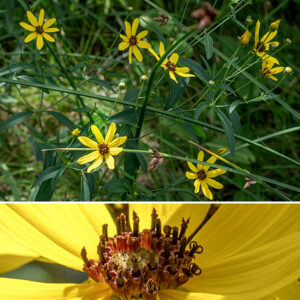
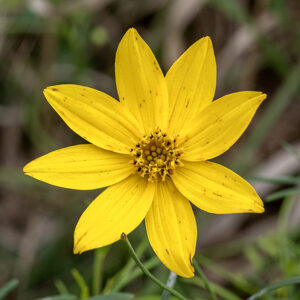
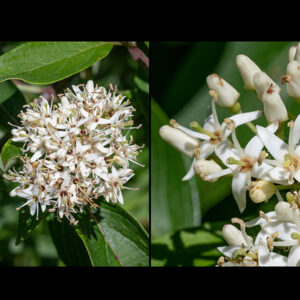
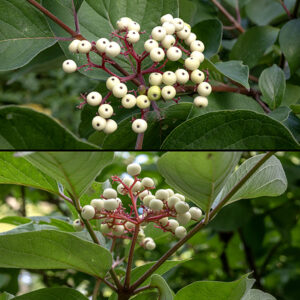
![Evening primrose — clusters of yellow flowers occur at the apex of the plant. The flowers are 1-2" across, with four 1/2-1" long green sepals strongly reflected over a long (3/4-2"), green, cylindrical floral tube (the ovary is located just above the leaf axil), four heart-shaped yellow petals, eight stamens, and a single style with an X-shaped stigma. The sepals typically remain connected (in pairs) along one edge until the flower opens. The seedpods develop within the ovary (the base of the elongate floral tube); they are hairy, urn-shaped with rounded edges, and have four or eight small lobes on the apex. The seeds are claimed to remain viable in the soil for up to 70 years. The flowers open at dusk and close early in the day. — — — There are (at least) three evening primroses in Jackson Park — common evening primrose (Oenothera biennis), northern evening primrose (Oenothera parviflora), and hairy evening primrose (Oenothera villosa). They are easily confused with each other. (Judging by the conflicts between the accounts on Illinois Wildflowers [https://www.illinoiswildflowers.info/], Minnesota Wildflowers [https://www.minnesotawildflowers.info/], and Missouri Plants [http://www.missouriplants.com/], even the experts are confused.) All three species have yellow flowers with an X-shaped stigma, reflected sepals, petals with a small notch in their apex, stems that may be red or green, and lance-shaped leaves with short, widely-spaced teeth. Northern evening primrose is distinguished by (1) the presence of a knob or ridge at the tip of each sepal which the other two species lack (2) a seed capsule with four robust, flaring lobes with rounded tips at the apex of the seed capsule, and (3) a stigma that is very robust and almost fills the opening of the flower. Northern evening primrose has green to yellowish-green sepals. Hairy evening primrose (often but not always) has (1) striped or reddish-tinged sepals (check the buds where this character is often easier to see), (2) flowers that turn orange as they begin to senesce (although the reliability of this character is uncertain), and (3) always has glandular hairs covering the ovary that have "pimple-like" bright-red bases; these red pimples may also occur on the stems. All three species are somewhat similar to prairie sundrop (O. pilosella); the latter has very hairy stems and leaves, and translucent lines that radiate from the base of the petals in the flowers.](https://jacksonparkwildflowers.info/wp-content/uploads/2025/03/Oenothera_biennis-1t-300x300.jpg)
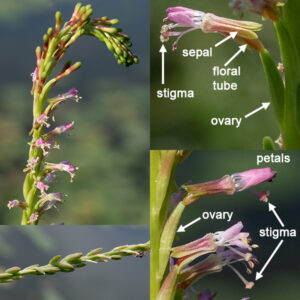
![Northern evening primrose flowers are 3/4-1.5" across, have four yellow, heart-shaped petals, eight yellow stamens, and a cross-shaped stigma on a modest style; the stamens are as long or longer than the petals and the stigma is nearly fills the floral opening. At the base of the flower are four sepals 1/2-1" long, that bend back along the 3/4-1.5" long floral tube as the flower develops with pairs of sepals attached along one edge until the flower opens. Only northern evening primrose with a distinct ridge or knob near the tips of the sepals. The seed capsule develops from the ovary; it is 3/4-1.5" long, cylindrical but tapering slightly towards the tip, with four robust, flaring lobes at the tip. — — — There are (at least) three evening primroses in Jackson Park — common evening primrose (Oenothera biennis), northern evening primrose (Oenothera parviflora), and hairy evening primrose (Oenothera villosa). They are easily confused with each other. (Judging by the conflicts between the accounts on Illinois Wildflowers [https://www.illinoiswildflowers.info/], Minnesota Wildflowers [https://www.minnesotawildflowers.info/], and Missouri Plants [http://www.missouriplants.com/], even the experts are confused.) All three species have yellow flowers with an X-shaped stigma, reflected sepals, petals with a small notch in their apex, stems that may be red or green, and lance-shaped leaves with short, widely-spaced teeth. Northern evening primrose is distinguished by (1) the presence of a knob or ridge at the tip of each sepal which the other two species lack (2) a seed capsule with four robust, flaring lobes with rounded tips at the apex of the seed capsule, and (3) a stigma that is very robust and almost fills the opening of the flower. Northern evening primrose has green to yellowish-green sepals and is the only one of the three evening primroses to (sometimes) have reddish color on some or all of the midvein of the leaves. Hairy evening primrose (often but not always) has (1) striped or reddish-tinged sepals (check the buds where this character is often easier to see), (2) flowers that turn orange as they begin to senesce (although the reliability of this character is uncertain), and (3) always has glandular hairs covering the ovary that have "pimple-like" bright-red bases; these red pimples may also occur on the stems. All three species are somewhat similar to prairie sundrop (O. pilosella); the latter has very hairy stems and leaves, and translucent lines that radiate from the base of the petals in the flowers.](https://jacksonparkwildflowers.info/wp-content/uploads/2025/03/Oenothera_parviflora-1t-300x300.jpg)
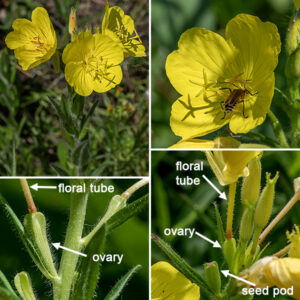
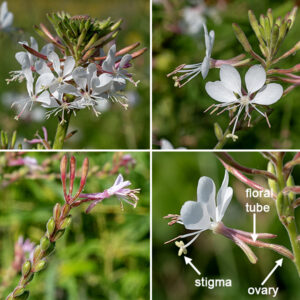
![Hairy evening primrose produves an elongating spike of flowers arises from the apex of the stem; flowers bloom near the tip while older flowers and seed capsules develop below. Individual flowers are 3/4-1.5" across; they sit on a long floral tube with the ovary at its base (attached to a leaf axil). The flowers have four yellow, heart-shaped petals, eight yellow stamens, and a cross-shaped stigma on a modest style; at the base of the flower are four sepals 3/8-3/4" long, reflected back along the floral tube as the flower develops with pairs of sepals attached along one edge until the flower opens. The sepals are often red-striped or red-tinged. Note the long, hairy floral tube below the sepals, the reddish stem, and glandular hairs with red bases on the ovary. The seed capsule develops from the ovary; it is up to 1.75" long, cylindrical but tapering slightly towards the tip, with four tiny lobes at the tip. — — — There are (at least) three evening primroses in Jackson Park — common evening primrose (Oenothera biennis), northern evening primrose (Oenothera parviflora), and hairy evening primrose (Oenothera villosa). They are easily confused with each other. (Judging by the conflicts between the accounts on Illinois Wildflowers [https://www.illinoiswildflowers.info/], Minnesota Wildflowers [https://www.minnesotawildflowers.info/], and Missouri Plants [http://www.missouriplants.com/], even the experts are confused.) All three species have yellow flowers with an X-shaped stigma, reflected sepals, petals with a small notch in their apex, stems that may be red or green, and lance-shaped leaves with short, widely-spaced teeth. Northern evening primrose is distinguished by (1) the presence of a knob or ridge at the tip of each sepal which the other two species lack (2) a seed capsule with four robust, flaring lobes with rounded tips at the apex of the seed capsule, and (3) a stigma that is very robust and almost fills the opening of the flower. Northern evening primrose has green to yellowish-green sepals. Hairy evening primrose (often but not always) has (1) striped or reddish-tinged sepals (check the buds where this character is often easier to see), (2) flowers that turn orange as they begin to senesce (although the reliability of this character is uncertain), and (3) always has glandular hairs covering the ovary that have "pimple-like" bright-red bases; these red pimples may also occur on the stems. All three species are somewhat similar to prairie sundrop (O. pilosella); the latter has very hairy stems and leaves, and translucent lines that radiate from the base of the petals in the flowers.](https://jacksonparkwildflowers.info/wp-content/uploads/2025/03/Oenothera_villosa-1t-300x300.jpg)