Vitis riparia
riverbank grape [Blooms: [May-Jun]
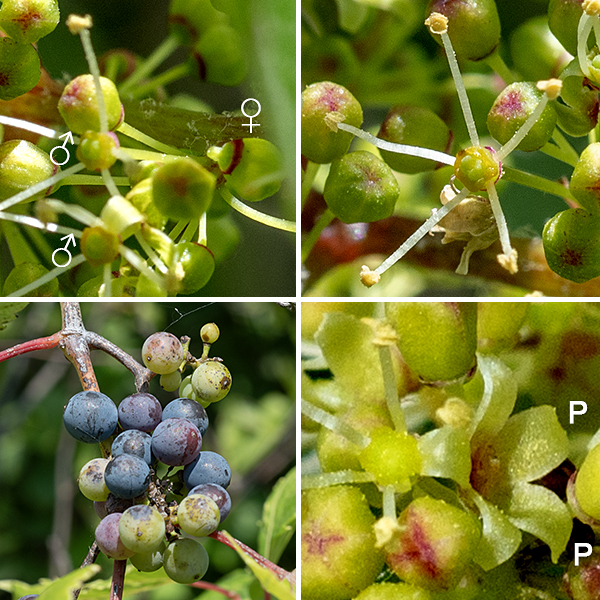
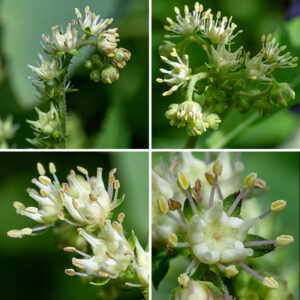
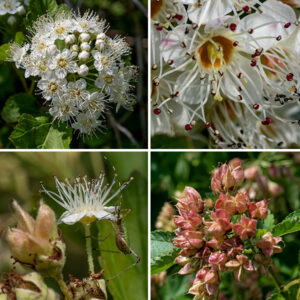
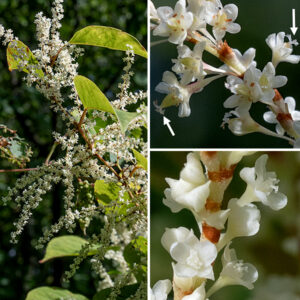
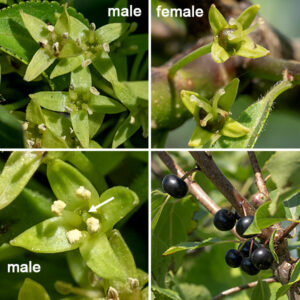
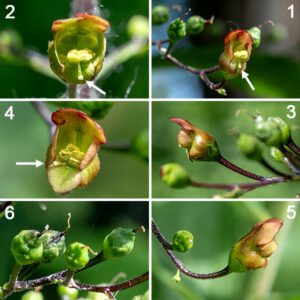
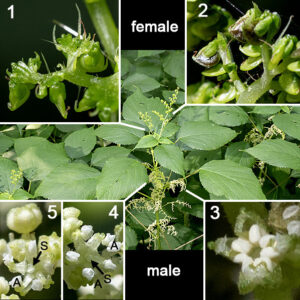
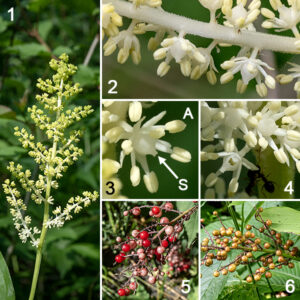
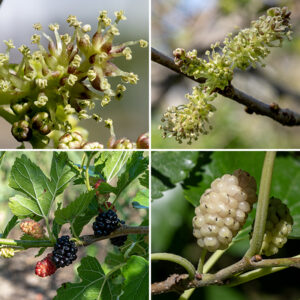
Riverbank grape (Vitis riparia) flowers and fruit. Bottom right: an immature flower with five yellow-green petals (P); the petals soon fall off while the flower continues to develop. Top right: a mature male (staminate) flower with five, very long, stamens; the anthers are tan colored. Top left: two male (♂︎) flowers with an immature female (pistillate) flower (♀︎) to their right. The nipple-like structure is the developing style; when mature the female flower will look like a stubby bud vase. Bottom left: a single bunch of the grapes exhibiting all stages from immature fruit (green) to fully ripe (purple).
Riverbank grape’s flowers develop in 5″ long, drooping, cylindrical or pyramidal panicles opposite the leaves of new branches (but skipping every third leaf). The flowers are greenish-yellow and are best described as skeletal; they may be either unisexual or (rarely) perfect (both male and female reproductive organs functional). The male and female unisexual flowers usually both occur on the same plant, either in separate or mixed clusters; both male and female flowers are 1/8″ across or less, with a minute calyx and five green to yellowish petals that quickly fall off. Male flowers have five very long, pale, erect stamens around a button-like center; female flowers have an ovary with a short style and five short, sterile stamens, often contorted. The fruit are …. grapes — a round berry, 1/4-1/2″ across containing 1-4 seeds, initially green but turning blue-black as it matures, often with a white bloom on the skin. You know, grapes. The fruit of riverside grape is often sour until after a frost, then becomes more “sweet/tart” to the tongue. Riverbank grape is subject to parasitism by the grape filbert gall midge (Ampelomyia vitiscoryloides), an insect whose larvae produce large, very hairy, conical galls at leaf nodes. This gall midge is restricted to the eastern half of North America; it was first described by Alpheus Spring Packard, Jr. in 1869.
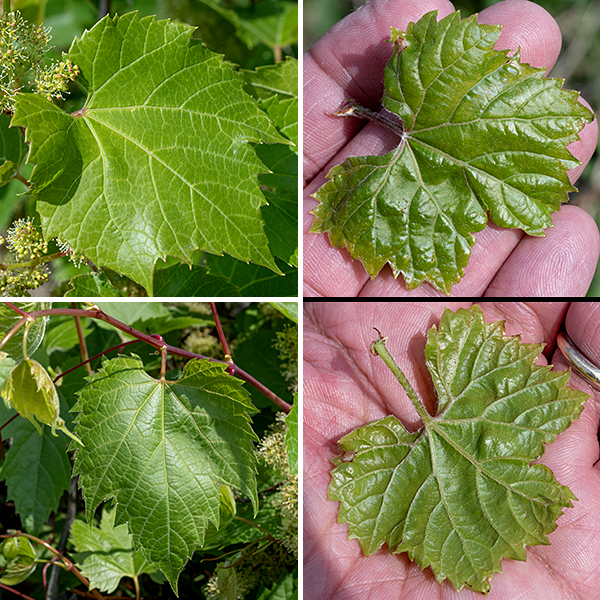
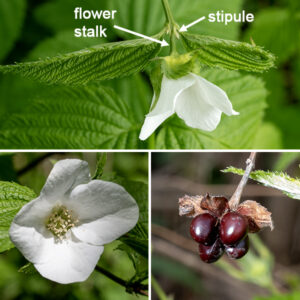
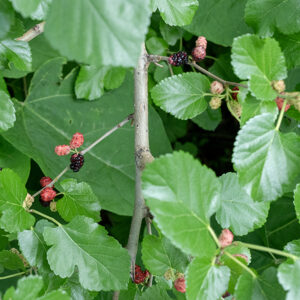
Riverbank grape (Vitis riparia) stems and leaves. Right: a single immature leaf showing the upper side of the leaf (top image) and the underside of the same leaf (lower image). Top left: a mature leaf showing the typical heart shape with three lobes. The petiole of this leaf is not visible. Bottom left: another mature, heart-shaped leaf with three lobes. Here the red petiole is paired on the (red) stem with a (red) tendril which will anchor the vine to neighboring vegetation.
Riverbank grape is a native perennial vine that can grow up to 50 feet long. It can climb surrounding vegetation and structures using its tendrils but can only rise a few feet off the ground without external support. The woody main stem branches occasionally and is covered with brown, shaggy bark; the smaller, non-woody stems are yellowish-green to red, hairless, and sometimes are covered with a waxy bloom. The stems become somewhat wider at leaf nodes (where a thin partition is present across the pith). The tip of an actively growing stem is covered by a pair of young leaves. The alternate leaves are roughly heart- or disc-shaped overall, 4-8″ long and nearly as wide, palmately lobed, (usually) with three clear lobes; the spaces between the lobes may be broad and shallow or narrow and U-shaped. The upper leaf surface is yellowish green and hairless while the underside is pale green with hairs along the main veins; the leaf margins are coarsely serrated with protruding hairs. The leaf petioles are about 3″ long and slender, usually pale green to red and hairless.

Two riverbank grape (Vitis riparia) plants at different stages in its seasonal development. Top: a riverbank grape in full bloom in early June. The fuzzy yellow-green structures are the inflorescences (shown enlarged in the upper left corner). Bottom: a riverbank grape laden with fruit in mid-September. A single bunch of the grapes is shown enlarged in the lower left corner; all stages can be seen from immature fruit (green) to fully ripe (purple).
Riverbank grape is a native perennial vine that can grow up to 50 feet long. It can climb surrounding vegetation and structures using its tendrils but can only rise a few feet off the ground without external support. The woody main stem branches occasionally and is covered with brown, shaggy bark; the smaller, non-woody stems are yellowish-green to red, hairless, and sometimes are covered with a waxy bloom. The stems become somewhat wider at leaf nodes (where a thin partition is present across the pith). The tip of an actively growing stem is covered by a pair of young leaves. The alternate leaves are roughly heart- or disc-shaped overall, 4-8″ long and nearly as wide, palmately lobed, (usually) with three clear lobes; the spaces between the lobes may be broad and shallow or narrow and U-shaped. The upper leaf surface is yellowish green and hairless while the underside is pale green with hairs along the main veins; the leaf margins are coarsely serrated with protruding hairs. The leaf petioles are about 3″ long and slender, usually pale green to red and hairless. The flowers develop in 5″ long, drooping, cylindrical or pyramidal panicles opposite the leaves of new branches (but skipping every third leaf). The flowers are greenish-yellow and are best described as skeletal; they may be either unisexual or (rarely) perfect (both male and female reproductive organs functional). The male and female unisexual flowers usually both occur on the same plant, either in separate or mixed clusters; both male and female flowers are 1/8″ across or less, with a minute calyx and five green to yellowish petals that quickly fall off. Male flowers have five very long, pale, erect stamens around a button-like center; female flowers have an ovary with a short style and five short, sterile stamens, often contorted. The fruit are …. grapes — a round berry, 1/4-1/2″ across containing 1-4 seeds, initially green but turning blue-black as it matures, often with a white bloom on the skin. You know, grapes. The fruit of riverside grape is often sour until after a frost, then becomes more “sweet/tart” to the tongue.
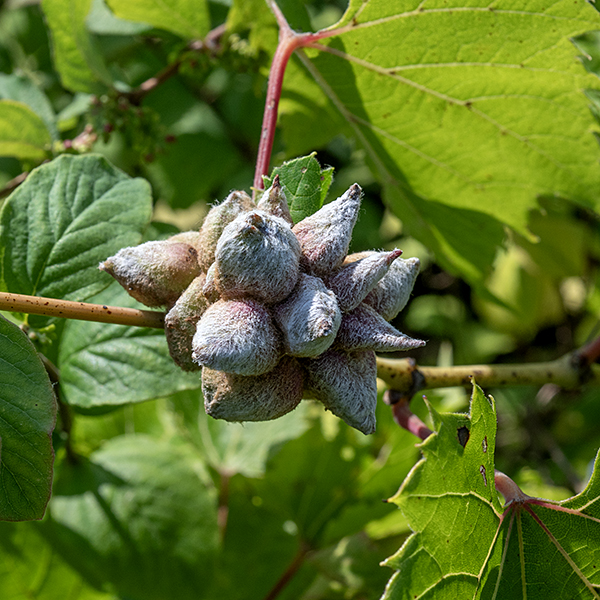
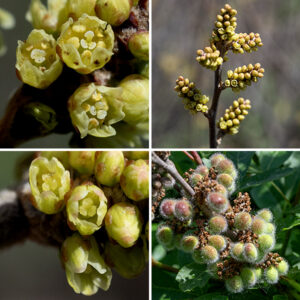
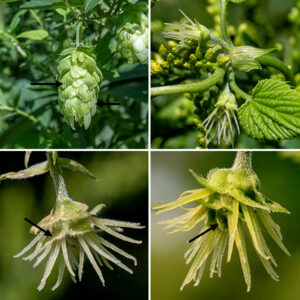
A riverbank grape (Vitis riparia) vine infested with the larvae of a grape filbert gall midge (Ampelomyia vitiscoryloides). Each hairy, conical gall is produced by the plant in response to the larva embedded in the plant’s tissues; the galls are produced only at leaf nodes.
Riverbank grape is subject to parasitism by the grape filbert gall midge (Ampelomyia vitiscoryloides), an insect whose larvae produce large, very hairy, conical galls at leaf nodes. This gall midge is restricted to the eastern half of North America; it was first described by Alpheus Spring Packard, Jr. in 1869.
Browse more plants
Want to keep exploring more plants? You can view other plants like this one by selecting a characteristic from the list below, or 'browse more plants' to go back to the Plant Finder.
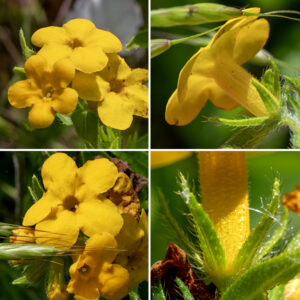
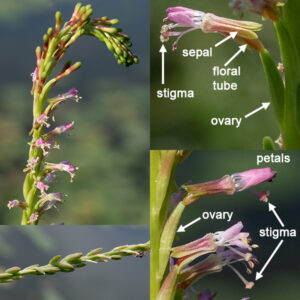
![Evening primrose — clusters of yellow flowers occur at the apex of the plant. The flowers are 1-2" across, with four 1/2-1" long green sepals strongly reflected over a long (3/4-2"), green, cylindrical floral tube (the ovary is located just above the leaf axil), four heart-shaped yellow petals, eight stamens, and a single style with an X-shaped stigma. The sepals typically remain connected (in pairs) along one edge until the flower opens. The seedpods develop within the ovary (the base of the elongate floral tube); they are hairy, urn-shaped with rounded edges, and have four or eight small lobes on the apex. The seeds are claimed to remain viable in the soil for up to 70 years. The flowers open at dusk and close early in the day. — — — There are (at least) three evening primroses in Jackson Park — common evening primrose (Oenothera biennis), northern evening primrose (Oenothera parviflora), and hairy evening primrose (Oenothera villosa). They are easily confused with each other. (Judging by the conflicts between the accounts on Illinois Wildflowers [https://www.illinoiswildflowers.info/], Minnesota Wildflowers [https://www.minnesotawildflowers.info/], and Missouri Plants [http://www.missouriplants.com/], even the experts are confused.) All three species have yellow flowers with an X-shaped stigma, reflected sepals, petals with a small notch in their apex, stems that may be red or green, and lance-shaped leaves with short, widely-spaced teeth. Northern evening primrose is distinguished by (1) the presence of a knob or ridge at the tip of each sepal which the other two species lack (2) a seed capsule with four robust, flaring lobes with rounded tips at the apex of the seed capsule, and (3) a stigma that is very robust and almost fills the opening of the flower. Northern evening primrose has green to yellowish-green sepals. Hairy evening primrose (often but not always) has (1) striped or reddish-tinged sepals (check the buds where this character is often easier to see), (2) flowers that turn orange as they begin to senesce (although the reliability of this character is uncertain), and (3) always has glandular hairs covering the ovary that have "pimple-like" bright-red bases; these red pimples may also occur on the stems. All three species are somewhat similar to prairie sundrop (O. pilosella); the latter has very hairy stems and leaves, and translucent lines that radiate from the base of the petals in the flowers.](https://jacksonparkwildflowers.info/wp-content/uploads/2025/03/Oenothera_biennis-1t-300x300.jpg)
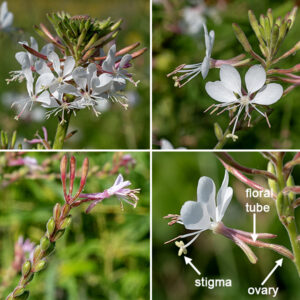
![Northern evening primrose flowers are 3/4-1.5" across, have four yellow, heart-shaped petals, eight yellow stamens, and a cross-shaped stigma on a modest style; the stamens are as long or longer than the petals and the stigma is nearly fills the floral opening. At the base of the flower are four sepals 1/2-1" long, that bend back along the 3/4-1.5" long floral tube as the flower develops with pairs of sepals attached along one edge until the flower opens. Only northern evening primrose with a distinct ridge or knob near the tips of the sepals. The seed capsule develops from the ovary; it is 3/4-1.5" long, cylindrical but tapering slightly towards the tip, with four robust, flaring lobes at the tip. — — — There are (at least) three evening primroses in Jackson Park — common evening primrose (Oenothera biennis), northern evening primrose (Oenothera parviflora), and hairy evening primrose (Oenothera villosa). They are easily confused with each other. (Judging by the conflicts between the accounts on Illinois Wildflowers [https://www.illinoiswildflowers.info/], Minnesota Wildflowers [https://www.minnesotawildflowers.info/], and Missouri Plants [http://www.missouriplants.com/], even the experts are confused.) All three species have yellow flowers with an X-shaped stigma, reflected sepals, petals with a small notch in their apex, stems that may be red or green, and lance-shaped leaves with short, widely-spaced teeth. Northern evening primrose is distinguished by (1) the presence of a knob or ridge at the tip of each sepal which the other two species lack (2) a seed capsule with four robust, flaring lobes with rounded tips at the apex of the seed capsule, and (3) a stigma that is very robust and almost fills the opening of the flower. Northern evening primrose has green to yellowish-green sepals and is the only one of the three evening primroses to (sometimes) have reddish color on some or all of the midvein of the leaves. Hairy evening primrose (often but not always) has (1) striped or reddish-tinged sepals (check the buds where this character is often easier to see), (2) flowers that turn orange as they begin to senesce (although the reliability of this character is uncertain), and (3) always has glandular hairs covering the ovary that have "pimple-like" bright-red bases; these red pimples may also occur on the stems. All three species are somewhat similar to prairie sundrop (O. pilosella); the latter has very hairy stems and leaves, and translucent lines that radiate from the base of the petals in the flowers.](https://jacksonparkwildflowers.info/wp-content/uploads/2025/03/Oenothera_parviflora-1t-300x300.jpg)
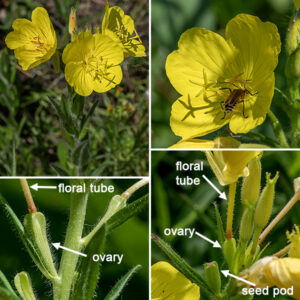
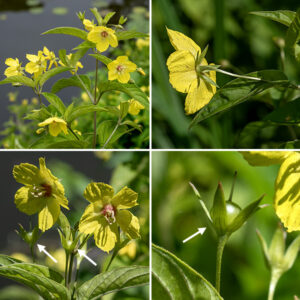
![Hairy evening primrose produves an elongating spike of flowers arises from the apex of the stem; flowers bloom near the tip while older flowers and seed capsules develop below. Individual flowers are 3/4-1.5" across; they sit on a long floral tube with the ovary at its base (attached to a leaf axil). The flowers have four yellow, heart-shaped petals, eight yellow stamens, and a cross-shaped stigma on a modest style; at the base of the flower are four sepals 3/8-3/4" long, reflected back along the floral tube as the flower develops with pairs of sepals attached along one edge until the flower opens. The sepals are often red-striped or red-tinged. Note the long, hairy floral tube below the sepals, the reddish stem, and glandular hairs with red bases on the ovary. The seed capsule develops from the ovary; it is up to 1.75" long, cylindrical but tapering slightly towards the tip, with four tiny lobes at the tip. — — — There are (at least) three evening primroses in Jackson Park — common evening primrose (Oenothera biennis), northern evening primrose (Oenothera parviflora), and hairy evening primrose (Oenothera villosa). They are easily confused with each other. (Judging by the conflicts between the accounts on Illinois Wildflowers [https://www.illinoiswildflowers.info/], Minnesota Wildflowers [https://www.minnesotawildflowers.info/], and Missouri Plants [http://www.missouriplants.com/], even the experts are confused.) All three species have yellow flowers with an X-shaped stigma, reflected sepals, petals with a small notch in their apex, stems that may be red or green, and lance-shaped leaves with short, widely-spaced teeth. Northern evening primrose is distinguished by (1) the presence of a knob or ridge at the tip of each sepal which the other two species lack (2) a seed capsule with four robust, flaring lobes with rounded tips at the apex of the seed capsule, and (3) a stigma that is very robust and almost fills the opening of the flower. Northern evening primrose has green to yellowish-green sepals. Hairy evening primrose (often but not always) has (1) striped or reddish-tinged sepals (check the buds where this character is often easier to see), (2) flowers that turn orange as they begin to senesce (although the reliability of this character is uncertain), and (3) always has glandular hairs covering the ovary that have "pimple-like" bright-red bases; these red pimples may also occur on the stems. All three species are somewhat similar to prairie sundrop (O. pilosella); the latter has very hairy stems and leaves, and translucent lines that radiate from the base of the petals in the flowers.](https://jacksonparkwildflowers.info/wp-content/uploads/2025/03/Oenothera_villosa-1t-300x300.jpg)