Viola pedata
birdfoot violet [Blooms: May]

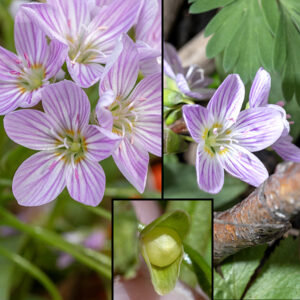
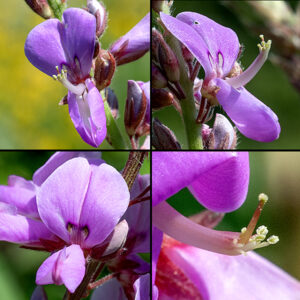
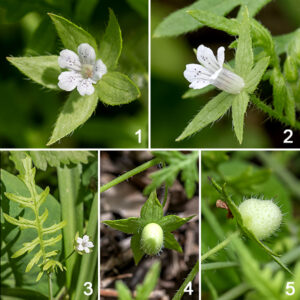
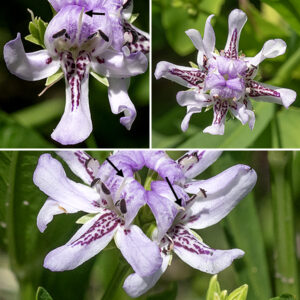
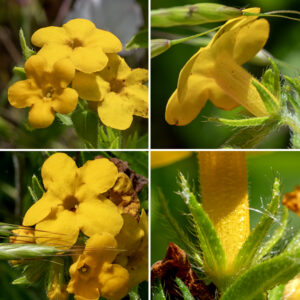
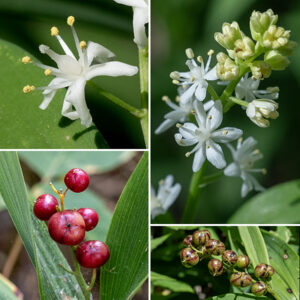
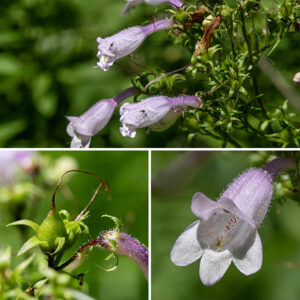
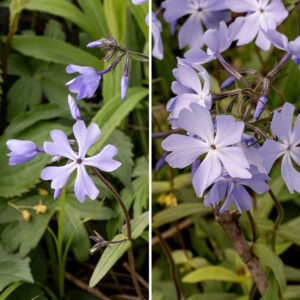
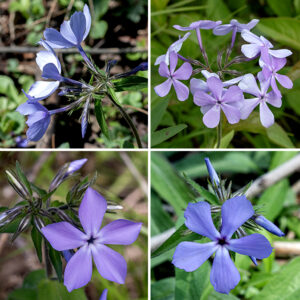
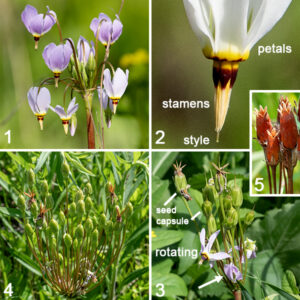
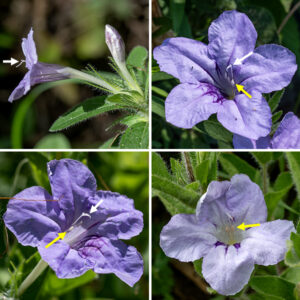
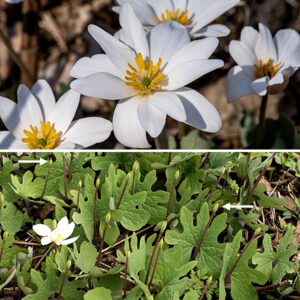
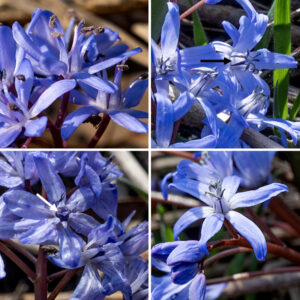
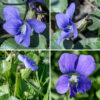
Birdfoot violet (Viola pedata) flowers. (1,2) Two birdfoot violet flowers seen from slightly different angles. Note the large showy petals, the rather subtle nectar guides on the lowest petal, and the absence of the white “beards” on the lateral petals that are so obvious on most violets. (3) A birdfoot violet flower showing its underside. The most obvious features in this image are the shiny U-shaped peduncle at the top, the rounded, reddish brown extension (the spur) of the lowest petal, and the two long sepals cupping the underside of the lowest petal. Careful inspection will reveal the other three, smaller triangle-shaped sepals. (4) The center of a birdfoot violet. The orange structures are the anthers of the stamens (white arrow, “a”); the green structure is the tip of the style (black arrow, “S”). (5) A close-up of the center of the flower shown in (1); labels as in (4).
Birdfoot violet’s flower stalks (peduncles) arise from the rootstock, reaching heights of only 3-6″ tall. The flower stalks are green or purple, up to 4″ long, each bearing a single flower at its apex. Each flower is 3/4-1.5″ across. Visible components include five green sepals; five pale blue-violet to dark purple-violet petals; a tight grouping of orange stamens that pokes out of the throat of the flower; and a short (2 mm long) green style with an oblique, concave area near its tip that is hidden inside the flower. Pollination is usually mediated by long-tongued bees and skippers and other small butterflies. Birdfoot violet uses two steps to disperse its seeds. First, the drying 3/8″ long seed capsule exerts increasing force on the tiny (~2 mm), copper-colored seeds; at some point, the three segments of the seed capsule split apart and the seeds are explosively ejected (an average of 4.5 feet, but up to 15 feet) “much like a marble squeezed between the fingers” (Beattie and Lyons. 1975. Am. J. Bot. 62:714-722). A stalk-like structure on the seeds (the elaiosome) that is made of a sugary gel encourages ants to pick up the seed (or a clump of seeds) and carry them back to the ants’ nests where they germinate. All petals in a flower may be the same color, or the upper two petals may be dark purple-violet while the lower three petals are pale blue-violet. Near the throat of the flower, the base of the lowest petal is white with fine violet nectar guides; this petal extends to form a short spur at the back of the flower. Unlike common violets, there are no white hairs on the lateral petals that occlude the throat of the flower.
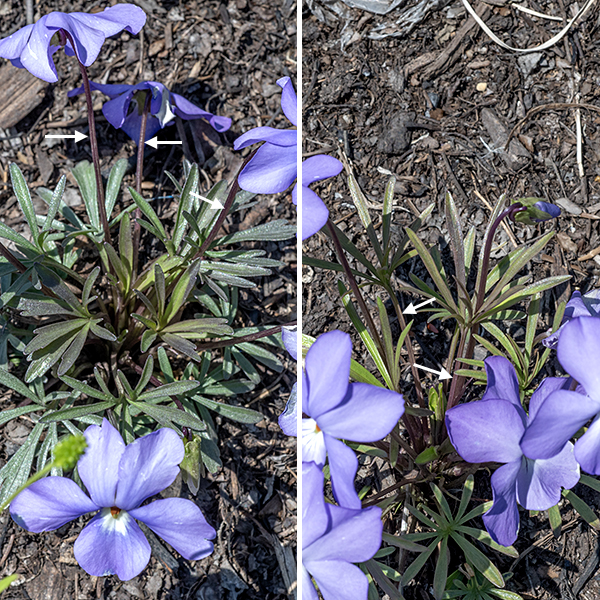
Birdfoot violet (Viola pedata) stems and leaves. Left: three-quarters view from above of the flower stalks (white arrows) and the palmately lobed leaves. Right: a more lateral view of a birdfoot violet plant showing the leaves and their long petioles (white arrows).
Birdfoot violet’s leaves arise directly from the rootstock, making them formally basal leaves. Each leaf is about 1-2″ long and across, egg to kidney shaped in outline, green to gray-green, and deeply divided into 3-5 palmate lobes. Some lobes may themselves be divided into 2-3 smaller lobes.

A birdfoot violet (Viola pedata) plant near the southeast edge of the Obama Presidential Center in early May.
Birdfoot violet is a native perennial widely distributed in the eastern half of the U.S. and Canada. Most violets show some degree of self-fertilization within unopened flowers (cleistogamy) but birdfoot violet does not. Birdfoot violet is easily distinguished from the other violets in Jackson Park by the large size of their flowers, the absence of white hairs occluding the throat of the flower, and the deeply lobed leaves. Birdfoot violet is restricted to high quality habitats. It has recently (2026) been planted on the southeast side of the Obama Presidential Center; we’ll have to see if it spreads to other parts of Jackson Park.
Browse more plants
Want to keep exploring more plants? You can view other plants like this one by selecting a characteristic from the list below, or 'browse more plants' to go back to the Plant Finder.
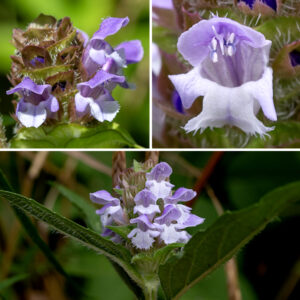
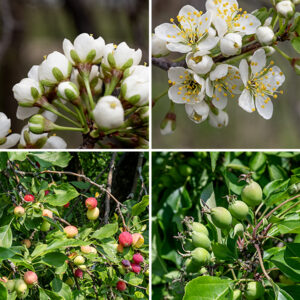
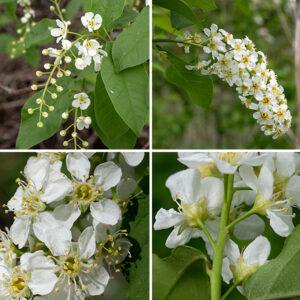
Related Plants