Quercus macrocarpa
bur oak [Blooms: Apr–May]

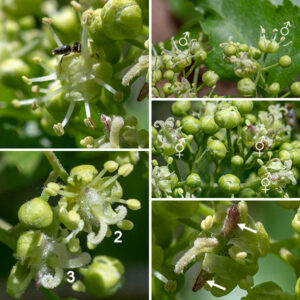
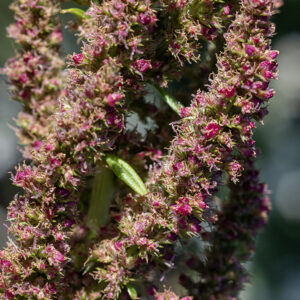
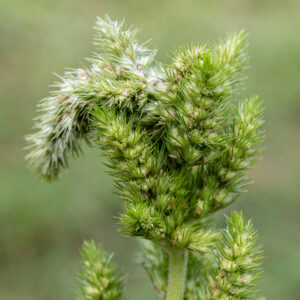
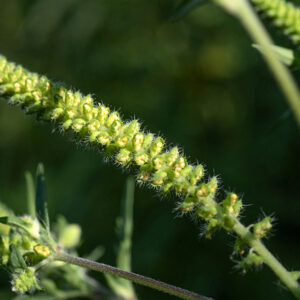
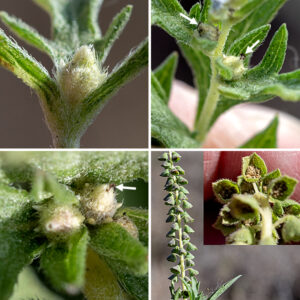
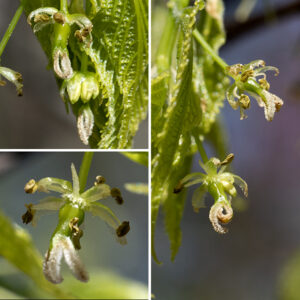
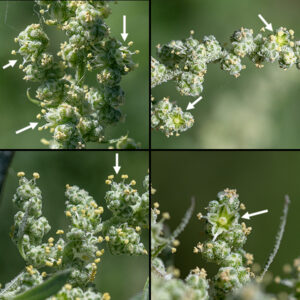
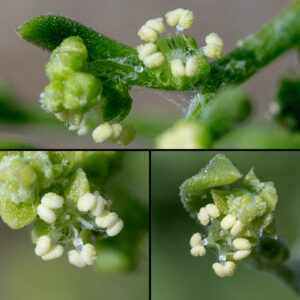
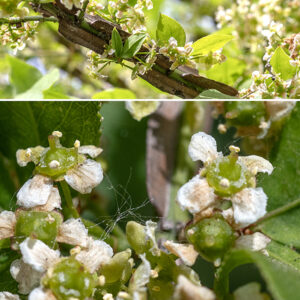
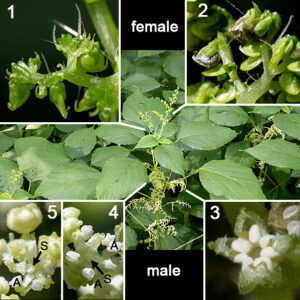
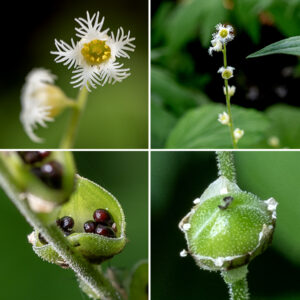
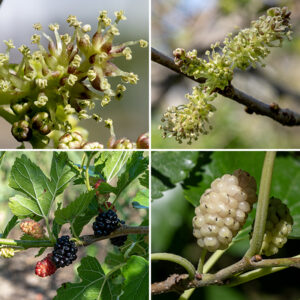
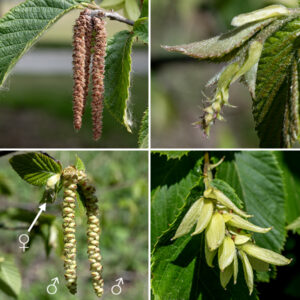
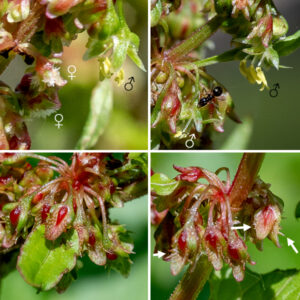
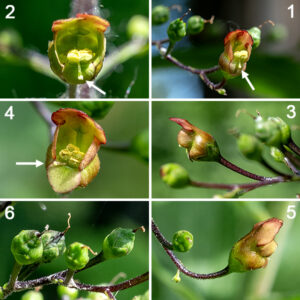
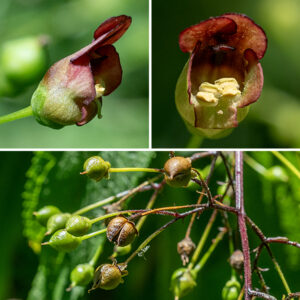
Bur oak (Quercus macrocarpa) flowers and fruit. Top right: a cluster of bur oak female flowers (arrow) nestled in the axil of a leaf. Bottom right: a close-up of three female flowers (arrows) arising from a leaf axil. The bulbous reddish green structure is a modified pistil; the three greenish, pad-like structures on each of the visible pistils are modified styles. Top left: half a dozen bur oak male catkins, with the tips of a few leaves for scale. The green, bulbous structures are the developing anthers; the clusters of the anthers each indicate a male flower. Bottom left: a maturing bur oak acorn. The keeled scales covering most of the acorn are the “bur”. Only the tip of the pericarp wall (the nut) is visible.
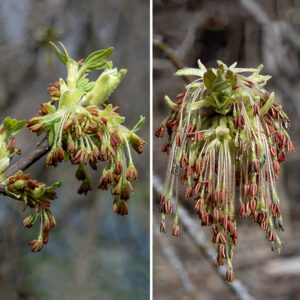
In bur oaks, both male and female flowers are produced on the same tree, but they are widely separated; the flowers are wind pollinated. Male flowers are borne on drooping, yellowish-green catkins 2-5″ long that hang from the tips of the previous year’s twigs; individual male flowers consist of 5-20 stamens surrounded by a lobed calyx. Some sources (e.g., the Missouri Botanical Garden) assert that the female flowers of bur oak also occur on catkins, but this is incorrect. Instead, the female flowers occur alone or in groups of 2-3 on short stalks that arise in the leaf axils of new leaves. Individual female flowers are about 3 mm (1/8″) long; a short, reddish green stalk (a pistil) covered with appressed scales bears naked reddish-green or light green styles on its tip. The female flowers are wind pollinated. Both male and female flowers form after the leaves begin to unfurl; the male catkins precede the female flowers by one to several weeks. Fertilized female flowers produce one or two acorns; the acorns may be nearly sessile or hang from short (<1″) stalks. Mature bur oak acorns are 1.5-2.5″ long and the same across (including the caps) — they are the largest acorn of any oak. The caps (= cupules) cover at least half of the length of bur oak acorns, often so much that only a nubbin of the acorn is visible. The caps are covered with coarse scales that have an obvious keel and appear knobby; the marginal scales on the caps bear soft awns up to 8 mm (1/3″) long that form a conspicuous fringe above the acorn — this is the “bur” that is referred to in the common name in analogy to the machine tool used for grinding. The acorns mature and germinate over a single summer; they do not need to be exposed to cold to germinate.

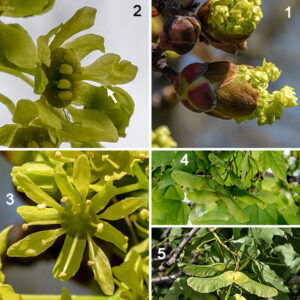
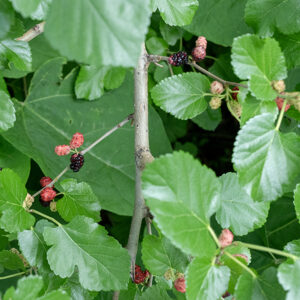
Bur oak (Quercus macrocarpa) stems and leaves. Right top: a young bur oak leaf that was photographed while the tree was in flower. Right bottom: a mature bur oak leaf in July. The upper surface of the leaf is shown in the upper image; the underside of the same leaf is shown in the lower image. Left top: the ridged or keeled bark on a bur oak branch. Left bottom: the furrowed bark of the trunk of a bur oak.
The bark on the trunk of bur oaks is gray brown to brown and is deeply furrowed; between the furrows are flat-topped, corky ridges. The bark on branches and twigs is also gray brown to brown and covered with prominent, elevated, irregular ridges or keels that make the branches look like stereotypical troll or goblin arms. The leaves are alternate, 4-10″ long and 2.5-5″ across; they develop off the twigs. Overall, the leaves are obovate or elliptical in overall outline, but that shape is hidden by the pinnitifid margins of the rounded lobes of the leaf, which extend well into the leaf blade. The leaf margins lack any bristles or true teeth, but the margins are irregular and undulate; the deepest lobes occur near the middle of the leaf. The upper surface of the leaf is dark green and hairless while the underside is pale gray-green and covered with short, fine hairs. The petioles are 1/2-1″ long and light green; they may or may not be hairy. The leaves turn golden brown in the autumn.

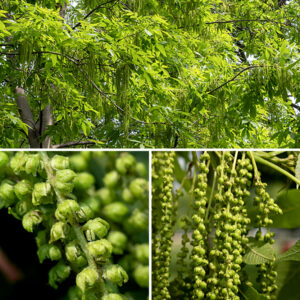
A young bur oak (Quercus macrocarpa) on the shore of Bobolink Meadow in the spring (early May); the tree has a few emerging leaves and numerous dangling male catkins (main image, left). Top right: a bur oak sapling with a mature foliage in June. Bottom right: a close-up of a pair of developing bur oak acorns.
Bur oak (Quercus macrocarpa) is a tree native to almost all the states in the eastern U.S. and the eastern provinces of eastern Canada. In Illinois, bur oaks reach a height of 80-120 feet and produce a trunk as much as five feet across. Depending on location, bur oaks can achieve an age of two to three hundred years and can still produce acorns at four hundred years old. It is the most cold-tolerant of all the oaks. Bur oak has a deep taproot and widely spreading lateral roots. It prefers moist, loamy soils but is tolerant of sandy, dry soils and its thick bark also makes it fire-tolerant; it does well on prairies. However, it does not tolerate shade so does not flourish in competition with previously established trees and shrubs.

A young bur oak (Quercus macrocarpa) downed by one of the Jackson Park beavers. The inset on the left shows an enlarged view of the stump and the base of the trunk. Apparently the beaver was unable to drag the trunk down to the waterline of the lagoon.
Browse more plants
Want to keep exploring more plants? You can view other plants like this one by selecting a characteristic from the list below, or 'browse more plants' to go back to the Plant Finder.
Related Plants