Dianthus barbatus
sweet-William [Blooms: Jun-Jul]

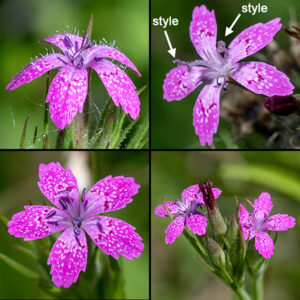
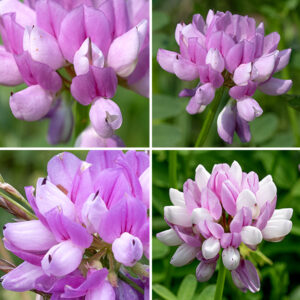
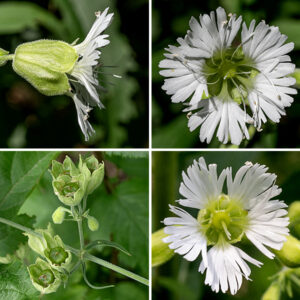
Top: A cyme of sweet-William (Dianthus barbatus) flowers from plants on the east side of Wooded Island. Bottom right: lateral view of a sweet William flower. The white, tapered cylinders emerging from the center of the flower are the filaments of the stamens; the anthers were spent and have fallen off. The two fuzzy cylinders labeled “s” are the two styles. Bottom left: a just-opened sweet William flower. Two stamens with terminal anthers have emerged from the throat of the flower; additional emerging stamens (with anthers) can be seen deeper in the throat.
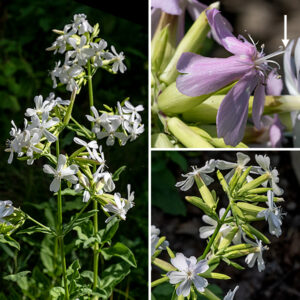
The inflorescence of sweet-William, located at the apex of the stem, is a flat-topped or slightly domed cyme of 5-30 flowers. Individual flowers are about an inch across, consisting of a tubular calyx about 3/8″ long with five sharply triangular lobes; five broad, variously colored petals that have very narrow bases (“clawed”) and a toothed or fringed outer edge; 10 stamens with purplish anthers (which often fall off the filament); and two styles. Fertilized flowers produce oval to cylindrical seed capsules about 1/2″ long with four teeth around the open end.

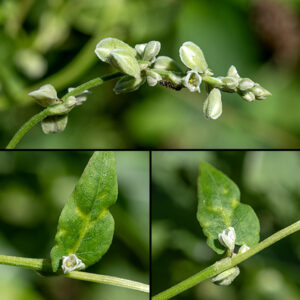
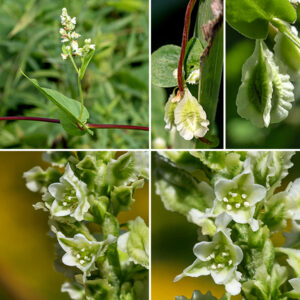
Sweet-William (Dianthus barbatus) stems and leaves. (1) A single leaf of sweet-William, showing the upper surface of the leaf (1a) and the underside of the same leaf (1b). The edges of the leaf are torn where it was removed from the fused opposite leaf. (2) A stem of sweet-William with a pair of opposite leaves that are fused at their bases, as is normal for this species. (3, 4) Closer views of two other leaf pairs where the bases are, to varying degrees, fused to each other.
Sweet-William can grow to 12-24″ tall at maturity. It has a single, hairless stem that is approximately square in cross section (with the angles rounded), sometimes with an occasional branch in the upper part of the stem. The leaves are opposite, lance shaped or oblong, up to 3″ long and 3/4″ wide with a pointed tip; they may be sessile or may have a short petiole. Opposite pairs of leaves are fused at their bases and swollen at the node; the more basal sections of the leaf often cup the stem.

The top half of a sweet-William (Dianthus barbatus) plant growing near the tip of the peninsula on the east side of Wooded Island at the end of June.
Sweet-William (Dianthus barbatus) is an exotic perennial native to southern Europe. The flowers of sweet-William are edible. Sweet-William prefers deep, organic-rich, well drained soils in full sun, preferably in a disturbed site. The sweet-William plants growing in Jackson Park are undoubtedly escapees from a nearby garden (a rare event). The only other Dianthus sp. in Jackson Park is Deptford pink (Dianthus armeria), also a perennial exotic. The two species are similar in having fringed petals and a terminal inflorescence, but otherwise you would never confuse them; Deptford pink is a subtle beauty, sweet William shouts for joy.
Browse more plants
Want to keep exploring more plants? You can view other plants like this one by selecting a characteristic from the list below, or 'browse more plants' to go back to the Plant Finder.
Related Plants