Euonymus atropurpureus
Eastern wahoo [Blooms: Jun]
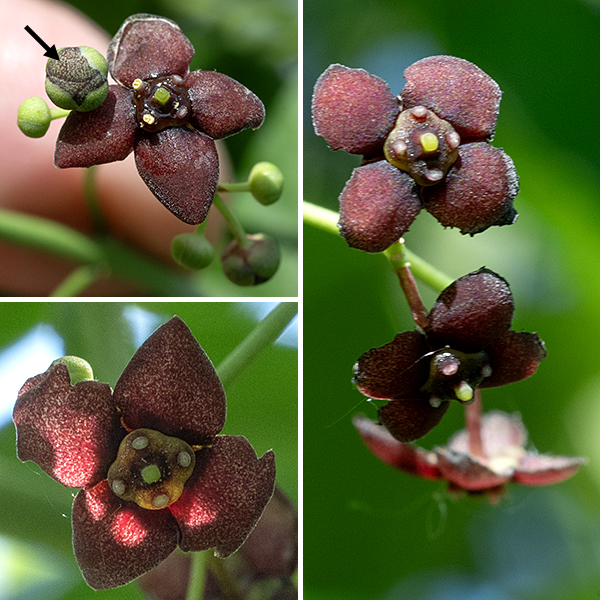
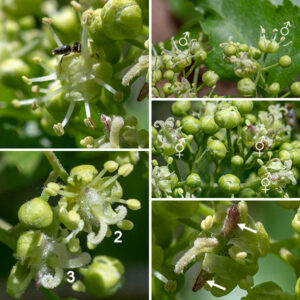
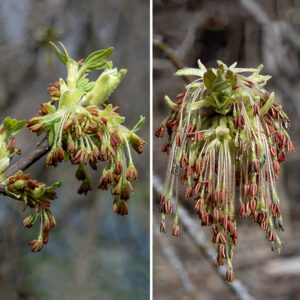
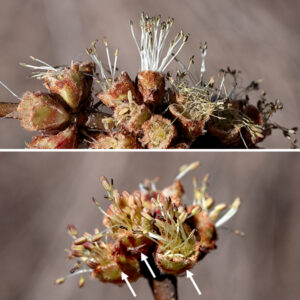
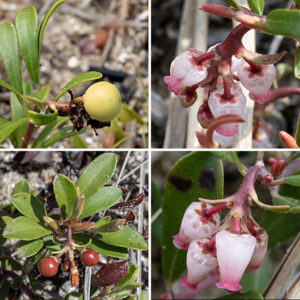
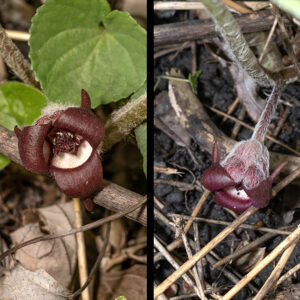
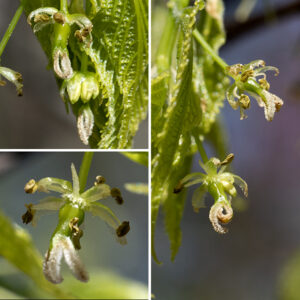
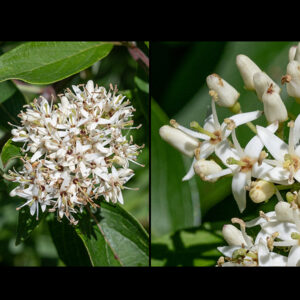
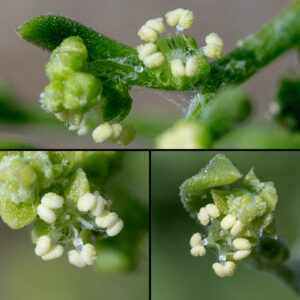
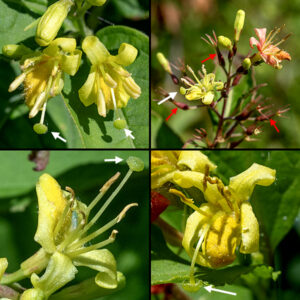
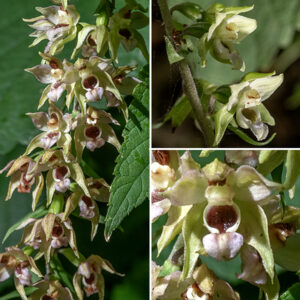
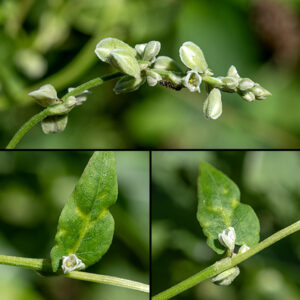
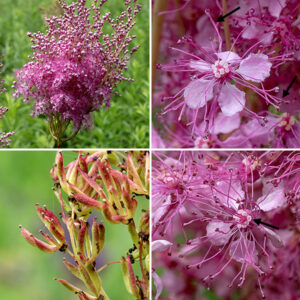
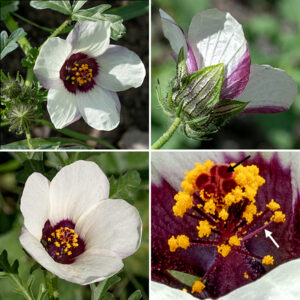
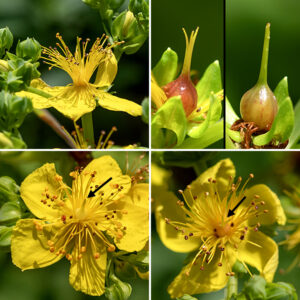
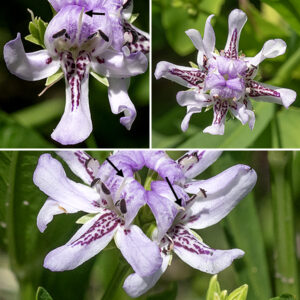
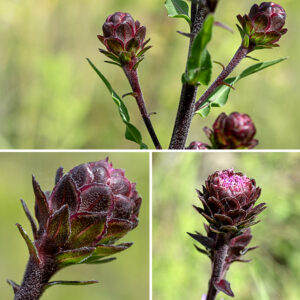
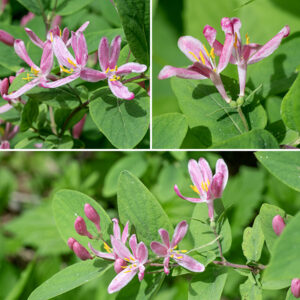
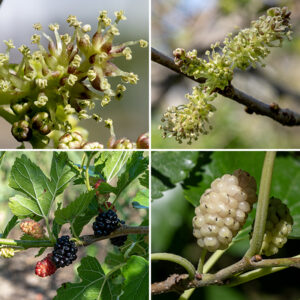
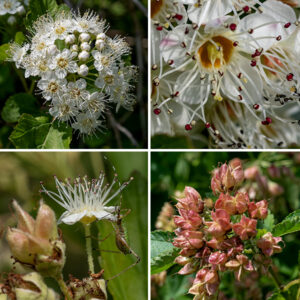
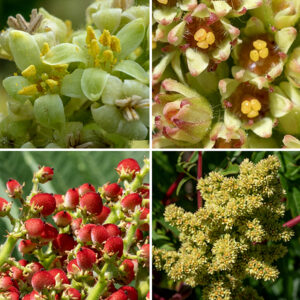
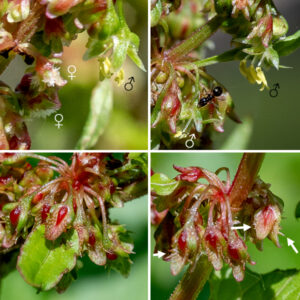
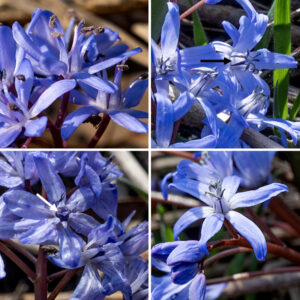
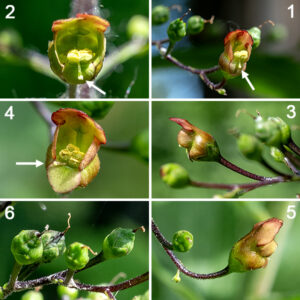
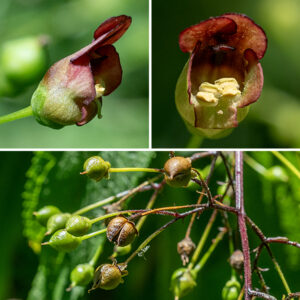
Eastern wahoo (Euonymus atropurpureus) flowers. Right: a portion of the inflorescence of Eastern wahoo. In the upper flower (seen face-on), note the four maroon petals and the central disc bearing a single green style in its center and four stamens with yellow to whitish anthers. One of the lower flowers is seen in profile, highlighting the relative elevation of the stamen and the style. Top left: a cyme of Eastern wahoo with one newly opened flower and five floral buds. The bud on the upper left (black arrow) is just beginning to open; its four green sepals and portions of the four maroon petals (still tightly furled) are apparent. Bottom left: a close-up of a single flower.
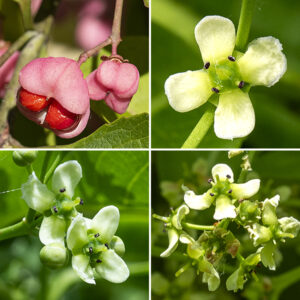
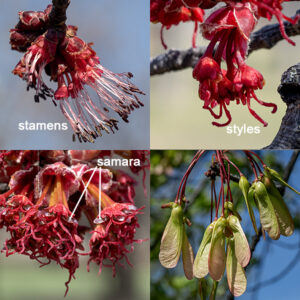
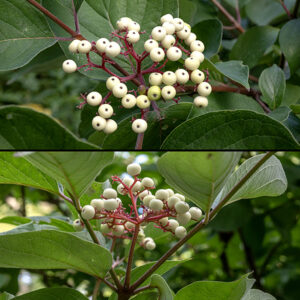
The inflorescence of Eastern wahoo is a branching cyme that arises from a leaf axil; the cyme carries seven to about twenty reddish-purple to maroon flowers. Individual flowers are about 8 mm (a bit over 1/4″) across, hairless, with four greenish purple, oval sepals that are fused at their bases; four spreading, reddish purple, oval petals; four stubby stamens with yellow anthers; and a pistil with a short, stout, green style. Fertilized flowers produce a four lobed seed capsule, initially light pink or pale purple but maturing to pinkish purple. The seed capsule splits open in the fall to expose four fleshy, bright red arils (the fruits), each of which contains two seeds.
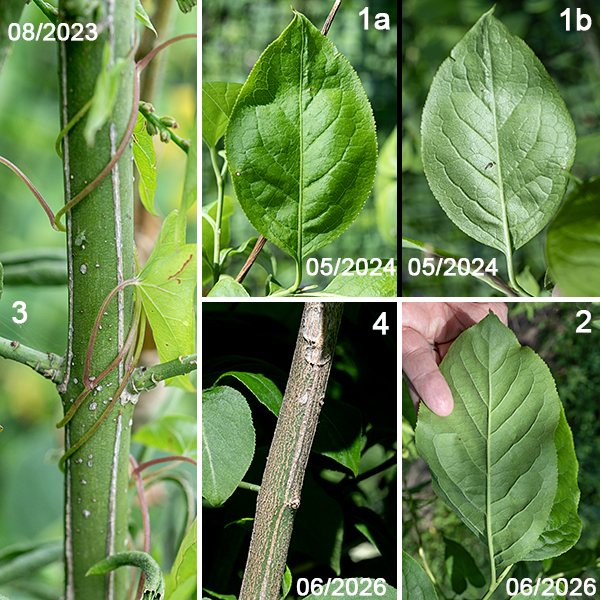
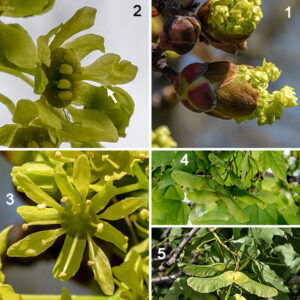
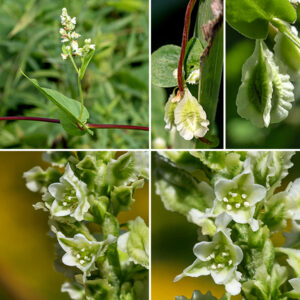
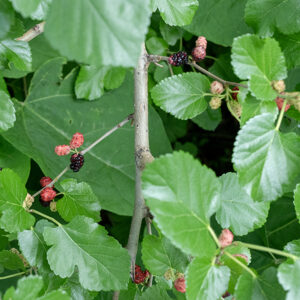
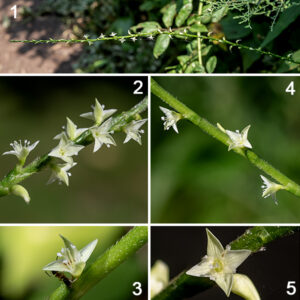
Eastern wahoo (Euonymus atropurpureus) stems and leaves. The sapling photographed was transplanted to Jackson Park in 2022. (1) A single leaf in leaf in early May, 2024 showing the upper surface of the leaf (1a) and the underside of the same leaf (1b). (2) The underside of a leaf from the same sapling in early June, 2026. Note the larger size of the leaf two years after the images in (1). (3) The trunk of the same Eastern wahoo sapling in late August of 2023; the trunk is covered with the twining stems of hedge bindweed (Calystegia sepium). Note the narrow, corky strips of tan bark running vertically on a background of green bark. (4) The same trunk in mid-June, 2026. Note the proliferation of the vertical strands of corky bark.
An Eastern wahoo can reach a height of about 25 feet with the canopy formed from relatively sparse ascending branches. The trunk is slender — 1.5-2″ wide at breast height. The bark of the trunk and larger branches is thin, gray, and slightly rough. Smaller branches are dull green with thin vertical strips of gray, corky bark running from one branch node to the next, and occasional “blobs” of gray bark scattered over the surface. The youngest twigs are almost entirely green and may be round or four-angled in section. The leaves are opposite, up to 5.5″ long and 2″ across, elliptical with a sharply pointed tip; the margins are covered with fine sharp or rounded teeth. The leaves are borne on a slender to stout, hairless petiole about 1/4-2/3″ long. The upper surface of the leaf is dark green and hairless; the lower surface is paler and covered with fine hairs. The leaves turn a vivid yellow or red in the autumn.
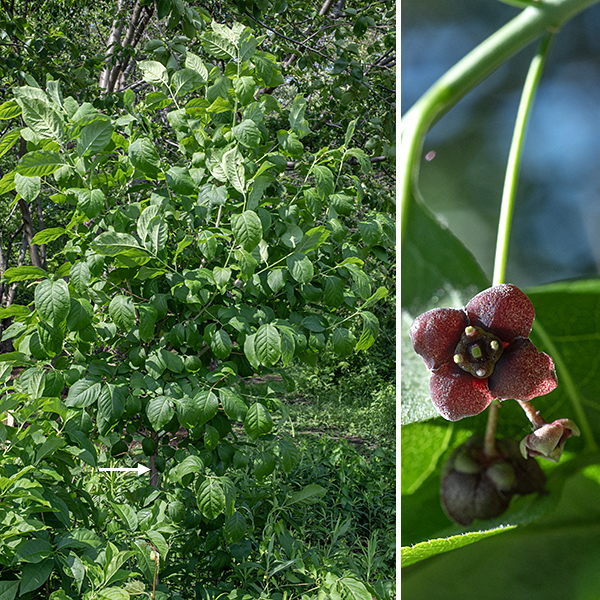
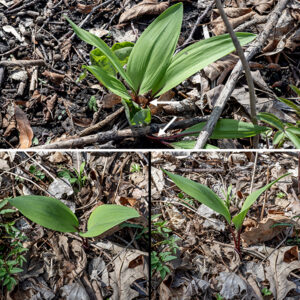
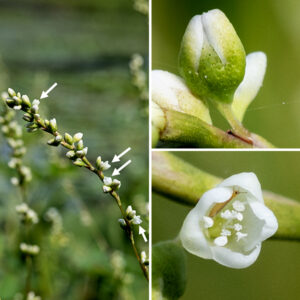
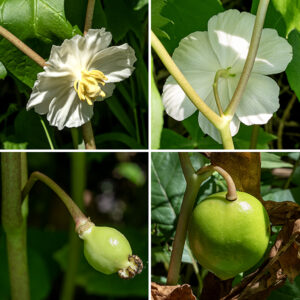
Left: An Eastern wahoo (Euonymus atropurpureus) sapling about seven feet tall growing on the south shore of Columbia Basin. The white arrow points to the trunk of the sapling. The base of the sapling is surrounded by metal mesh to protect it from the depredations of the local beavers; the mesh is covered with other vegetation and difficult to see here. Right: a much-enlarged image of an Eastern wahoo flower.
Eastern wahoo (Euonymus atropurpureus) is a native shrub or small tree whose range covers most of the eastern half of the U.S. Eastern wahoo is most common in the Midwest.
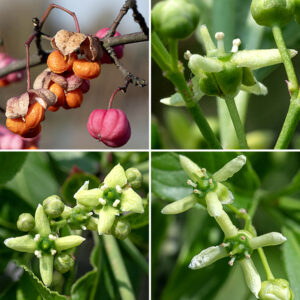
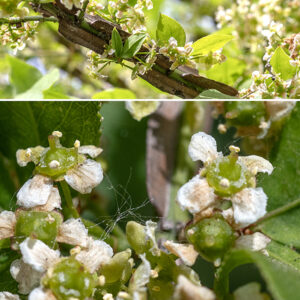
A handout occasionally distributed by the Jackson Park Advisory Council (“Wooded Island Tree Identification”) identifies one tree on the west side of Wooded Island (south of Osaka Garden) as an Eastern wahoo. This tree, unfortunately, is not an Eastern wahoo but is instead an exotic species of Euonymus — a European spindletree (E. europaeus). Indeed, all the Euonymus sp. on Wooded Island are one of three exotic species — winged Euonymus (E. alatus), European spindletree (E. europaeus), or Hamilton’s spindletree (E. hamiltonianus) and all three have blooms that lack the deep maroon color of Eastern wahoo’s flowers. A sapling labeled “Eastern wahoo (Euonymous atropurpureus)” was planted on the south shore of Columbia Basin in 2022. When it bloomed this year (2026) and showed maroon petals on the flowers, I could finally confirm that species identification. The seed capsule of Eastern Wahoo is pinker than those of European spindletree (E. europaeus) or Hamilton’s spindletree (E. hamiltonianus) and the arils are orange or scarlet respectively, not the red of Eastern wahoo. The best way to distinguish the three species is by the color of their petals — only Eastern wahoo has reddish purple to maroon petals, while the other two species have petals that are white, green, or yellow.
Browse more plants
Want to keep exploring more plants? You can view other plants like this one by selecting a characteristic from the list below, or 'browse more plants' to go back to the Plant Finder.
Related Plants