Ranunculus sardous
hairy buttercup [Blooms: May-Jun]
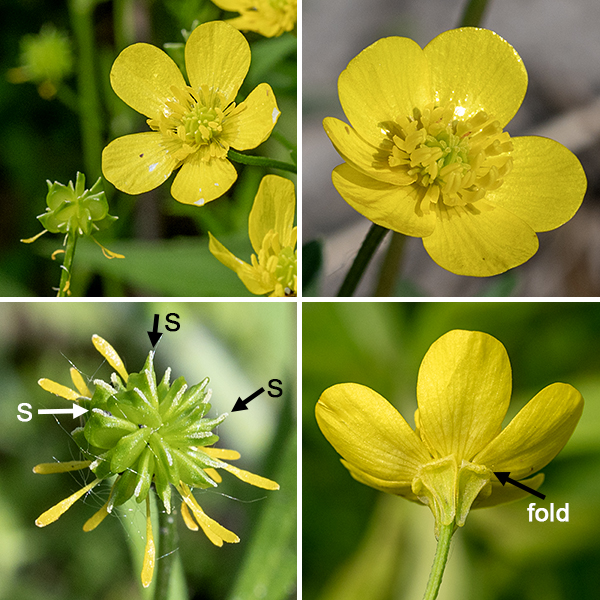
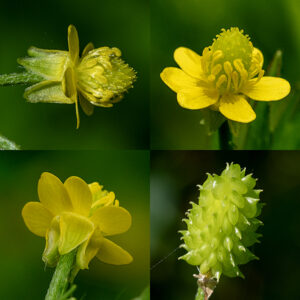
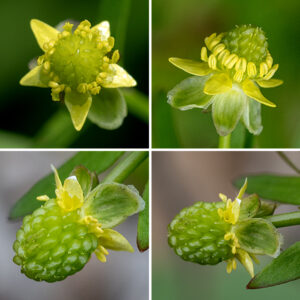
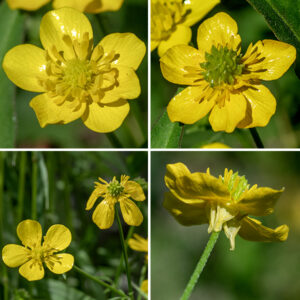
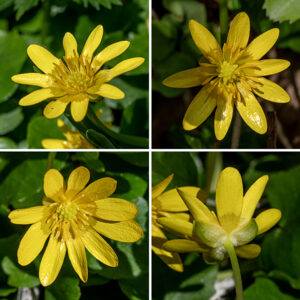
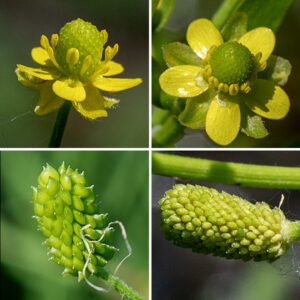
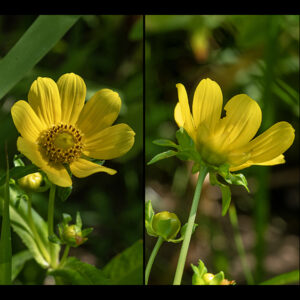
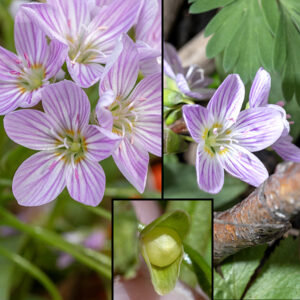
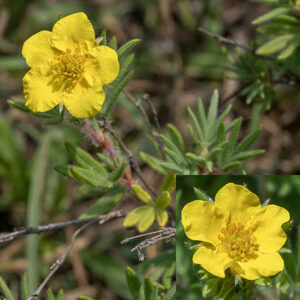
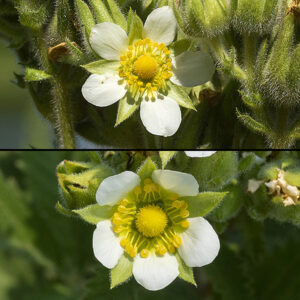
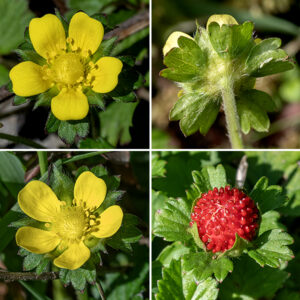
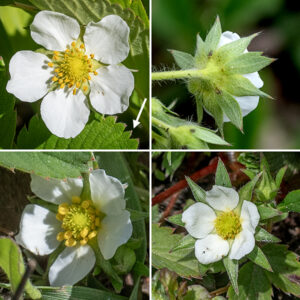
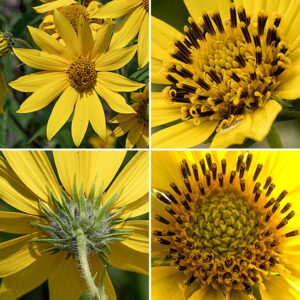
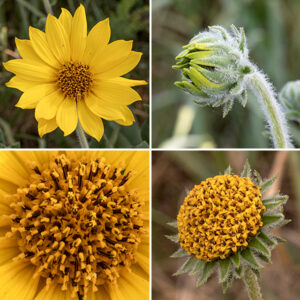
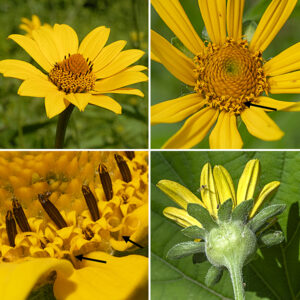
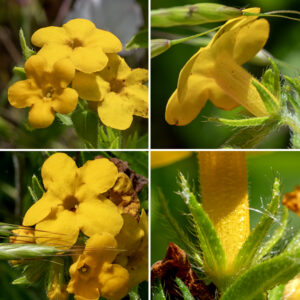
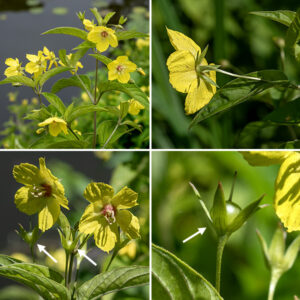
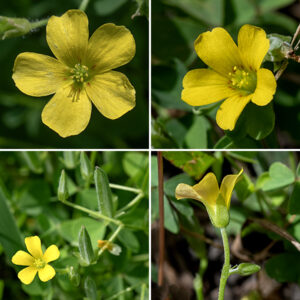
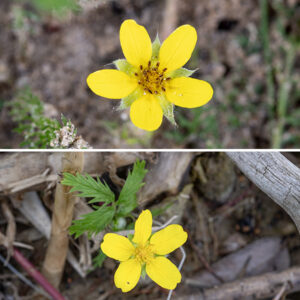
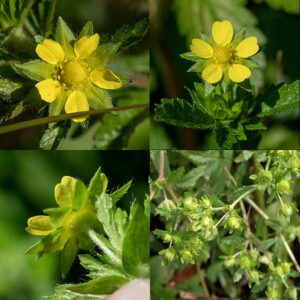
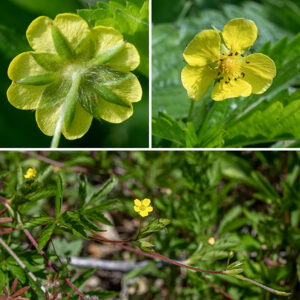
Hairy buttercup (Ranunculus sardous) is an exotic plant that is native to Europe, now widely naturalized in North America. It may grow as a perennial or biennial but it is most commonly an annual. Individual flowers have five sepals, each 1/8-1/4″ long with a sharp transverse fold at their base such that the sepals point down (are reflexed), parallel to the stem. There are five petals that are 7-10 mm long and 4-8 mm wide, roughly egg shaped, with the upper surface a brilliant, glossy yellow. Finally, two to three dozen yellow stamens with yellow anthers surround a yellowish-green central ovary with plate-like segments radiating out from the center of the ovary, each with a blunt, short style. The fruit develops by an enlargement of each of these segments, which remain attached to each other. Hairy buttercup is easily confused with early buttercup (Ranunculus fascicularis), but the sepals of early buttercup lie parallel to the petals (horizontal) while the sepals of hairy buttercup have a distinct transverse fold at their base such that the sepals lie parallel to the floral stem, at a steep angle to the petals.
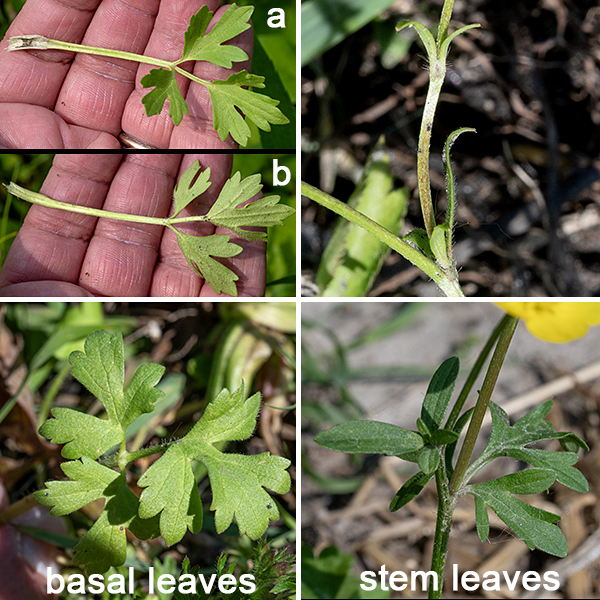
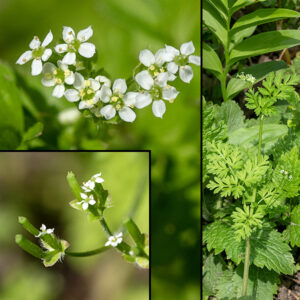
Hairy buttercup (Ranunculus sardous) stems and leaves. The basal leaves are shown in the images on the left, the stem leaves are shown in the images on the right. Top left: a single basal leaf showing (a) the upper surface of the leaf, and (b) the underside of the same leaf. Note that the three leaflets are attached to a long petiole, with each leaflet subdivided into multiple lobes. Bottom left: a close-up of the leaflets on a basal leaf. Bottom right: stem leaves about halfway up the stem. The lower stem leaves are divided into lobes (like the basal leaves). Top right: the stem leaves high on the stem are reduced to simple bracts.
The stems of hairy buttercup are hairy, ascending or erect, and up to 20″ tall; the base is not bulbous (again, unlike most Ranunculus sp.). Both basal and alternate stem leaves occur and persist through flowering. The basal leaves are 0.5-2.75″ long and 0.5-2.5″ across and are deeply lobed with long petioles; they are usually compound, with three leaflets (sometimes just lobes). The lobes are either oblong or wider towards the tip, the base rounded or heart shaped. The stem leaves are also hairy; they have short petioles or are sessile. The stem leaves become smaller higher on the stem, with the lobes becoming narrower, more sharply divided into three parts, and with more sharply pointed lobes.
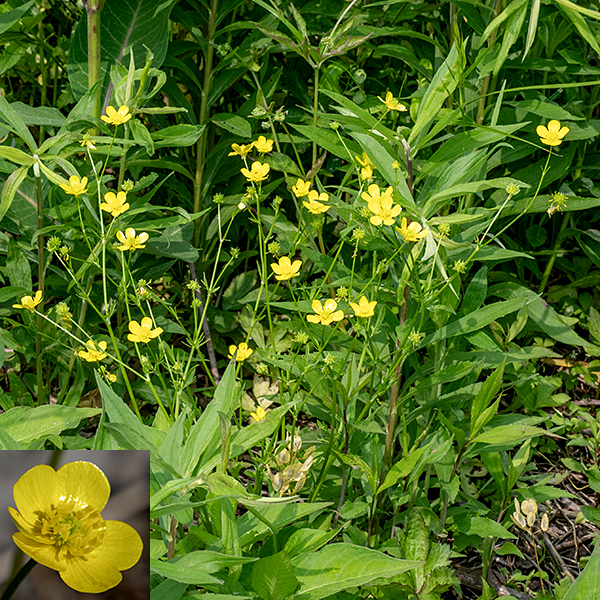
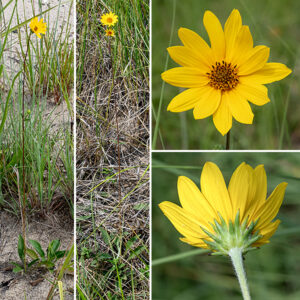
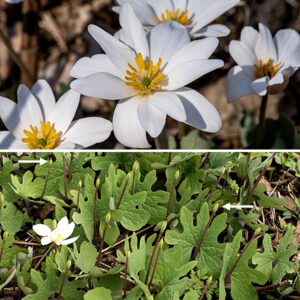
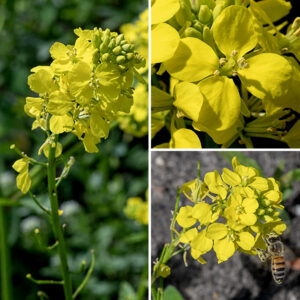
A thriving colony of hairy buttercup (Ranunculus sardous) on the west shore of West Lagoon in mid-June. An enlarged image of a single flower is present in the lower left of the main image.
Hairy buttercup (Ranunculus sardous) is an exotic plant that is native to Europe, now widely naturalized in North America. It may grow as a perennial or biennial but it is most commonly an annual. The roots of hairy buttercup are fibrous (unlike most Ranunculus sp., which have tuberous roots). The stems of hairy buttercup are hairy, ascending or erect, and up to 20″ tall; the base is not bulbous (again, unlike most Ranunculus sp.). Both basal and alternate stem leaves occur and persist through flowering. The basal leaves are 0.5-2.75″ long and 0.5-2.5″ across and are deeply lobed with long petioles; they are usually compound, with three leaflets (sometimes just lobes). The lobes are either oblong or wider towards the tip, the base rounded or heart shaped. The stem leaves are also hairy; they have short petioles or are sessile. The stem leaves become smaller higher on the stem, with the lobes becoming narrower, more sharply divided into three parts, and with more sharply pointed lobes. Individual flowers have five sepals, each 1/8-1/4″ long with a sharp transverse fold at their base such that the sepals point down (are reflexed), parallel to the stem. There are five petals that are 7-10 mm long and 4-8 mm wide, roughly egg shaped, with the upper surface a brilliant, glossy yellow. Finally, two to three dozen yellow stamens with yellow anthers surround a yellowish-green central ovary with plate-like segments radiating out from the center of the ovary, each with a blunt, short style. The fruit develops by an enlargement of each of these segments, which remain attached to each other. Hairy buttercup is easily confused with early buttercup (Ranunculus fascicularis), but the sepals of early buttercup lie parallel to the petals (horizontal) while the sepals of hairy buttercup have a distinct transverse fold at their base such that the sepals lie parallel to the floral stem, at a steep angle to the petals. Hairy buttercup prefers disturbed habitats but tends to die back in late spring or early summer. The foliage is apparently quite bitter and tends to be avoided by grazing animals.
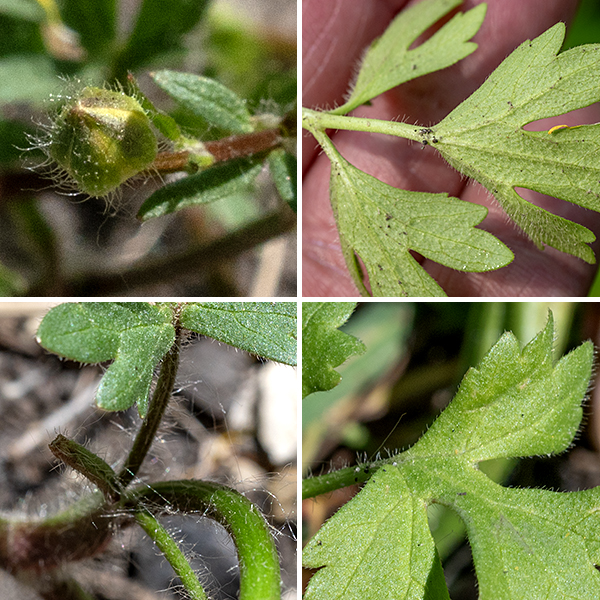
The hairiness of hairy buttercup (Ranunculus sardous). From the previous images, you might have wondered why this buttercup is saddled with the adjective “hairy.” It is indeed hairy, but the hairs are pale and easy to overlook. Here I offer close-up views of the stems and leaflets of two basal leaves (top right, bottom right), an unopened bud (top left) and a stem and the petiole of a stem leaf (bottom left) — this species is markedly hairy, especially in contrast with other Ranunculus sp.
Browse more plants
Want to keep exploring more plants? You can view other plants like this one by selecting a characteristic from the list below, or 'browse more plants' to go back to the Plant Finder.
Related Plants